Grading the strength and certainty of the scientific evidence of the bidirectional association between periodontitis and noncommunicable diseases: an umbrella review
Carolina Rodríguez-Medina, Sandra Amaya Sánchez, Adolfo Contreras, Javier Enrique Botero
{"title":"Grading the strength and certainty of the scientific evidence of the bidirectional association between periodontitis and noncommunicable diseases: an umbrella review","authors":"Carolina Rodríguez-Medina, Sandra Amaya Sánchez, Adolfo Contreras, Javier Enrique Botero","doi":"10.1038/s41432-025-01132-9","DOIUrl":null,"url":null,"abstract":"Periodontitis and various noncommunicable diseases (NCDs) have been proposed to have a bidirectional relationship. The purpose of this umbrella review is (1) to synthesize the evidence and (2) to grade the strength and certainty of the scientific evidence regarding the bidirectional association between periodontitis and NCDs. Electronic databases were systematically searched from January 2021 and July 2024; MEDLINE (via PubMed), Embase and SciELO. Potential epidemiologic systematic reviews with meta-analysis that studied the bidirectional association between periodontitis and NCDs were identified by two independent reviewers and filtered by title and abstract according to the selection criteria. The strength and the quality and certainty of the evidence was assessed according to the Grading of Recommendations, Assessment, Development and Evaluations (GRADE) guide. 561,554 potential results were identified. After removing duplicates and excluding records deemed ineligible by automated filters, 450 results were screened by title and abstract. This process led to 41 records being appraised in full-text. Of these, 17 were further excluded leaving a total of 24 systematic reviews that met the inclusion criteria. 24 systematic reviews with a total of 32 NCDs were appraised and consolidated. Risk of bias assessment indicated that 21 systematic reviews (87.5%) demonstrated low bias (high quality), 2 had medium bias, and 1 exhibited high bias (low quality). Key issues identified included the formulation of explicit research questions, critical appraisal, data extraction, and publication bias. The association between periodontitis and NCDs was strong in 1 systematic review, moderate in 8, weak in 10 and absent in 7 systematic reviews. The strength of the association between NCDs and periodontitis was moderate in 6 systematic reviews and weak in 3 systematic reviews. The size of the reported effect (odds ratio/risk ratio/hazard ratio) was broader with increasing strength. Although data supports the association between periodontitis and some NCDs, and to a lesser extent between some NCDs and periodontitis, the certainty of the evidence was classified as low to very low. There is some data that, with varying degrees of association and low to very low certainty, provide evidence that periodontitis may be a potential risk factor for some NCDs and vice versa.","PeriodicalId":12234,"journal":{"name":"Evidence-based dentistry","volume":"26 3","pages":"147-147"},"PeriodicalIF":2.3000,"publicationDate":"2025-03-13","publicationTypes":"Journal Article","fieldsOfStudy":null,"isOpenAccess":false,"openAccessPdf":"https://www.nature.comhttps://www.nature.com/articles/s41432-025-01132-9.pdf","citationCount":"0","resultStr":null,"platform":"Semanticscholar","paperid":null,"PeriodicalName":"Evidence-based dentistry","FirstCategoryId":"1085","ListUrlMain":"https://www.nature.com/articles/s41432-025-01132-9","RegionNum":0,"RegionCategory":null,"ArticlePicture":[],"TitleCN":null,"AbstractTextCN":null,"PMCID":null,"EPubDate":"","PubModel":"","JCR":"Q3","JCRName":"Dentistry","Score":null,"Total":0}
引用次数: 0
Abstract
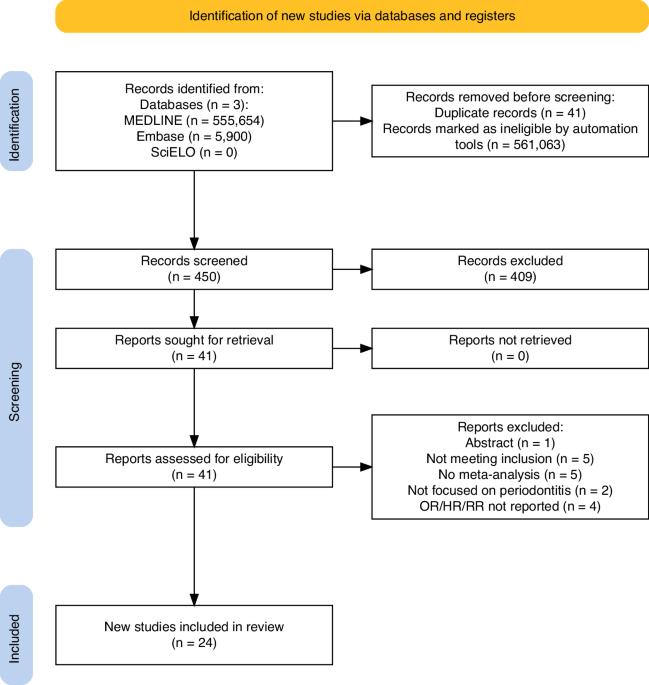
Periodontitis and various noncommunicable diseases (NCDs) have been proposed to have a bidirectional relationship. The purpose of this umbrella review is (1) to synthesize the evidence and (2) to grade the strength and certainty of the scientific evidence regarding the bidirectional association between periodontitis and NCDs. Electronic databases were systematically searched from January 2021 and July 2024; MEDLINE (via PubMed), Embase and SciELO. Potential epidemiologic systematic reviews with meta-analysis that studied the bidirectional association between periodontitis and NCDs were identified by two independent reviewers and filtered by title and abstract according to the selection criteria. The strength and the quality and certainty of the evidence was assessed according to the Grading of Recommendations, Assessment, Development and Evaluations (GRADE) guide. 561,554 potential results were identified. After removing duplicates and excluding records deemed ineligible by automated filters, 450 results were screened by title and abstract. This process led to 41 records being appraised in full-text. Of these, 17 were further excluded leaving a total of 24 systematic reviews that met the inclusion criteria. 24 systematic reviews with a total of 32 NCDs were appraised and consolidated. Risk of bias assessment indicated that 21 systematic reviews (87.5%) demonstrated low bias (high quality), 2 had medium bias, and 1 exhibited high bias (low quality). Key issues identified included the formulation of explicit research questions, critical appraisal, data extraction, and publication bias. The association between periodontitis and NCDs was strong in 1 systematic review, moderate in 8, weak in 10 and absent in 7 systematic reviews. The strength of the association between NCDs and periodontitis was moderate in 6 systematic reviews and weak in 3 systematic reviews. The size of the reported effect (odds ratio/risk ratio/hazard ratio) was broader with increasing strength. Although data supports the association between periodontitis and some NCDs, and to a lesser extent between some NCDs and periodontitis, the certainty of the evidence was classified as low to very low. There is some data that, with varying degrees of association and low to very low certainty, provide evidence that periodontitis may be a potential risk factor for some NCDs and vice versa.
期刊介绍:
Evidence-Based Dentistry delivers the best available evidence on the latest developments in oral health. We evaluate the evidence and provide guidance concerning the value of the author''s conclusions. We keep dentistry up to date with new approaches, exploring a wide range of the latest developments through an accessible expert commentary. Original papers and relevant publications are condensed into digestible summaries, drawing attention to the current methods and findings. We are a central resource for the most cutting edge and relevant issues concerning the evidence-based approach in dentistry today. Evidence-Based Dentistry is published by Springer Nature on behalf of the British Dental Association.



 京公网安备 11010802042870号
京ICP备2023020795号-1
京公网安备 11010802042870号
京ICP备2023020795号-1

 分享
分享
 求助内容:
求助内容: 应助结果提醒方式:
 扫码关注我们
