Comparison of the analgesic efficacy of ultrasound-guided superficial serratus anterior plane block and intercostal nerve block for rib fractures: a randomized controlled trial.
Musa Zengin, Onur Küçük, Muhyettin Aslan, Göktürk Fındık, Ali Alagöz
{"title":"Comparison of the analgesic efficacy of ultrasound-guided superficial serratus anterior plane block and intercostal nerve block for rib fractures: a randomized controlled trial.","authors":"Musa Zengin, Onur Küçük, Muhyettin Aslan, Göktürk Fındık, Ali Alagöz","doi":"10.1186/s12871-025-03000-6","DOIUrl":null,"url":null,"abstract":"<p><strong>Background: </strong>Various regional analgesic methods are frequently incorporated into multimodal analgesia strategies for managing rib fractures. This study aimed to compare the analgesic efficacy of ultrasound-guided superficial serratus anterior plane block (S-SAPB) and intercostal nerve block (ICNB) in patients with isolated rib fractures.</p><p><strong>Methods: </strong>This randomized controlled trial included patients aged 18-65 years with unilateral isolated rib fractures (≤ 6 ribs) resulting from trauma. Patients underwent ultrasound-guided S-SAPB (20 ml 0.25% bupivacaine) or ICNB (3 ml 0.25% bupivacaine for each fractured rib). Pain levels were assessed using the Visual Analogue Scale (VAS) both prior to the procedure (Pre-Block, (T0)) and at specific time points following the intervention: 1st hour (T1), 2nd hour (T2), 4th hour (T4), 8th hour (T8), 16th hour (T16), and 24th hour (T24). The changes in observed values over time were expressed as delta (Δ).</p><p><strong>Results: </strong>Both S-SAPB and ICNB provided effective analgesia. In the first 4 h, ICNB demonstrated a greater reduction in VAS scores, particularly in patients with 10<sup>th</sup> and 11<sup>th</sup> rib fractures. However, S-SAPB resulted in significantly longer-lasting analgesia, with greater pain relief after 8 h (T8-T24) compared to ICNB (p < 0.05). Patients in the S-SAPB group required no additional analgesia, whereas 43.3% of ICNB patients required supplemental tramadol (p < 0.001). Both techniques were well tolerated, with no reported complications.</p><p><strong>Conclusions: </strong>S-SAPB provides prolonged analgesia and may be preferable for managing rib fracture pain beyond the initial 8 h. However, ICNB offers superior pain relief in the early postoperative period, especially for lower rib fractures (10<sup>th</sup>-11<sup>th</sup> ribs). A combined approach that includes both blocks may optimize pain control in patients with multiple rib fractures involving the 10<sup>th</sup> and 11<sup>th</sup> ribs.</p>","PeriodicalId":9190,"journal":{"name":"BMC Anesthesiology","volume":"25 1","pages":"122"},"PeriodicalIF":2.6000,"publicationDate":"2025-03-13","publicationTypes":"Journal Article","fieldsOfStudy":null,"isOpenAccess":false,"openAccessPdf":"https://www.ncbi.nlm.nih.gov/pmc/articles/PMC11905462/pdf/","citationCount":"0","resultStr":null,"platform":"Semanticscholar","paperid":null,"PeriodicalName":"BMC Anesthesiology","FirstCategoryId":"3","ListUrlMain":"https://doi.org/10.1186/s12871-025-03000-6","RegionNum":3,"RegionCategory":"医学","ArticlePicture":[],"TitleCN":null,"AbstractTextCN":null,"PMCID":null,"EPubDate":"","PubModel":"","JCR":"Q2","JCRName":"ANESTHESIOLOGY","Score":null,"Total":0}
引用次数: 0
Abstract
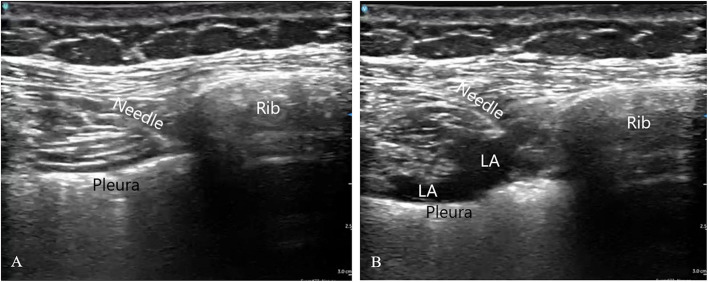
Background: Various regional analgesic methods are frequently incorporated into multimodal analgesia strategies for managing rib fractures. This study aimed to compare the analgesic efficacy of ultrasound-guided superficial serratus anterior plane block (S-SAPB) and intercostal nerve block (ICNB) in patients with isolated rib fractures.
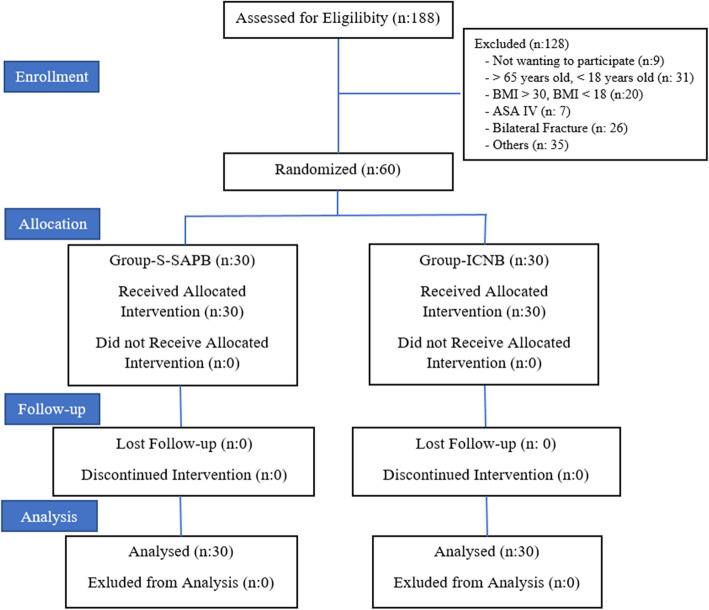
Methods: This randomized controlled trial included patients aged 18-65 years with unilateral isolated rib fractures (≤ 6 ribs) resulting from trauma. Patients underwent ultrasound-guided S-SAPB (20 ml 0.25% bupivacaine) or ICNB (3 ml 0.25% bupivacaine for each fractured rib). Pain levels were assessed using the Visual Analogue Scale (VAS) both prior to the procedure (Pre-Block, (T0)) and at specific time points following the intervention: 1st hour (T1), 2nd hour (T2), 4th hour (T4), 8th hour (T8), 16th hour (T16), and 24th hour (T24). The changes in observed values over time were expressed as delta (Δ).
Results: Both S-SAPB and ICNB provided effective analgesia. In the first 4 h, ICNB demonstrated a greater reduction in VAS scores, particularly in patients with 10th and 11th rib fractures. However, S-SAPB resulted in significantly longer-lasting analgesia, with greater pain relief after 8 h (T8-T24) compared to ICNB (p < 0.05). Patients in the S-SAPB group required no additional analgesia, whereas 43.3% of ICNB patients required supplemental tramadol (p < 0.001). Both techniques were well tolerated, with no reported complications.
Conclusions: S-SAPB provides prolonged analgesia and may be preferable for managing rib fracture pain beyond the initial 8 h. However, ICNB offers superior pain relief in the early postoperative period, especially for lower rib fractures (10th-11th ribs). A combined approach that includes both blocks may optimize pain control in patients with multiple rib fractures involving the 10th and 11th ribs.
背景:不同的局部镇痛方法经常被纳入多模式镇痛策略来治疗肋骨骨折。本研究旨在比较超声引导下浅表锯肌前平面阻滞(S-SAPB)与肋间神经阻滞(ICNB)对孤立性肋骨骨折患者的镇痛效果。方法:该随机对照试验纳入18-65岁因创伤导致单侧孤立性肋骨骨折(≤6根肋骨)的患者。患者行超声引导下S-SAPB (20 ml 0.25%布比卡因)或ICNB (3 ml 0.25%布比卡因)。采用视觉模拟量表(VAS)评估手术前(Pre-Block, T0)和干预后特定时间点的疼痛水平:1小时(T1)、2小时(T2)、4小时(T4)、8小时(T8)、16小时(T16)和24小时(T24)。观测值随时间的变化用delta表示(Δ)。结果:S-SAPB和ICNB均有较好的镇痛效果。在前4小时,ICNB显示VAS评分有更大的降低,特别是在第10和第11肋骨骨折的患者中。然而,与ICNB相比,S-SAPB的镇痛效果明显更持久,8小时(T8-T24)后疼痛缓解更明显(p结论:S-SAPB可延长镇痛时间,可能更适合治疗最初8小时以上的肋骨骨折疼痛。然而,ICNB在术后早期提供了更好的疼痛缓解,特别是对于下肋骨骨折(第10 -11根肋骨)。包括两种阻滞的联合方法可以优化包括第10和第11根肋骨的多发肋骨骨折患者的疼痛控制。
期刊介绍:
BMC Anesthesiology is an open access, peer-reviewed journal that considers articles on all aspects of anesthesiology, critical care, perioperative care and pain management, including clinical and experimental research into anesthetic mechanisms, administration and efficacy, technology and monitoring, and associated economic issues.




 京公网安备 11010802042870号
京ICP备2023020795号-1
京公网安备 11010802042870号
京ICP备2023020795号-1

 分享
分享
 求助内容:
求助内容: 应助结果提醒方式:
 扫码关注我们
