Daniel Rosenfeld, Sean Brennan, Andrew Wallach, Theodore Long, Chris Keeley, Sarah Joseph Kurien
{"title":"COVID-19 Testing Equity in New York City During the First 2 Years of the Pandemic: Demographic Analysis of Free Testing Data.","authors":"Daniel Rosenfeld, Sean Brennan, Andrew Wallach, Theodore Long, Chris Keeley, Sarah Joseph Kurien","doi":"10.2196/52972","DOIUrl":null,"url":null,"abstract":"<p><strong>Background: </strong>COVID-19 has caused over 46,000 deaths in New York City, with a disproportional impact on certain communities. As part of the COVID-19 response, the city has directly administered over 6 million COVID-19 tests (in addition to millions of indirectly administered tests not covered in this analysis) at no cost to individuals, resulting in nearly half a million positive results. Given that the prevalence of testing, throughout the pandemic, has tended to be higher in more affluent areas, these tests were targeted to areas with fewer resources.</p><p><strong>Objective: </strong>This study aimed to evaluate the impact of New York City's COVID-19 testing program; specifically, we aimed to review its ability to provide equitable testing in economically, geographically, and demographically diverse populations. Of note, in addition to the brick-and-mortar testing sites evaluated herein, this program conducted 2.1 million tests through mobile units to further address testing inequity.</p><p><strong>Methods: </strong>Testing data were collected from the in-house Microsoft SQL Server Management Studio 18 Clarity database, representing 6,347,533 total tests and 449,721 positive test results. These tests were conducted at 48 hospital system locations. Per capita testing rates by zip code tabulation area (ZCTA) and COVID-19 positivity rates by ZCTA were used as dependent variables in separate regressions. Median income, median age, the percentage of English-speaking individuals, and the percentage of people of color were used as independent demographic variables to analyze testing patterns across several intersecting identities. Negative binomial regressions were run in a Jupyter Notebook using Python.</p><p><strong>Results: </strong>Per capita testing inversely correlated with median income geographically. The overall pseudo r2 value was 0.1101 when comparing hospital system tests by ZCTA against the selected variables. The number of tests significantly increased as median income fell (SE 1.00000155; P<.001). No other variables correlated at a significant level with the number of tests (all P values were >.05). When considering positive test results by ZCTA, the number of positive test results also significantly increased as median income fell (SE 1.57e-6; P<.001) and as the percentage of female residents fell (SE 0.957; P=.001). The number of positive test results by ZCTA rose at a significant level alongside the percentage of English-only speakers (SE 0.271; P=.03).</p><p><strong>Conclusions: </strong>New York City's COVID-19 testing program was able to improve equity through the provision of no-cost testing, which focused on areas of the city that were disproportionately impacted by COVID-19 and had fewer resources. By detecting higher numbers of positive test results in resource-poor neighborhoods, New York City was able to deploy additional resources, such as those for contact tracing and isolation and quarantine support (eg, free food delivery and free hotel stays), early during the COVID-19 pandemic. Equitable deployment of testing is feasible and should be considered early in future epidemics or pandemics.</p>","PeriodicalId":14765,"journal":{"name":"JMIR Public Health and Surveillance","volume":"11 ","pages":"e52972"},"PeriodicalIF":3.9000,"publicationDate":"2025-03-13","publicationTypes":"Journal Article","fieldsOfStudy":null,"isOpenAccess":false,"openAccessPdf":"https://www.ncbi.nlm.nih.gov/pmc/articles/PMC11924968/pdf/","citationCount":"0","resultStr":null,"platform":"Semanticscholar","paperid":null,"PeriodicalName":"JMIR Public Health and Surveillance","FirstCategoryId":"3","ListUrlMain":"https://doi.org/10.2196/52972","RegionNum":2,"RegionCategory":"医学","ArticlePicture":[],"TitleCN":null,"AbstractTextCN":null,"PMCID":null,"EPubDate":"","PubModel":"","JCR":"Q1","JCRName":"PUBLIC, ENVIRONMENTAL & OCCUPATIONAL HEALTH","Score":null,"Total":0}
引用次数: 0
Abstract
Background: COVID-19 has caused over 46,000 deaths in New York City, with a disproportional impact on certain communities. As part of the COVID-19 response, the city has directly administered over 6 million COVID-19 tests (in addition to millions of indirectly administered tests not covered in this analysis) at no cost to individuals, resulting in nearly half a million positive results. Given that the prevalence of testing, throughout the pandemic, has tended to be higher in more affluent areas, these tests were targeted to areas with fewer resources.
Objective: This study aimed to evaluate the impact of New York City's COVID-19 testing program; specifically, we aimed to review its ability to provide equitable testing in economically, geographically, and demographically diverse populations. Of note, in addition to the brick-and-mortar testing sites evaluated herein, this program conducted 2.1 million tests through mobile units to further address testing inequity.
Methods: Testing data were collected from the in-house Microsoft SQL Server Management Studio 18 Clarity database, representing 6,347,533 total tests and 449,721 positive test results. These tests were conducted at 48 hospital system locations. Per capita testing rates by zip code tabulation area (ZCTA) and COVID-19 positivity rates by ZCTA were used as dependent variables in separate regressions. Median income, median age, the percentage of English-speaking individuals, and the percentage of people of color were used as independent demographic variables to analyze testing patterns across several intersecting identities. Negative binomial regressions were run in a Jupyter Notebook using Python.
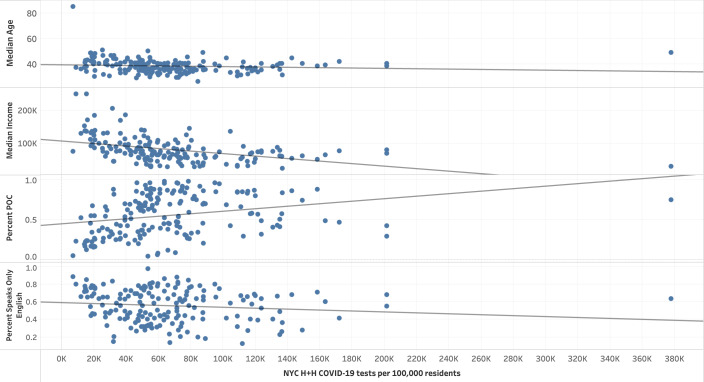
Results: Per capita testing inversely correlated with median income geographically. The overall pseudo r2 value was 0.1101 when comparing hospital system tests by ZCTA against the selected variables. The number of tests significantly increased as median income fell (SE 1.00000155; P<.001). No other variables correlated at a significant level with the number of tests (all P values were >.05). When considering positive test results by ZCTA, the number of positive test results also significantly increased as median income fell (SE 1.57e-6; P<.001) and as the percentage of female residents fell (SE 0.957; P=.001). The number of positive test results by ZCTA rose at a significant level alongside the percentage of English-only speakers (SE 0.271; P=.03).
Conclusions: New York City's COVID-19 testing program was able to improve equity through the provision of no-cost testing, which focused on areas of the city that were disproportionately impacted by COVID-19 and had fewer resources. By detecting higher numbers of positive test results in resource-poor neighborhoods, New York City was able to deploy additional resources, such as those for contact tracing and isolation and quarantine support (eg, free food delivery and free hotel stays), early during the COVID-19 pandemic. Equitable deployment of testing is feasible and should be considered early in future epidemics or pandemics.
背景:2019冠状病毒病已在纽约市造成4.6万多人死亡,对某些社区造成了不成比例的影响。作为COVID-19应对措施的一部分,该市直接进行了600多万次COVID-19检测(此外还有本分析未涵盖的数百万次间接进行的检测),个人无需支付任何费用,产生了近50万例阳性结果。鉴于在整个大流行期间,检测的流行率往往在较富裕的地区较高,因此这些检测针对的是资源较少的地区。目的:本研究旨在评估纽约市COVID-19检测计划的影响;具体而言,我们的目的是审查其在经济、地理和人口统计学上不同的人群中提供公平测试的能力。值得注意的是,除了本文评估的实体测试站点外,该计划还通过移动设备进行了210万次测试,以进一步解决测试不平等问题。方法:检测数据来自公司内部Microsoft SQL Server Management Studio 18 Clarity数据库,共检测6347,533例,阳性检测结果449,721例。这些测试在48个医院系统地点进行。以邮政编码制表区(ZCTA)的人均检测率和ZCTA的COVID-19阳性率作为独立回归的因变量。收入中位数、年龄中位数、说英语的人的百分比和有色人种的百分比被用作独立的人口统计变量来分析几个交叉身份的测试模式。负二项回归在Jupyter Notebook中使用Python运行。结果:人均测试与地理上的收入中位数呈负相关。将ZCTA医院系统检验与所选变量进行比较,总体伪r2值为0.1101。随着收入中位数的下降,测试次数显著增加(SE 1.00000155;P.05)。当考虑ZCTA的阳性检验结果时,随着收入中位数的下降,阳性检验结果的数量也显著增加(SE为1.57e-6;结论:纽约市的COVID-19检测项目能够通过提供免费检测来提高公平性,该项目侧重于受COVID-19影响严重且资源较少的城市地区。通过在资源贫乏的社区检测到更多的阳性检测结果,纽约市能够在COVID-19大流行早期部署额外的资源,例如接触者追踪和隔离检疫支持(例如,免费送餐和免费酒店住宿)。公平部署检测是可行的,应在未来流行病或大流行的早期加以考虑。
期刊介绍:
JMIR Public Health & Surveillance (JPHS) is a renowned scholarly journal indexed on PubMed. It follows a rigorous peer-review process and covers a wide range of disciplines. The journal distinguishes itself by its unique focus on the intersection of technology and innovation in the field of public health. JPHS delves into diverse topics such as public health informatics, surveillance systems, rapid reports, participatory epidemiology, infodemiology, infoveillance, digital disease detection, digital epidemiology, electronic public health interventions, mass media and social media campaigns, health communication, and emerging population health analysis systems and tools.





 京公网安备 11010802042870号
京ICP备2023020795号-1
京公网安备 11010802042870号
京ICP备2023020795号-1

 分享
分享
 求助内容:
求助内容: 应助结果提醒方式:
 扫码关注我们
