Identifying Data-Driven Clinical Subgroups for Cervical Cancer Prevention With Machine Learning: Population-Based, External, and Diagnostic Validation Study.
{"title":"Identifying Data-Driven Clinical Subgroups for Cervical Cancer Prevention With Machine Learning: Population-Based, External, and Diagnostic Validation Study.","authors":"Zhen Lu, Binhua Dong, Hongning Cai, Tian Tian, Junfeng Wang, Leiwen Fu, Bingyi Wang, Weijie Zhang, Shaomei Lin, Xunyuan Tuo, Juntao Wang, Tianjie Yang, Xinxin Huang, Zheng Zheng, Huifeng Xue, Shuxia Xu, Siyang Liu, Pengming Sun, Huachun Zou","doi":"10.2196/67840","DOIUrl":null,"url":null,"abstract":"<p><strong>Background: </strong>Cervical cancer remains a major global health issue. Personalized, data-driven cervical cancer prevention (CCP) strategies tailored to phenotypic profiles may improve prevention and reduce disease burden.</p><p><strong>Objective: </strong>This study aimed to identify subgroups with differential cervical precancer or cancer risks using machine learning, validate subgroup predictions across datasets, and propose a computational phenomapping strategy to enhance global CCP efforts.</p><p><strong>Methods: </strong>We explored the data-driven CCP subgroups by applying unsupervised machine learning to a deeply phenotyped, population-based discovery cohort. We extracted CCP-specific risks of cervical intraepithelial neoplasia (CIN) and cervical cancer through weighted logistic regression analyses providing odds ratio (OR) estimates and 95% CIs. We trained a supervised machine learning model and developed pathways to classify individuals before evaluating its diagnostic validity and usability on an external cohort.</p><p><strong>Results: </strong>This study included 551,934 women (median age, 49 years) in the discovery cohort and 47,130 women (median age, 37 years) in the external cohort. Phenotyping identified 5 CCP subgroups, with CCP4 showing the highest carcinoma prevalence. CCP2-4 had significantly higher risks of CIN2+ (CCP2: OR 2.07 [95% CI: 2.03-2.12], CCP3: 3.88 [3.78-3.97], and CCP4: 4.47 [4.33-4.63]) and CIN3+ (CCP2: 2.10 [2.05-2.14], CCP3: 3.92 [3.82-4.02], and CCP4: 4.45 [4.31-4.61]) compared to CCP1 (P<.001), consistent with the direction of results observed in the external cohort. The proposed triple strategy was validated as clinically relevant, prioritizing high-risk subgroups (CCP3-4) for colposcopies and scaling human papillomavirus screening for CCP1-2.</p><p><strong>Conclusions: </strong>This study underscores the potential of leveraging machine learning algorithms and large-scale routine electronic health records to enhance CCP strategies. By identifying key determinants of CIN2+/CIN3+ risk and classifying 5 distinct subgroups, our study provides a robust, data-driven foundation for the proposed triple strategy. This approach prioritizes tailored prevention efforts for subgroups with varying risks, offering a novel and scalable tool to complement existing cervical cancer screening guidelines. Future work should focus on independent external and prospective validation to maximize the global impact of this strategy.</p>","PeriodicalId":14765,"journal":{"name":"JMIR Public Health and Surveillance","volume":"11 ","pages":"e67840"},"PeriodicalIF":3.9000,"publicationDate":"2025-03-19","publicationTypes":"Journal Article","fieldsOfStudy":null,"isOpenAccess":false,"openAccessPdf":"https://www.ncbi.nlm.nih.gov/pmc/articles/PMC11939026/pdf/","citationCount":"0","resultStr":null,"platform":"Semanticscholar","paperid":null,"PeriodicalName":"JMIR Public Health and Surveillance","FirstCategoryId":"3","ListUrlMain":"https://doi.org/10.2196/67840","RegionNum":2,"RegionCategory":"医学","ArticlePicture":[],"TitleCN":null,"AbstractTextCN":null,"PMCID":null,"EPubDate":"","PubModel":"","JCR":"Q1","JCRName":"PUBLIC, ENVIRONMENTAL & OCCUPATIONAL HEALTH","Score":null,"Total":0}
引用次数: 0
Abstract
Background: Cervical cancer remains a major global health issue. Personalized, data-driven cervical cancer prevention (CCP) strategies tailored to phenotypic profiles may improve prevention and reduce disease burden.
Objective: This study aimed to identify subgroups with differential cervical precancer or cancer risks using machine learning, validate subgroup predictions across datasets, and propose a computational phenomapping strategy to enhance global CCP efforts.
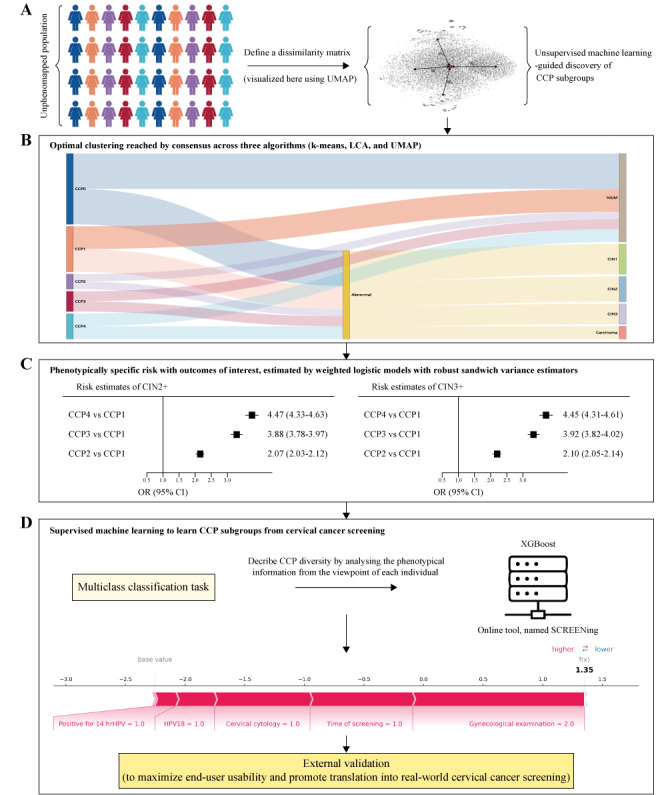
Methods: We explored the data-driven CCP subgroups by applying unsupervised machine learning to a deeply phenotyped, population-based discovery cohort. We extracted CCP-specific risks of cervical intraepithelial neoplasia (CIN) and cervical cancer through weighted logistic regression analyses providing odds ratio (OR) estimates and 95% CIs. We trained a supervised machine learning model and developed pathways to classify individuals before evaluating its diagnostic validity and usability on an external cohort.
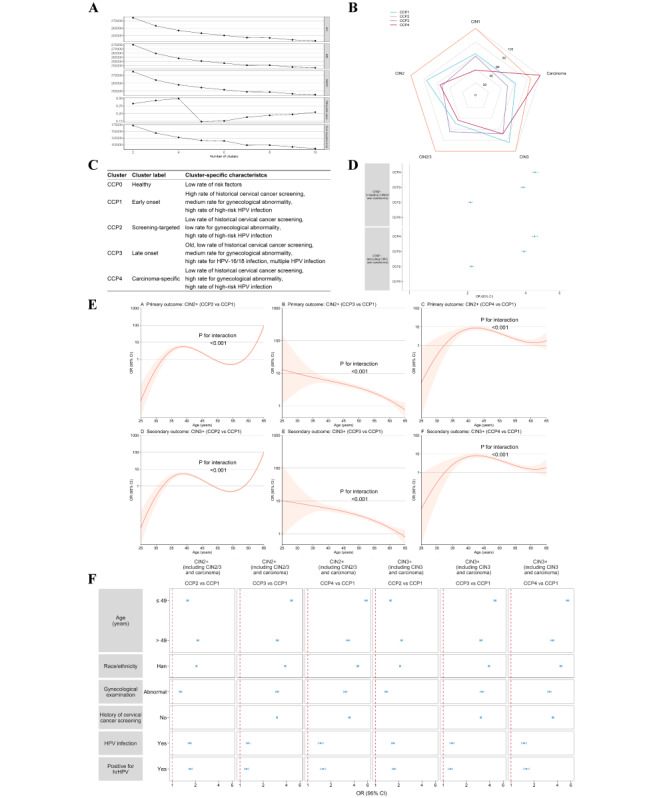
Results: This study included 551,934 women (median age, 49 years) in the discovery cohort and 47,130 women (median age, 37 years) in the external cohort. Phenotyping identified 5 CCP subgroups, with CCP4 showing the highest carcinoma prevalence. CCP2-4 had significantly higher risks of CIN2+ (CCP2: OR 2.07 [95% CI: 2.03-2.12], CCP3: 3.88 [3.78-3.97], and CCP4: 4.47 [4.33-4.63]) and CIN3+ (CCP2: 2.10 [2.05-2.14], CCP3: 3.92 [3.82-4.02], and CCP4: 4.45 [4.31-4.61]) compared to CCP1 (P<.001), consistent with the direction of results observed in the external cohort. The proposed triple strategy was validated as clinically relevant, prioritizing high-risk subgroups (CCP3-4) for colposcopies and scaling human papillomavirus screening for CCP1-2.
Conclusions: This study underscores the potential of leveraging machine learning algorithms and large-scale routine electronic health records to enhance CCP strategies. By identifying key determinants of CIN2+/CIN3+ risk and classifying 5 distinct subgroups, our study provides a robust, data-driven foundation for the proposed triple strategy. This approach prioritizes tailored prevention efforts for subgroups with varying risks, offering a novel and scalable tool to complement existing cervical cancer screening guidelines. Future work should focus on independent external and prospective validation to maximize the global impact of this strategy.
期刊介绍:
JMIR Public Health & Surveillance (JPHS) is a renowned scholarly journal indexed on PubMed. It follows a rigorous peer-review process and covers a wide range of disciplines. The journal distinguishes itself by its unique focus on the intersection of technology and innovation in the field of public health. JPHS delves into diverse topics such as public health informatics, surveillance systems, rapid reports, participatory epidemiology, infodemiology, infoveillance, digital disease detection, digital epidemiology, electronic public health interventions, mass media and social media campaigns, health communication, and emerging population health analysis systems and tools.





 京公网安备 11010802042870号
京ICP备2023020795号-1
京公网安备 11010802042870号
京ICP备2023020795号-1

 分享
分享
 求助内容:
求助内容: 应助结果提醒方式:
 扫码关注我们
