Integration of artificial intelligence in radiology education: a requirements survey and recommendations from faculty radiologists, residents, and medical students.
Ruili Li, Guangxue Liu, Miao Zhang, Dongdong Rong, Zhuangzhi Su, Yi Shan, Jie Lu
{"title":"Integration of artificial intelligence in radiology education: a requirements survey and recommendations from faculty radiologists, residents, and medical students.","authors":"Ruili Li, Guangxue Liu, Miao Zhang, Dongdong Rong, Zhuangzhi Su, Yi Shan, Jie Lu","doi":"10.1186/s12909-025-06859-8","DOIUrl":null,"url":null,"abstract":"<p><strong>Background: </strong>To investigate the perspectives and expectations of faculty radiologists, residents, and medical students regarding the integration of artificial intelligence (AI) in radiology education, a survey was conducted to collect their opinions and attitudes on implementing AI in radiology education.</p><p><strong>Methods: </strong>An online questionnaire was used for this survey, and the participant anonymity was ensured. In total, 41 faculty radiologists, 38 residents, and 120 medical students from the authors' institution completed the questionnaire.</p><p><strong>Results: </strong>Most residents and students experience different levels of psychological stress during the initial stage of clinical practice, and this stress mainly stems from tight schedules, heavy workloads, apprehensions about making mistakes in diagnostic report writing, as well as academic or employment pressures. Although most of the respondents were not familiar with how AI is applied in radiology education, a substantial proportion of them expressed eagerness and enthusiasm for the integration of AI into radiology education. Especially among radiologists and residents, they showed a desire to utilize an AI-driven online platform for practicing radiology skills, including reading medical images and writing diagnostic reports, before engaging in clinical practice. Furthermore, faculty radiologists demonstrated strong enthusiasm for the notion that AI training platforms can enhance training efficiency and boost learners' confidence. Notably, only approximately half of the residents and medical students shared the instructors' optimism, with the remainder expressing neutrality or concern, emphasizing the need for robust AI feedback systems and user-centered designs. Moreover, the authors' team has developed a preliminary framework for an AI-driven radiology education training platform, consisting of four key components: imaging case sets, intelligent interactive learning, self-quiz, and online exam.</p><p><strong>Conclusions: </strong>The integration of AI technology in radiology education has the potential to revolutionize the field by providing innovative solutions for enhancing competency levels and optimizing learning outcomes.</p>","PeriodicalId":51234,"journal":{"name":"BMC Medical Education","volume":"25 1","pages":"380"},"PeriodicalIF":3.2000,"publicationDate":"2025-03-13","publicationTypes":"Journal Article","fieldsOfStudy":null,"isOpenAccess":false,"openAccessPdf":"https://www.ncbi.nlm.nih.gov/pmc/articles/PMC11908051/pdf/","citationCount":"0","resultStr":null,"platform":"Semanticscholar","paperid":null,"PeriodicalName":"BMC Medical Education","FirstCategoryId":"3","ListUrlMain":"https://doi.org/10.1186/s12909-025-06859-8","RegionNum":2,"RegionCategory":"医学","ArticlePicture":[],"TitleCN":null,"AbstractTextCN":null,"PMCID":null,"EPubDate":"","PubModel":"","JCR":"Q1","JCRName":"EDUCATION & EDUCATIONAL RESEARCH","Score":null,"Total":0}
引用次数: 0
Abstract
Background: To investigate the perspectives and expectations of faculty radiologists, residents, and medical students regarding the integration of artificial intelligence (AI) in radiology education, a survey was conducted to collect their opinions and attitudes on implementing AI in radiology education.
Methods: An online questionnaire was used for this survey, and the participant anonymity was ensured. In total, 41 faculty radiologists, 38 residents, and 120 medical students from the authors' institution completed the questionnaire.
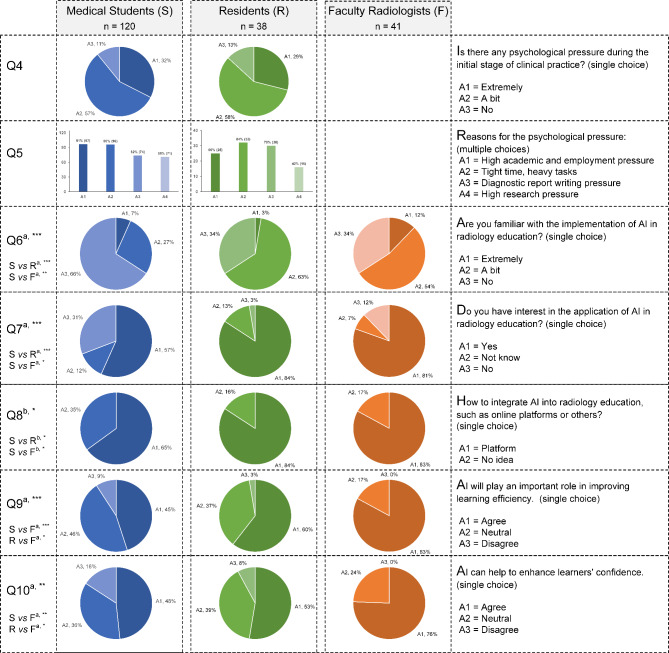
Results: Most residents and students experience different levels of psychological stress during the initial stage of clinical practice, and this stress mainly stems from tight schedules, heavy workloads, apprehensions about making mistakes in diagnostic report writing, as well as academic or employment pressures. Although most of the respondents were not familiar with how AI is applied in radiology education, a substantial proportion of them expressed eagerness and enthusiasm for the integration of AI into radiology education. Especially among radiologists and residents, they showed a desire to utilize an AI-driven online platform for practicing radiology skills, including reading medical images and writing diagnostic reports, before engaging in clinical practice. Furthermore, faculty radiologists demonstrated strong enthusiasm for the notion that AI training platforms can enhance training efficiency and boost learners' confidence. Notably, only approximately half of the residents and medical students shared the instructors' optimism, with the remainder expressing neutrality or concern, emphasizing the need for robust AI feedback systems and user-centered designs. Moreover, the authors' team has developed a preliminary framework for an AI-driven radiology education training platform, consisting of four key components: imaging case sets, intelligent interactive learning, self-quiz, and online exam.
Conclusions: The integration of AI technology in radiology education has the potential to revolutionize the field by providing innovative solutions for enhancing competency levels and optimizing learning outcomes.
期刊介绍:
BMC Medical Education is an open access journal publishing original peer-reviewed research articles in relation to the training of healthcare professionals, including undergraduate, postgraduate, and continuing education. The journal has a special focus on curriculum development, evaluations of performance, assessment of training needs and evidence-based medicine.





 京公网安备 11010802042870号
京ICP备2023020795号-1
京公网安备 11010802042870号
京ICP备2023020795号-1

 分享
分享
 求助内容:
求助内容: 应助结果提醒方式:
 扫码关注我们
