{"title":"Role of moisture on gas sorption capacity and kinetics of Coal: Novel experimental and modeling insights","authors":"Sikandar Azam, Shimin Liu","doi":"10.1016/j.cej.2025.161540","DOIUrl":null,"url":null,"abstract":"<div><div>Water in coal pores, whether as gas or condensed can impact the CO<sub>2</sub> and CH<sub>4</sub> sorption behavior during Carbon Capture, Utilization, and Storage (CCUS) and Enhanced Coal Bed Methane (ECBM) processes. Most of the studies so far use dry or moisture equilibrated coal samples to assess water’s impact on CO<sub>2</sub>/CH<sub>4</sub> sorption. Experiments with the dry coal samples could overestimate the net adsorption due to not accounting for the moisture while moisture equilibrated coal samples capture the impact of moisture to some extent but lacks insights into the dynamic and competitive sorption processes. To address these limitations, we devised controlled RH systems using salt solutions (CRHS) experiments, offering a realistic and dynamic approach to study water–gas interactions in coal. CRHS experiment models the simultaneous sorption of water vapor and gases on coal surfaces under controlled RH systems. The experiments were performed up to < 9.5 MPa and < 5.2 MPa for CO<sub>2</sub> and CH<sub>4</sub>, respectively. The results demonstrate that vapor’s presence reduces CH<sub>4</sub> and CO<sub>2</sub> adsorption capacity from 25.36 g/kg to 18.72 g/kg and from 55.94 g/kg to 37.71 g/kg, respectively, highlighting the stronger inhibitory effect of water on CO<sub>2</sub>/CH<sub>4</sub> sorption. Additionally, a decrease in heat of adsorption (ΔQ) from 17.38 kJ/mol to 15.34 kJ/mol for CH<sub>4</sub> and from 15.56 kJ/mol to 14.93 kJ/mol for CO<sub>2</sub> indicates weakened van der Waals interactions due to moisture. Overall, findings signifies that the CRHS effectively demonstrated that the presence of moisture not only reduces the gas adsorption capacity but also alters the sorption kinetics.</div></div>","PeriodicalId":270,"journal":{"name":"Chemical Engineering Journal","volume":"510 ","pages":"Article 161540"},"PeriodicalIF":13.2000,"publicationDate":"2025-04-15","publicationTypes":"Journal Article","fieldsOfStudy":null,"isOpenAccess":false,"openAccessPdf":"","citationCount":"0","resultStr":null,"platform":"Semanticscholar","paperid":null,"PeriodicalName":"Chemical Engineering Journal","FirstCategoryId":"5","ListUrlMain":"https://www.sciencedirect.com/science/article/pii/S1385894725023629","RegionNum":1,"RegionCategory":"工程技术","ArticlePicture":[],"TitleCN":null,"AbstractTextCN":null,"PMCID":null,"EPubDate":"2025/3/15 0:00:00","PubModel":"Epub","JCR":"Q1","JCRName":"ENGINEERING, CHEMICAL","Score":null,"Total":0}
引用次数: 0
Abstract
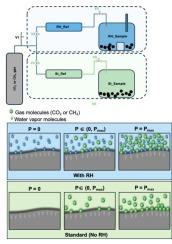
Water in coal pores, whether as gas or condensed can impact the CO2 and CH4 sorption behavior during Carbon Capture, Utilization, and Storage (CCUS) and Enhanced Coal Bed Methane (ECBM) processes. Most of the studies so far use dry or moisture equilibrated coal samples to assess water’s impact on CO2/CH4 sorption. Experiments with the dry coal samples could overestimate the net adsorption due to not accounting for the moisture while moisture equilibrated coal samples capture the impact of moisture to some extent but lacks insights into the dynamic and competitive sorption processes. To address these limitations, we devised controlled RH systems using salt solutions (CRHS) experiments, offering a realistic and dynamic approach to study water–gas interactions in coal. CRHS experiment models the simultaneous sorption of water vapor and gases on coal surfaces under controlled RH systems. The experiments were performed up to < 9.5 MPa and < 5.2 MPa for CO2 and CH4, respectively. The results demonstrate that vapor’s presence reduces CH4 and CO2 adsorption capacity from 25.36 g/kg to 18.72 g/kg and from 55.94 g/kg to 37.71 g/kg, respectively, highlighting the stronger inhibitory effect of water on CO2/CH4 sorption. Additionally, a decrease in heat of adsorption (ΔQ) from 17.38 kJ/mol to 15.34 kJ/mol for CH4 and from 15.56 kJ/mol to 14.93 kJ/mol for CO2 indicates weakened van der Waals interactions due to moisture. Overall, findings signifies that the CRHS effectively demonstrated that the presence of moisture not only reduces the gas adsorption capacity but also alters the sorption kinetics.
期刊介绍:
The Chemical Engineering Journal is an international research journal that invites contributions of original and novel fundamental research. It aims to provide an international platform for presenting original fundamental research, interpretative reviews, and discussions on new developments in chemical engineering. The journal welcomes papers that describe novel theory and its practical application, as well as those that demonstrate the transfer of techniques from other disciplines. It also welcomes reports on carefully conducted experimental work that is soundly interpreted. The main focus of the journal is on original and rigorous research results that have broad significance. The Catalysis section within the Chemical Engineering Journal focuses specifically on Experimental and Theoretical studies in the fields of heterogeneous catalysis, molecular catalysis, and biocatalysis. These studies have industrial impact on various sectors such as chemicals, energy, materials, foods, healthcare, and environmental protection.




 京公网安备 11010802042870号
京ICP备2023020795号-1
京公网安备 11010802042870号
京ICP备2023020795号-1

 分享
分享
 求助内容:
求助内容: 应助结果提醒方式:
 扫码关注我们
