{"title":"US special operations in Africa—Challenges to trauma care and training","authors":"Chris Marcus BS , Oren Prusik BHS","doi":"10.1016/j.surg.2025.109314","DOIUrl":null,"url":null,"abstract":"<div><div>The lessons learned from combat casualties have positioned the US Department of Defense to pioneer advancements in trauma management practices. However, for foreign military partner forces, basic tactical or combat trauma care management remains suboptimal. For these partners, the primary challenges facing combat trauma training are availability of equipment, previous knowledge scope, baseline education of partner force, and training management. At the same time, training curricula and first-world emergency medical training standards are continuously changing as the result of different battlefield environments and information gathered from the latest trauma management data. In 2015, the civilian “Stop the Bleed” public awareness campaign prescribed hemorrhage control measures identical to those of the Department of Defense (<span><span>https://www.facs.org/media-center/press-releases/2023/stop-the-bleed-is-the-cpr-of-bleeding/</span><svg><path></path></svg></span>). The techniques taught in Stop the Bleed, in particular, the use of tourniquets was formerly opposed by US pre-hospital care standards and highlights the dynamic nature of trauma management practices. However, these lessons learned are not typically transferred in training to partner force organizations, and consequently, these forces do not have the capability or survivability that the US forces have. Africa represents a unique challenge to training partner forces due to its less traditional warfare and scarce resources. This article describes the challenges of training partner forces on combat casualty care in Africa.</div></div>","PeriodicalId":22152,"journal":{"name":"Surgery","volume":"181 ","pages":"Article 109314"},"PeriodicalIF":2.7000,"publicationDate":"2025-05-01","publicationTypes":"Journal Article","fieldsOfStudy":null,"isOpenAccess":false,"openAccessPdf":"","citationCount":"0","resultStr":null,"platform":"Semanticscholar","paperid":null,"PeriodicalName":"Surgery","FirstCategoryId":"3","ListUrlMain":"https://www.sciencedirect.com/science/article/pii/S0039606025001667","RegionNum":2,"RegionCategory":"医学","ArticlePicture":[],"TitleCN":null,"AbstractTextCN":null,"PMCID":null,"EPubDate":"2025/3/14 0:00:00","PubModel":"Epub","JCR":"Q1","JCRName":"SURGERY","Score":null,"Total":0}
引用次数: 0
Abstract
The lessons learned from combat casualties have positioned the US Department of Defense to pioneer advancements in trauma management practices. However, for foreign military partner forces, basic tactical or combat trauma care management remains suboptimal. For these partners, the primary challenges facing combat trauma training are availability of equipment, previous knowledge scope, baseline education of partner force, and training management. At the same time, training curricula and first-world emergency medical training standards are continuously changing as the result of different battlefield environments and information gathered from the latest trauma management data. In 2015, the civilian “Stop the Bleed” public awareness campaign prescribed hemorrhage control measures identical to those of the Department of Defense (https://www.facs.org/media-center/press-releases/2023/stop-the-bleed-is-the-cpr-of-bleeding/). The techniques taught in Stop the Bleed, in particular, the use of tourniquets was formerly opposed by US pre-hospital care standards and highlights the dynamic nature of trauma management practices. However, these lessons learned are not typically transferred in training to partner force organizations, and consequently, these forces do not have the capability or survivability that the US forces have. Africa represents a unique challenge to training partner forces due to its less traditional warfare and scarce resources. This article describes the challenges of training partner forces on combat casualty care in Africa.
期刊介绍:
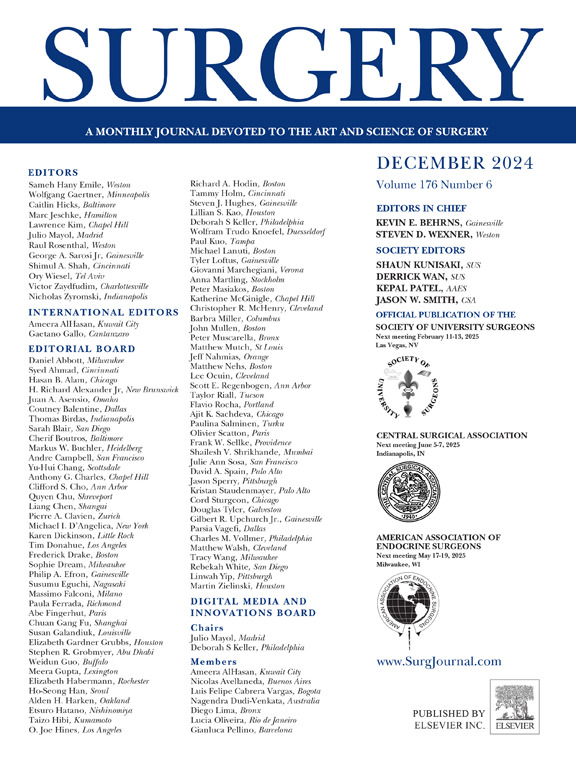
For 66 years, Surgery has published practical, authoritative information about procedures, clinical advances, and major trends shaping general surgery. Each issue features original scientific contributions and clinical reports. Peer-reviewed articles cover topics in oncology, trauma, gastrointestinal, vascular, and transplantation surgery. The journal also publishes papers from the meetings of its sponsoring societies, the Society of University Surgeons, the Central Surgical Association, and the American Association of Endocrine Surgeons.



 京公网安备 11010802042870号
京ICP备2023020795号-1
京公网安备 11010802042870号
京ICP备2023020795号-1

 分享
分享
 求助内容:
求助内容: 应助结果提醒方式:
 扫码关注我们
