Charikleia Lampraki, Daniela S Jopp, Angélique Roquet, Adar Hoffman, Kim Uittenhove
{"title":"Development of depressive symptoms during the COVID-19 crisis: the role of coping strategies and their change.","authors":"Charikleia Lampraki, Daniela S Jopp, Angélique Roquet, Adar Hoffman, Kim Uittenhove","doi":"10.1186/s40359-025-02406-8","DOIUrl":null,"url":null,"abstract":"<p><strong>Background: </strong>Confronted with stressful circumstances, individuals use coping strategies to adapt. During the COVID-19 pandemic, individuals were threatened by an unprecedented health crisis, which governments tried to navigate with various imposed measures. Social distancing had massive negative consequences for mental health; yet studies also documented important interindividual differences, which may be related to differences in coping strategies. This study aims at identifying the most frequent coping responses, their change over time, as well as their possible role for adapting to the crisis.</p><p><strong>Methods: </strong>Our sample consisted of 732 individuals living in Switzerland (age range 18-81 years). An online three-wave questionnaire was administered during the second pandemic wave (i.e., October, November, and December 2020). We used bivariate latent growth modeling and multilevel modeling in order to investigate the development of depressive symptoms and the extent to which it related to the level and change in coping strategies, adjusting for sociodemographic characteristics.</p><p><strong>Results: </strong>Bivariate latent growth models showed that feeling depressed was related to lower use of seeking functional and emotional support, positive reappraisal and acceptance, and higher use of self-distracting. Moreover, results indicated that more change in depressive symptoms was related to less change in seeking functional support and positive reappraisal, and to more change in self-distracting. Regarding multilevel modeling, where all coping strategies were simultaneously included as predictors of depressive symptoms, a higher level of support seeking and positive reappraisal, and a lower level of self-distracting were related to fewer depressive symptoms. Over time, seeking support, positive reappraisal, acceptance, and self-distracting decreased, while depressive symptoms increased. Decreasing the use of positive reappraisal and increasing the use of self-distracting were related to increasing depressive symptoms. Younger aged individuals experienced significantly more depressive symptoms than their older age counterparts when they decreased the use of positive reappraisal.</p><p><strong>Conclusions: </strong>In conclusion, individuals used various coping strategies to adapt to the COVID-19-related life circumstances, but only some of them related to changes in depressing symptoms, possibly demonstrating a gap between the availability and use of coping strategies during the pandemic and their actual effect on mental health.</p>","PeriodicalId":37867,"journal":{"name":"BMC Psychology","volume":"13 1","pages":"250"},"PeriodicalIF":3.0000,"publicationDate":"2025-03-14","publicationTypes":"Journal Article","fieldsOfStudy":null,"isOpenAccess":false,"openAccessPdf":"https://www.ncbi.nlm.nih.gov/pmc/articles/PMC11907944/pdf/","citationCount":"0","resultStr":null,"platform":"Semanticscholar","paperid":null,"PeriodicalName":"BMC Psychology","FirstCategoryId":"102","ListUrlMain":"https://doi.org/10.1186/s40359-025-02406-8","RegionNum":3,"RegionCategory":"心理学","ArticlePicture":[],"TitleCN":null,"AbstractTextCN":null,"PMCID":null,"EPubDate":"","PubModel":"","JCR":"Q1","JCRName":"PSYCHOLOGY, MULTIDISCIPLINARY","Score":null,"Total":0}
引用次数: 0
Abstract
Background: Confronted with stressful circumstances, individuals use coping strategies to adapt. During the COVID-19 pandemic, individuals were threatened by an unprecedented health crisis, which governments tried to navigate with various imposed measures. Social distancing had massive negative consequences for mental health; yet studies also documented important interindividual differences, which may be related to differences in coping strategies. This study aims at identifying the most frequent coping responses, their change over time, as well as their possible role for adapting to the crisis.
Methods: Our sample consisted of 732 individuals living in Switzerland (age range 18-81 years). An online three-wave questionnaire was administered during the second pandemic wave (i.e., October, November, and December 2020). We used bivariate latent growth modeling and multilevel modeling in order to investigate the development of depressive symptoms and the extent to which it related to the level and change in coping strategies, adjusting for sociodemographic characteristics.
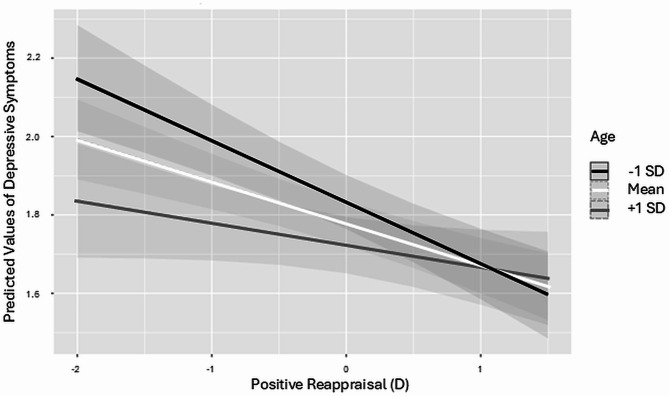
Results: Bivariate latent growth models showed that feeling depressed was related to lower use of seeking functional and emotional support, positive reappraisal and acceptance, and higher use of self-distracting. Moreover, results indicated that more change in depressive symptoms was related to less change in seeking functional support and positive reappraisal, and to more change in self-distracting. Regarding multilevel modeling, where all coping strategies were simultaneously included as predictors of depressive symptoms, a higher level of support seeking and positive reappraisal, and a lower level of self-distracting were related to fewer depressive symptoms. Over time, seeking support, positive reappraisal, acceptance, and self-distracting decreased, while depressive symptoms increased. Decreasing the use of positive reappraisal and increasing the use of self-distracting were related to increasing depressive symptoms. Younger aged individuals experienced significantly more depressive symptoms than their older age counterparts when they decreased the use of positive reappraisal.
Conclusions: In conclusion, individuals used various coping strategies to adapt to the COVID-19-related life circumstances, but only some of them related to changes in depressing symptoms, possibly demonstrating a gap between the availability and use of coping strategies during the pandemic and their actual effect on mental health.
期刊介绍:
BMC Psychology is an open access, peer-reviewed journal that considers manuscripts on all aspects of psychology, human behavior and the mind, including developmental, clinical, cognitive, experimental, health and social psychology, as well as personality and individual differences. The journal welcomes quantitative and qualitative research methods, including animal studies.



 京公网安备 11010802042870号
京ICP备2023020795号-1
京公网安备 11010802042870号
京ICP备2023020795号-1

 分享
分享
 求助内容:
求助内容: 应助结果提醒方式:
 扫码关注我们
