{"title":"A scoping review of human genetic resources management policies and databases in high- and middle-low-income countries.","authors":"Hongwei Liu, Yin Liu, Yanyan Zhao, Yingqi Ma, Qiong Chen, Huifang Xu, Xiaoyang Wang, Xiaoli Guo, Hong Wang, Zelong Chen, Shaokai Zhang, Binbin Han","doi":"10.1186/s12910-025-01192-7","DOIUrl":null,"url":null,"abstract":"<p><strong>Background: </strong>This review examines global human genetic resources management, focusing on genetic data policies and repositories in high- and middle-low-income countries.</p><p><strong>Methods: </strong>A comprehensive search strategy was employed across multiple databases, including official government websites and Google, to gather relevant literature on human genetic resources management policies and genetic resource databases. Documents were screened for relevance, focusing on high-income countries (United States, United Kingdom, Japan) and middle-low-income countries (China, India, Kenya). Data were extracted, coded, and analyzed to identify common themes and differences in genetic resource management practices.</p><p><strong>Results: </strong>High-income countries benefit from robust legal frameworks and advanced technological infrastructures. The United States enforces the Health Insurance Portability and Accountability Act and the Genetic Information Nondiscrimination Act to protect privacy and facilitate data sharing, while Japan relies on the Act on the Protection of Personal Information and ethical guidelines. Additionally, high-income countries host a variety of genetic databases and biobanks that support scientific research. In contrast, middle-low-income countries like China, India, and Kenya are still developing their frameworks. China has regulations such as the Biosecurity Law and the Regulations on the Management of Human Genetic Resources, but still requires more unified standards. India's policies focus on genetic research and data protection through the Biological Diversity Act, while Kenya seeks to improve data management through the 2019 Data Protection Act.</p><p><strong>Conclusion: </strong>Significant disparities exist in human genetic resources management between high-income and middle-low-income countries. High-income countries have robust systems balancing privacy protection with research facilitation, supported by comprehensive and large-scale databases for scientific research. Middle-low-income countries need to enhance legal frameworks and build population-specific databases. Promoting equitable data sharing and adopting best practices from high-income countries are essential for advancing global scientific discovery and ensuring fair management of genetic resources.</p>","PeriodicalId":55348,"journal":{"name":"BMC Medical Ethics","volume":"26 1","pages":"37"},"PeriodicalIF":3.1000,"publicationDate":"2025-03-15","publicationTypes":"Journal Article","fieldsOfStudy":null,"isOpenAccess":false,"openAccessPdf":"https://www.ncbi.nlm.nih.gov/pmc/articles/PMC11909912/pdf/","citationCount":"0","resultStr":null,"platform":"Semanticscholar","paperid":null,"PeriodicalName":"BMC Medical Ethics","FirstCategoryId":"98","ListUrlMain":"https://doi.org/10.1186/s12910-025-01192-7","RegionNum":1,"RegionCategory":"哲学","ArticlePicture":[],"TitleCN":null,"AbstractTextCN":null,"PMCID":null,"EPubDate":"","PubModel":"","JCR":"Q1","JCRName":"ETHICS","Score":null,"Total":0}
引用次数: 0
Abstract
Background: This review examines global human genetic resources management, focusing on genetic data policies and repositories in high- and middle-low-income countries.
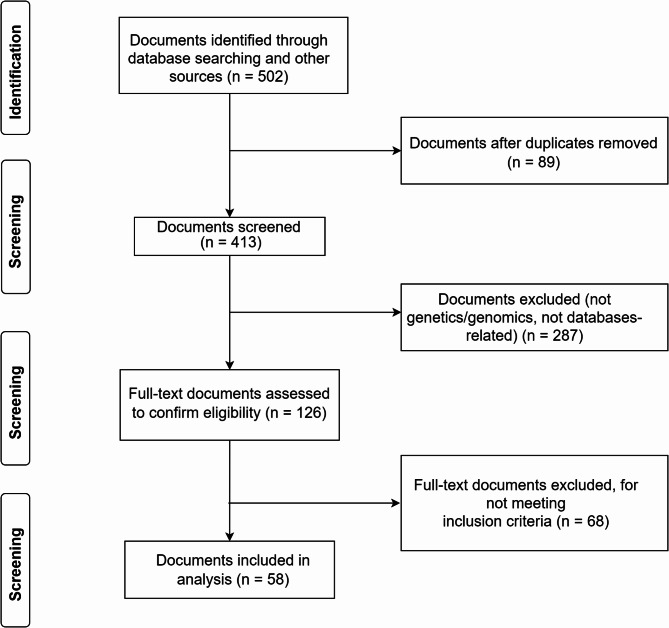
Methods: A comprehensive search strategy was employed across multiple databases, including official government websites and Google, to gather relevant literature on human genetic resources management policies and genetic resource databases. Documents were screened for relevance, focusing on high-income countries (United States, United Kingdom, Japan) and middle-low-income countries (China, India, Kenya). Data were extracted, coded, and analyzed to identify common themes and differences in genetic resource management practices.
Results: High-income countries benefit from robust legal frameworks and advanced technological infrastructures. The United States enforces the Health Insurance Portability and Accountability Act and the Genetic Information Nondiscrimination Act to protect privacy and facilitate data sharing, while Japan relies on the Act on the Protection of Personal Information and ethical guidelines. Additionally, high-income countries host a variety of genetic databases and biobanks that support scientific research. In contrast, middle-low-income countries like China, India, and Kenya are still developing their frameworks. China has regulations such as the Biosecurity Law and the Regulations on the Management of Human Genetic Resources, but still requires more unified standards. India's policies focus on genetic research and data protection through the Biological Diversity Act, while Kenya seeks to improve data management through the 2019 Data Protection Act.
Conclusion: Significant disparities exist in human genetic resources management between high-income and middle-low-income countries. High-income countries have robust systems balancing privacy protection with research facilitation, supported by comprehensive and large-scale databases for scientific research. Middle-low-income countries need to enhance legal frameworks and build population-specific databases. Promoting equitable data sharing and adopting best practices from high-income countries are essential for advancing global scientific discovery and ensuring fair management of genetic resources.
期刊介绍:
BMC Medical Ethics is an open access journal publishing original peer-reviewed research articles in relation to the ethical aspects of biomedical research and clinical practice, including professional choices and conduct, medical technologies, healthcare systems and health policies.



 京公网安备 11010802042870号
京ICP备2023020795号-1
京公网安备 11010802042870号
京ICP备2023020795号-1

 分享
分享
 求助内容:
求助内容: 应助结果提醒方式:
 扫码关注我们
