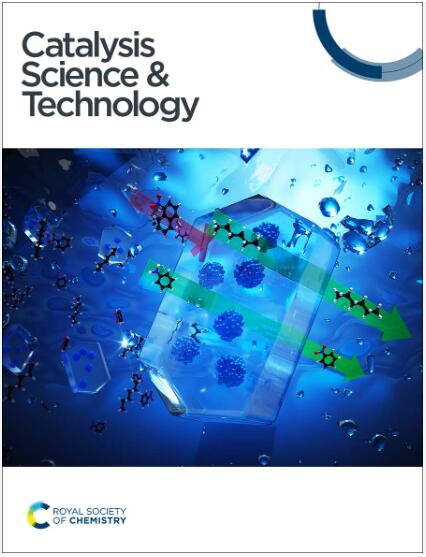
{"title":"Formation of HCHO, CO and H2 by methane oxidation with O2 over Cu catalysts stabilized in silicoaluminophosphates†","authors":"Mana Shimakawa , Rieko Nagase , Ryoya Kugo , Junya Ohyama , Sakae Takenaka","doi":"10.1039/d4cy01469c","DOIUrl":null,"url":null,"abstract":"<div><div>The catalytic performance of Cu catalysts supported on SAPO34 (denoted as Cu/SAPO) for methane oxidation with O<sub>2</sub> has been investigated in detail. Cu/SAPO catalysts formed H<sub>2</sub> in addition to CO and HCHO during methane oxidation in the temperature range from 773 and 923 K, while the other 3d transition metal catalysts such as V, Cr, Mn, Fe, Co and Ni were less active for the formation of these products. The formation of HCHO, H<sub>2</sub> and CO was also confirmed during the reaction over Cu catalysts supported on zeolites different from SAPO34, such as mordenite, faujasite, chabazite, and beta-zeolite, but the yields of these products, especially the H<sub>2</sub> yield in the reaction over the Cu/SAPO catalyst, were significantly higher than those over other zeolite-supported Cu catalysts. In the oxidation over Cu/SAPO catalysts at 923 K, the yields of H<sub>2</sub>, CO, and HCHO reached 2.2, 5.4, and 0.7%, respectively, at a methane conversion of 8.2%. These Cu catalysts were characterized by XRD patterns and <em>in situ</em> UV-vis spectra. Highly dispersed Cu<sup>2+</sup> species stabilized in SAPO34 were the active sites for methane oxidation, which were reduced to Cu<sup>+</sup> species by methane and oxidized to Cu<sup>2+</sup> by O<sub>2</sub> to facilitate the reaction.</div></div>","PeriodicalId":66,"journal":{"name":"Catalysis Science & Technology","volume":"15 6","pages":"Pages 1998-2007"},"PeriodicalIF":4.0000,"publicationDate":"2025-01-07","publicationTypes":"Journal Article","fieldsOfStudy":null,"isOpenAccess":false,"openAccessPdf":"https://pubs.rsc.org/en/content/articlepdf/2025/cy/d4cy01469c?page=search","citationCount":"0","resultStr":null,"platform":"Semanticscholar","paperid":null,"PeriodicalName":"Catalysis Science & Technology","FirstCategoryId":"92","ListUrlMain":"https://www.sciencedirect.com/org/science/article/pii/S2044475325000644","RegionNum":3,"RegionCategory":"化学","ArticlePicture":[],"TitleCN":null,"AbstractTextCN":null,"PMCID":null,"EPubDate":"2025/2/13 0:00:00","PubModel":"Epub","JCR":"Q2","JCRName":"CHEMISTRY, PHYSICAL","Score":null,"Total":0}
引用次数: 0
Abstract
The catalytic performance of Cu catalysts supported on SAPO34 (denoted as Cu/SAPO) for methane oxidation with O2 has been investigated in detail. Cu/SAPO catalysts formed H2 in addition to CO and HCHO during methane oxidation in the temperature range from 773 and 923 K, while the other 3d transition metal catalysts such as V, Cr, Mn, Fe, Co and Ni were less active for the formation of these products. The formation of HCHO, H2 and CO was also confirmed during the reaction over Cu catalysts supported on zeolites different from SAPO34, such as mordenite, faujasite, chabazite, and beta-zeolite, but the yields of these products, especially the H2 yield in the reaction over the Cu/SAPO catalyst, were significantly higher than those over other zeolite-supported Cu catalysts. In the oxidation over Cu/SAPO catalysts at 923 K, the yields of H2, CO, and HCHO reached 2.2, 5.4, and 0.7%, respectively, at a methane conversion of 8.2%. These Cu catalysts were characterized by XRD patterns and in situ UV-vis spectra. Highly dispersed Cu2+ species stabilized in SAPO34 were the active sites for methane oxidation, which were reduced to Cu+ species by methane and oxidized to Cu2+ by O2 to facilitate the reaction.
期刊介绍:
A multidisciplinary journal focusing on cutting edge research across all fundamental science and technological aspects of catalysis.
Editor-in-chief: Bert Weckhuysen
Impact factor: 5.0
Time to first decision (peer reviewed only): 31 days





 京公网安备 11010802042870号
京ICP备2023020795号-1
京公网安备 11010802042870号
京ICP备2023020795号-1

 分享
分享
 求助内容:
求助内容: 应助结果提醒方式:
 扫码关注我们
