Bidirectional S-bridge coordination in the magnetic Au/FeOxSy catalyst for the catalytic oxidation of 5-hydroxymethylfurfural to 2,5-furandicarboxylic acid†
Yu Ruan, Shaoyi Wu, Yingxin Lu, Tiefeng Xu, Wenxing Chen and Wangyang Lu
{"title":"Bidirectional S-bridge coordination in the magnetic Au/FeOxSy catalyst for the catalytic oxidation of 5-hydroxymethylfurfural to 2,5-furandicarboxylic acid†","authors":"Yu Ruan, Shaoyi Wu, Yingxin Lu, Tiefeng Xu, Wenxing Chen and Wangyang Lu","doi":"10.1039/D4TA09277E","DOIUrl":null,"url":null,"abstract":"<p >The aerobic oxidation of 5-hydroxymethylfurfural (HMF) to 2,5-furandicarboxylic acid (FDCA) is a promising approach for producing renewable biodegradable plastics. However, thus far, the development of catalytic oxidation processes operating under mild conditions and the design of highly stable catalysts have been challenging. Herein, the magnetic catalyst Au/FeO<small><sub><em>x</em></sub></small>S<small><sub><em>y</em></sub></small> was synthesised by doping S into the Fe/Au bimetallic structure. The reaction was conducted in water at 60 °C under air and atmospheric pressure, achieving 100% conversion of HMF and a FDCA yield of 98.5%. The catalytic performance of S-doping Au/FeO<small><sub><em>x</em></sub></small> was 4.73 times greater than that of undoped Au/FeO<small><sub><em>x</em></sub></small> under the same conditions. Furthermore, the catalyst demonstrated excellent cycling stability, with the FDCA yield maintained above 93% after at least 30 cycles. The introduction of S altered the electronic configuration of Au through the formation of Au–S bonds, thereby enhancing electron mobility and catalytic activity. Additionally, the interaction of S with FeO<small><sub><em>x</em></sub></small> led to the formation of Fe–O–S bonds, which fortified the structure of the catalyst and ensured prolonged cycling stability. Thus, this study effectively converted HMF to FDCA under mild conditions through S incorporation, offering a novel approach for preparing metal catalysts and laying a robust foundation for utilising FDCA as a sustainable alternative to terephthalic acid in bio-based polyester production.</p>","PeriodicalId":82,"journal":{"name":"Journal of Materials Chemistry A","volume":" 15","pages":" 10814-10824"},"PeriodicalIF":9.5000,"publicationDate":"2025-03-18","publicationTypes":"Journal Article","fieldsOfStudy":null,"isOpenAccess":false,"openAccessPdf":"","citationCount":"0","resultStr":null,"platform":"Semanticscholar","paperid":null,"PeriodicalName":"Journal of Materials Chemistry A","FirstCategoryId":"88","ListUrlMain":"https://pubs.rsc.org/en/content/articlelanding/2025/ta/d4ta09277e","RegionNum":2,"RegionCategory":"材料科学","ArticlePicture":[],"TitleCN":null,"AbstractTextCN":null,"PMCID":null,"EPubDate":"","PubModel":"","JCR":"Q1","JCRName":"CHEMISTRY, PHYSICAL","Score":null,"Total":0}
引用次数: 0
Abstract
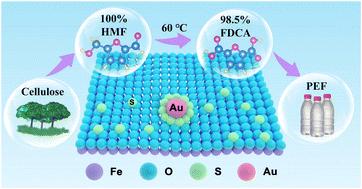
The aerobic oxidation of 5-hydroxymethylfurfural (HMF) to 2,5-furandicarboxylic acid (FDCA) is a promising approach for producing renewable biodegradable plastics. However, thus far, the development of catalytic oxidation processes operating under mild conditions and the design of highly stable catalysts have been challenging. Herein, the magnetic catalyst Au/FeOxSy was synthesised by doping S into the Fe/Au bimetallic structure. The reaction was conducted in water at 60 °C under air and atmospheric pressure, achieving 100% conversion of HMF and a FDCA yield of 98.5%. The catalytic performance of S-doping Au/FeOx was 4.73 times greater than that of undoped Au/FeOx under the same conditions. Furthermore, the catalyst demonstrated excellent cycling stability, with the FDCA yield maintained above 93% after at least 30 cycles. The introduction of S altered the electronic configuration of Au through the formation of Au–S bonds, thereby enhancing electron mobility and catalytic activity. Additionally, the interaction of S with FeOx led to the formation of Fe–O–S bonds, which fortified the structure of the catalyst and ensured prolonged cycling stability. Thus, this study effectively converted HMF to FDCA under mild conditions through S incorporation, offering a novel approach for preparing metal catalysts and laying a robust foundation for utilising FDCA as a sustainable alternative to terephthalic acid in bio-based polyester production.
期刊介绍:
The Journal of Materials Chemistry A, B & C covers a wide range of high-quality studies in the field of materials chemistry, with each section focusing on specific applications of the materials studied. Journal of Materials Chemistry A emphasizes applications in energy and sustainability, including topics such as artificial photosynthesis, batteries, and fuel cells. Journal of Materials Chemistry B focuses on applications in biology and medicine, while Journal of Materials Chemistry C covers applications in optical, magnetic, and electronic devices. Example topic areas within the scope of Journal of Materials Chemistry A include catalysis, green/sustainable materials, sensors, and water treatment, among others.




 京公网安备 11010802042870号
京ICP备2023020795号-1
京公网安备 11010802042870号
京ICP备2023020795号-1

 分享
分享
 求助内容:
求助内容: 应助结果提醒方式:
 扫码关注我们
