Sergio Ferrer-Nicomedes, Andrés Mormeneo-Segarra, Nuria Vicente-Agut and Antonio Barba-Juan
{"title":"Densification and performance optimization of NaSICON solid electrolytes via a low-temperature cold sintering process with sodium ionic salt doping†","authors":"Sergio Ferrer-Nicomedes, Andrés Mormeneo-Segarra, Nuria Vicente-Agut and Antonio Barba-Juan","doi":"10.1039/D5TA00698H","DOIUrl":null,"url":null,"abstract":"<p >Sodium-ion batteries (SIBs) have emerged as a sustainable alternative to lithium-ion systems, offering cost-effective and environmentally friendly energy storage solutions. Solid-state electrolytes (SSEs), particularly NaSICON-type materials such as Na<small><sub>3.4</sub></small>Zr<small><sub>1.9</sub></small>Zn<small><sub>0.1</sub></small>Si<small><sub>2.2</sub></small>P<small><sub>0.8</sub></small>O<small><sub>12</sub></small> (NZZSP) studied here, are critical for enhancing the safety and stability of SIBs. However, conventional high-temperature sintering methods for fabricating these electrolytes are energy-intensive and environmentally impactful. In this work, we employed the Cold Sintering Process (CSP) to densify NZZSP at a low temperature of 150 °C under 720 MPa with the aid of a transient liquid phase (TLP), achieving a sustainable electrolyte production with competitive performance. The effects of milling time and two different TLP media were evaluated, with 3 M acetic acid solution (HAc) being more effective than 25 mM sodium hydroxide solution (NaOH) in preserving particle integrity and yielding higher ionic conductivity (0.50 mS cm<small><sup>−1</sup></small>). Doping with NaPF<small><sub>6</sub></small> and NaTFSI further enhanced performance, with 20% NaPF<small><sub>6</sub></small>-doped samples achieving the highest densification (94.3%) and conductivity (0.80 mS cm<small><sup>−1</sup></small>). Optimized 2 hour-milled, 20% NaPF<small><sub>6</sub></small> electrolytes demonstrated suitable cycling stability in symmetric cells (over 500 hours) and specific capacity in half cells, with Na metal and Na<small><sub>3</sub></small>V<small><sub>2</sub></small>(PO<small><sub>4</sub></small>)<small><sub>3</sub></small> (NVP) as electrodes, of about 85 mA h g<small><sub>NVP</sub></small><small><sup>−1</sup></small> at C/2 and over 100 mA h g<small><sub>NVP</sub></small><small><sup>−1</sup></small> at C/10 after cycling at multiple rates. These results underscore the potential of the CSP as a sustainable, low-temperature alternative for fabricating high-performance solid-state electrolytes for application in all solid-state sodium batteries.</p>","PeriodicalId":82,"journal":{"name":"Journal of Materials Chemistry A","volume":" 17","pages":" 12439-12451"},"PeriodicalIF":9.5000,"publicationDate":"2025-03-18","publicationTypes":"Journal Article","fieldsOfStudy":null,"isOpenAccess":false,"openAccessPdf":"https://pubs.rsc.org/en/content/articlepdf/2025/ta/d5ta00698h?page=search","citationCount":"0","resultStr":null,"platform":"Semanticscholar","paperid":null,"PeriodicalName":"Journal of Materials Chemistry A","FirstCategoryId":"88","ListUrlMain":"https://pubs.rsc.org/en/content/articlelanding/2025/ta/d5ta00698h","RegionNum":2,"RegionCategory":"材料科学","ArticlePicture":[],"TitleCN":null,"AbstractTextCN":null,"PMCID":null,"EPubDate":"","PubModel":"","JCR":"Q1","JCRName":"CHEMISTRY, PHYSICAL","Score":null,"Total":0}
引用次数: 0
Abstract
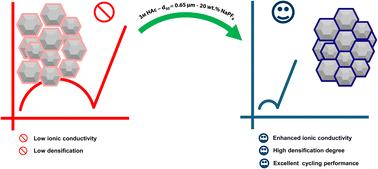
Sodium-ion batteries (SIBs) have emerged as a sustainable alternative to lithium-ion systems, offering cost-effective and environmentally friendly energy storage solutions. Solid-state electrolytes (SSEs), particularly NaSICON-type materials such as Na3.4Zr1.9Zn0.1Si2.2P0.8O12 (NZZSP) studied here, are critical for enhancing the safety and stability of SIBs. However, conventional high-temperature sintering methods for fabricating these electrolytes are energy-intensive and environmentally impactful. In this work, we employed the Cold Sintering Process (CSP) to densify NZZSP at a low temperature of 150 °C under 720 MPa with the aid of a transient liquid phase (TLP), achieving a sustainable electrolyte production with competitive performance. The effects of milling time and two different TLP media were evaluated, with 3 M acetic acid solution (HAc) being more effective than 25 mM sodium hydroxide solution (NaOH) in preserving particle integrity and yielding higher ionic conductivity (0.50 mS cm−1). Doping with NaPF6 and NaTFSI further enhanced performance, with 20% NaPF6-doped samples achieving the highest densification (94.3%) and conductivity (0.80 mS cm−1). Optimized 2 hour-milled, 20% NaPF6 electrolytes demonstrated suitable cycling stability in symmetric cells (over 500 hours) and specific capacity in half cells, with Na metal and Na3V2(PO4)3 (NVP) as electrodes, of about 85 mA h gNVP−1 at C/2 and over 100 mA h gNVP−1 at C/10 after cycling at multiple rates. These results underscore the potential of the CSP as a sustainable, low-temperature alternative for fabricating high-performance solid-state electrolytes for application in all solid-state sodium batteries.
钠离子电池(sib)已经成为锂离子系统的可持续替代品,提供了经济高效且环保的能源存储解决方案。固态电解质(ssi),特别是nasicon类型的材料,如本文研究的Na3.4Zr1.9Zn0.1Si2.2P0.8O12 (NZZSP),对于提高sib的安全性和稳定性至关重要。然而,传统的高温烧结方法是制造这些电解质的能源密集型和对环境的影响。在这项工作中,我们采用冷烧结工艺(CSP)在720 MPa下,在150°C的低温下,在瞬态液相(TLP)的帮助下致密化NZZSP,实现了具有竞争力性能的可持续电解质生产。对研磨时间和两种不同TLP介质的影响进行了评估,结果表明,3M醋酸溶液(HAc)比25 mM氢氧化钠溶液(NaOH)更有效地保持颗粒完整性,并产生更高的离子电导率(0.50 mS cm-1)。NaPF6和NaTFSI的掺杂进一步提高了性能,掺20% NaPF6的样品获得了最高的密度(94.3%)和电导率(0.80 mS cm-1)。经过优化的2小时研磨,20%的NaPF6电解质在对称电池中表现出合适的循环稳定性(超过500小时)和半电池的比容量,以Na金属和Na3V2(PO4)3 (NVP)为电极,在C/2下循环约85 mAh g-1NVP,在C/10下循环超过100 mAh g-1NVP。这些结果强调了CSP作为一种可持续的、低温的制造高性能固态电解质的替代方案的潜力,可应用于所有固态钠电池。
期刊介绍:
The Journal of Materials Chemistry A, B & C covers a wide range of high-quality studies in the field of materials chemistry, with each section focusing on specific applications of the materials studied. Journal of Materials Chemistry A emphasizes applications in energy and sustainability, including topics such as artificial photosynthesis, batteries, and fuel cells. Journal of Materials Chemistry B focuses on applications in biology and medicine, while Journal of Materials Chemistry C covers applications in optical, magnetic, and electronic devices. Example topic areas within the scope of Journal of Materials Chemistry A include catalysis, green/sustainable materials, sensors, and water treatment, among others.



 京公网安备 11010802042870号
京ICP备2023020795号-1
京公网安备 11010802042870号
京ICP备2023020795号-1

 分享
分享
 求助内容:
求助内容: 应助结果提醒方式:
 扫码关注我们
