Lin Wang, Manman Jia, Hui Jiao, Shukang Ti and Dongmei Yue
{"title":"High-performance, recyclable, and multifunctional nitrile butadiene rubber based on hydrogen and urea bonds†","authors":"Lin Wang, Manman Jia, Hui Jiao, Shukang Ti and Dongmei Yue","doi":"10.1039/D4TA09201E","DOIUrl":null,"url":null,"abstract":"<p >Nitrile Butadiene Rubber (NBR) is widely used in aerospace, petroleum exploration, auto parts, and other fields because of its excellent performance. Nevertheless, NBR usually needs to be crosslinked with sulfur or peroxide, which restricts the tensile performance and recyclability of NBR. Herein, a novel strategy was developed to address these issues by introducing dynamic urea bonds into the main chain using a simple, catalyst-free one-pot method. The presence of urea bonds not only provides a large number of hydrogen bonding sites between the molecular chains but also exhibits the remarkable microphase separation properties of thermoplastic elastomers. This approach endows NBR with enhanced dynamic characteristics and significant recyclability. As a result, the as-synthesized multifunctional NBR elastomer (I–A<small><sub>0.5</sub></small>–P<small><sub>0.5</sub></small>) exhibits excellent tensile strength (19.9 MPa), toughness (93.7 MJ m<small><sup>−3</sup></small>), low glass transition temperature (−52 °C), and low compression cold resistance coefficient (0.15 at −55 °C), which are comparable to those of conventionally covalently crosslinked NBR. Importantly, the elastomer can retain its mechanical robustness, chemical structure, and thermal stability after multiple rounds of recycling (after five times of recycling, with a recovery of more than 81%). To broaden the application of NBR products, I–A<small><sub>0.5</sub></small>–P<small><sub>0.5</sub></small> was crosslinked with sulfur, and its performance was compared with NBR vulcanizates of different acrylonitrile contents. It shows excellent oil resistance and low temperature resistance. Surprisingly, it can also possess the ability to be reprocessed multiple times. This new multifunctional thermoplastic NBR elastomer is of great significance in solving the problem of difficult recycling of traditional NBR and is expected to replace traditional covalently cross-linked NBR.</p>","PeriodicalId":82,"journal":{"name":"Journal of Materials Chemistry A","volume":" 15","pages":" 10749-10759"},"PeriodicalIF":9.5000,"publicationDate":"2025-03-18","publicationTypes":"Journal Article","fieldsOfStudy":null,"isOpenAccess":false,"openAccessPdf":"","citationCount":"0","resultStr":null,"platform":"Semanticscholar","paperid":null,"PeriodicalName":"Journal of Materials Chemistry A","FirstCategoryId":"88","ListUrlMain":"https://pubs.rsc.org/en/content/articlelanding/2025/ta/d4ta09201e","RegionNum":2,"RegionCategory":"材料科学","ArticlePicture":[],"TitleCN":null,"AbstractTextCN":null,"PMCID":null,"EPubDate":"","PubModel":"","JCR":"Q1","JCRName":"CHEMISTRY, PHYSICAL","Score":null,"Total":0}
引用次数: 0
Abstract
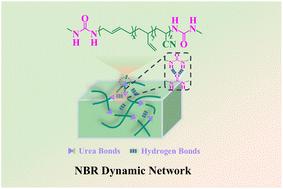
Nitrile Butadiene Rubber (NBR) is widely used in aerospace, petroleum exploration, auto parts, and other fields because of its excellent performance. Nevertheless, NBR usually needs to be crosslinked with sulfur or peroxide, which restricts the tensile performance and recyclability of NBR. Herein, a novel strategy was developed to address these issues by introducing dynamic urea bonds into the main chain using a simple, catalyst-free one-pot method. The presence of urea bonds not only provides a large number of hydrogen bonding sites between the molecular chains but also exhibits the remarkable microphase separation properties of thermoplastic elastomers. This approach endows NBR with enhanced dynamic characteristics and significant recyclability. As a result, the as-synthesized multifunctional NBR elastomer (I–A0.5–P0.5) exhibits excellent tensile strength (19.9 MPa), toughness (93.7 MJ m−3), low glass transition temperature (−52 °C), and low compression cold resistance coefficient (0.15 at −55 °C), which are comparable to those of conventionally covalently crosslinked NBR. Importantly, the elastomer can retain its mechanical robustness, chemical structure, and thermal stability after multiple rounds of recycling (after five times of recycling, with a recovery of more than 81%). To broaden the application of NBR products, I–A0.5–P0.5 was crosslinked with sulfur, and its performance was compared with NBR vulcanizates of different acrylonitrile contents. It shows excellent oil resistance and low temperature resistance. Surprisingly, it can also possess the ability to be reprocessed multiple times. This new multifunctional thermoplastic NBR elastomer is of great significance in solving the problem of difficult recycling of traditional NBR and is expected to replace traditional covalently cross-linked NBR.
期刊介绍:
The Journal of Materials Chemistry A, B & C covers a wide range of high-quality studies in the field of materials chemistry, with each section focusing on specific applications of the materials studied. Journal of Materials Chemistry A emphasizes applications in energy and sustainability, including topics such as artificial photosynthesis, batteries, and fuel cells. Journal of Materials Chemistry B focuses on applications in biology and medicine, while Journal of Materials Chemistry C covers applications in optical, magnetic, and electronic devices. Example topic areas within the scope of Journal of Materials Chemistry A include catalysis, green/sustainable materials, sensors, and water treatment, among others.




 京公网安备 11010802042870号
京ICP备2023020795号-1
京公网安备 11010802042870号
京ICP备2023020795号-1

 分享
分享
 求助内容:
求助内容: 应助结果提醒方式:
 扫码关注我们
