Lechen Qian, Mark Burrell, Jay A. Hennig, Sara Matias, Venkatesh N. Murthy, Samuel J. Gershman, Naoshige Uchida
{"title":"Prospective contingency explains behavior and dopamine signals during associative learning","authors":"Lechen Qian, Mark Burrell, Jay A. Hennig, Sara Matias, Venkatesh N. Murthy, Samuel J. Gershman, Naoshige Uchida","doi":"10.1038/s41593-025-01915-4","DOIUrl":null,"url":null,"abstract":"Associative learning depends on contingency, the degree to which a stimulus predicts an outcome. Despite its importance, the neural mechanisms linking contingency to behavior remain elusive. In the present study, we examined the dopamine activity in the ventral striatum—a signal implicated in associative learning—in a Pavlovian contingency degradation task in mice. We show that both anticipatory licking and dopamine responses to a conditioned stimulus decreased when additional rewards were delivered uncued, but remained unchanged if additional rewards were cued. These results conflict with contingency-based accounts using a traditional definition of contingency or a new causal learning model (ANCCR), but can be explained by temporal difference (TD) learning models equipped with an appropriate intertrial interval state representation. Recurrent neural networks trained within a TD framework develop state representations akin to our best ‘handcrafted’ model. Our findings suggest that the TD error can be a measure that describes both contingency and dopaminergic activity. The authors show that behavior and dopamine responses track prospective, but not retrospective, contingency. These results are explained by temporal difference (TD) learning models, indicating that TD errors are a measure of contingency.","PeriodicalId":19076,"journal":{"name":"Nature neuroscience","volume":"28 6","pages":"1280-1292"},"PeriodicalIF":20.0000,"publicationDate":"2025-03-18","publicationTypes":"Journal Article","fieldsOfStudy":null,"isOpenAccess":false,"openAccessPdf":"","citationCount":"0","resultStr":null,"platform":"Semanticscholar","paperid":null,"PeriodicalName":"Nature neuroscience","FirstCategoryId":"3","ListUrlMain":"https://www.nature.com/articles/s41593-025-01915-4","RegionNum":1,"RegionCategory":"医学","ArticlePicture":[],"TitleCN":null,"AbstractTextCN":null,"PMCID":null,"EPubDate":"","PubModel":"","JCR":"Q1","JCRName":"NEUROSCIENCES","Score":null,"Total":0}
引用次数: 0
Abstract
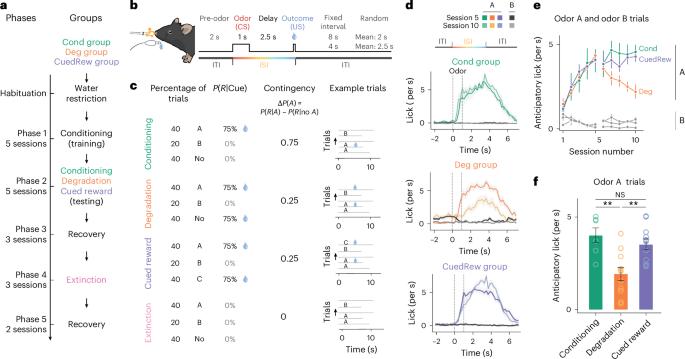
Associative learning depends on contingency, the degree to which a stimulus predicts an outcome. Despite its importance, the neural mechanisms linking contingency to behavior remain elusive. In the present study, we examined the dopamine activity in the ventral striatum—a signal implicated in associative learning—in a Pavlovian contingency degradation task in mice. We show that both anticipatory licking and dopamine responses to a conditioned stimulus decreased when additional rewards were delivered uncued, but remained unchanged if additional rewards were cued. These results conflict with contingency-based accounts using a traditional definition of contingency or a new causal learning model (ANCCR), but can be explained by temporal difference (TD) learning models equipped with an appropriate intertrial interval state representation. Recurrent neural networks trained within a TD framework develop state representations akin to our best ‘handcrafted’ model. Our findings suggest that the TD error can be a measure that describes both contingency and dopaminergic activity. The authors show that behavior and dopamine responses track prospective, but not retrospective, contingency. These results are explained by temporal difference (TD) learning models, indicating that TD errors are a measure of contingency.
期刊介绍:
Nature Neuroscience, a multidisciplinary journal, publishes papers of the utmost quality and significance across all realms of neuroscience. The editors welcome contributions spanning molecular, cellular, systems, and cognitive neuroscience, along with psychophysics, computational modeling, and nervous system disorders. While no area is off-limits, studies offering fundamental insights into nervous system function receive priority.
The journal offers high visibility to both readers and authors, fostering interdisciplinary communication and accessibility to a broad audience. It maintains high standards of copy editing and production, rigorous peer review, rapid publication, and operates independently from academic societies and other vested interests.
In addition to primary research, Nature Neuroscience features news and views, reviews, editorials, commentaries, perspectives, book reviews, and correspondence, aiming to serve as the voice of the global neuroscience community.




 京公网安备 11010802042870号
京ICP备2023020795号-1
京公网安备 11010802042870号
京ICP备2023020795号-1

 分享
分享
 求助内容:
求助内容: 应助结果提醒方式:
 扫码关注我们
