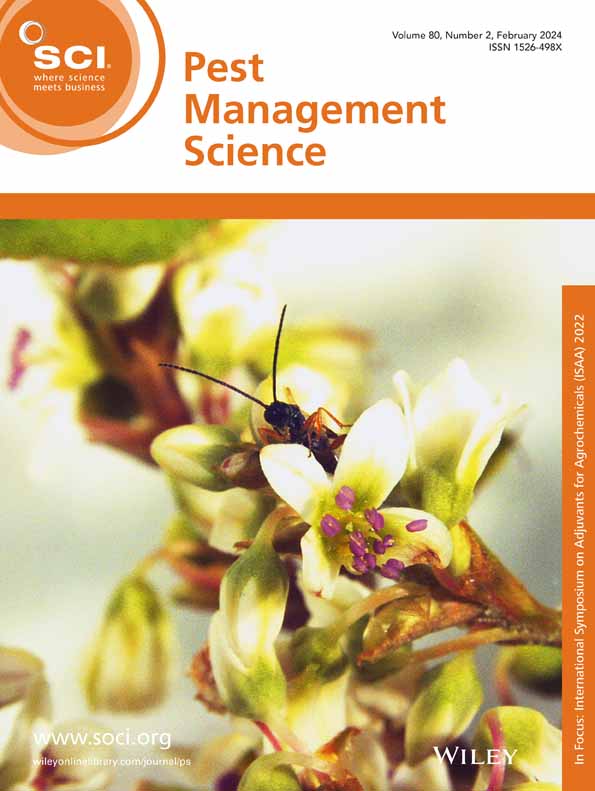
Complementarity between Orius predators improves control of foliar and flower pests

IF 3.8 1区 农林科学 Q1 AGRONOMY Pest Management Science Pub Date : 2025-03-18 DOI:10.1002/ps.8784
Angelos Mouratidis, Sophie Le Hesran, Marcel Dicke, Gerben J Messelink
{"title":"Complementarity between Orius predators improves control of foliar and flower pests","authors":"Angelos Mouratidis,&nbsp;Sophie Le Hesran,&nbsp;Marcel Dicke,&nbsp;Gerben J Messelink","doi":"10.1002/ps.8784","DOIUrl":null,"url":null,"abstract":"<div>\n \n \n <section>\n \n <h3> BACKGROUND</h3>\n \n <p>Multispecies natural enemy assemblages may be more successful in suppressing herbivorous pests compared to low-diversity communities, especially when natural enemies complement each other regarding the niches they exploit. <i>Orius</i> predatory bugs are omnivorous biological control agents used in horticulture, and are widely associated with the control of flower thrips. However, species within the <i>Orius</i> genus may differ significantly in biological characteristics, such as size, thermal development requirements, induction of diapause, degree of omnivory, and within-plant distribution. In this study, we explored the differences in within-plant preferences and pest-control efficacy against foliar and flower pests of the predators <i>Orius laevigatus</i>, <i>O. majusculus</i> and <i>O. minutus</i>.</p>\n </section>\n \n <section>\n \n <h3> RESULTS</h3>\n \n <p>In oviposition experiments with <i>Gerbera jamesonii</i> plants, we found that <i>O. laevigatus</i> preferred ovipositing in the flower calyx, while eggs of the other two <i>Orius</i> species were mainly found in the leaves. Similarly, in a greenhouse trial where gerbera plants were infested with both the western flower thrips <i>Frankliniella occidentalis</i> and the greenhouse whitefly <i>Trialeurodes vaporariorum</i>, <i>O. laevigatus</i> was the most effective predator against the flower thrips, but the least effective against whiteflies. When <i>O. laevigatus</i> was combined with <i>O. minutus</i>, the best control of both pests at the same time was observed.</p>\n </section>\n \n <section>\n \n <h3> CONCLUSION</h3>\n \n <p>Our results suggest that the use of <i>Orius</i> predators for pest control may be further exploited and that species combinations that complement each other may expand the range of pests successfully controlled by anthocorids. © 2025 The Author(s). <i>Pest Management Science</i> published by John Wiley &amp; Sons Ltd on behalf of Society of Chemical Industry.</p>\n </section>\n </div>","PeriodicalId":218,"journal":{"name":"Pest Management Science","volume":"81 8","pages":"4230-4242"},"PeriodicalIF":3.8000,"publicationDate":"2025-03-18","publicationTypes":"Journal Article","fieldsOfStudy":null,"isOpenAccess":false,"openAccessPdf":"https://onlinelibrary.wiley.com/doi/epdf/10.1002/ps.8784","citationCount":"0","resultStr":null,"platform":"Semanticscholar","paperid":null,"PeriodicalName":"Pest Management Science","FirstCategoryId":"97","ListUrlMain":"https://scijournals.onlinelibrary.wiley.com/doi/10.1002/ps.8784","RegionNum":1,"RegionCategory":"农林科学","ArticlePicture":[],"TitleCN":null,"AbstractTextCN":null,"PMCID":null,"EPubDate":"","PubModel":"","JCR":"Q1","JCRName":"AGRONOMY","Score":null,"Total":0}
引用次数: 0

Abstract

BACKGROUND

Multispecies natural enemy assemblages may be more successful in suppressing herbivorous pests compared to low-diversity communities, especially when natural enemies complement each other regarding the niches they exploit. Orius predatory bugs are omnivorous biological control agents used in horticulture, and are widely associated with the control of flower thrips. However, species within the Orius genus may differ significantly in biological characteristics, such as size, thermal development requirements, induction of diapause, degree of omnivory, and within-plant distribution. In this study, we explored the differences in within-plant preferences and pest-control efficacy against foliar and flower pests of the predators Orius laevigatus, O. majusculus and O. minutus.

RESULTS

In oviposition experiments with Gerbera jamesonii plants, we found that O. laevigatus preferred ovipositing in the flower calyx, while eggs of the other two Orius species were mainly found in the leaves. Similarly, in a greenhouse trial where gerbera plants were infested with both the western flower thrips Frankliniella occidentalis and the greenhouse whitefly Trialeurodes vaporariorum, O. laevigatus was the most effective predator against the flower thrips, but the least effective against whiteflies. When O. laevigatus was combined with O. minutus, the best control of both pests at the same time was observed.

CONCLUSION

Our results suggest that the use of Orius predators for pest control may be further exploited and that species combinations that complement each other may expand the range of pests successfully controlled by anthocorids. © 2025 The Author(s). Pest Management Science published by John Wiley & Sons Ltd on behalf of Society of Chemical Industry.

Abstract Image

Abstract Image

Abstract Image

Abstract Image

Abstract Image

查看原文
分享 分享
微信好友 朋友圈 QQ好友 复制链接
本刊更多论文
捕食者之间的互补性提高了对叶面和花卉害虫的控制
与低多样性群落相比,多物种天敌组合在抑制草食性害虫方面可能更成功,特别是当天敌在它们所利用的生态位方面相互补充时。鸢尾捕食性臭虫是一种杂食性的园艺生物防治剂,广泛应用于花卉蓟马的防治。然而,在大小、热发育需求、滞育诱导、杂食程度和植物内分布等生物学特征上,鹅角属的物种可能存在显著差异。本研究探讨了三种掠食性昆虫(Orius laevigatus、O. majusculus和O. minutus)对叶害虫和花害虫的植物偏好和防治效果的差异。
本文章由计算机程序翻译,如有差异,请以英文原文为准。
求助全文
约1分钟内获得全文 去求助
来源期刊
Pest Management Science
Pest Management Science 农林科学-昆虫学
CiteScore
7.90
自引率
9.80%
发文量
553
审稿时长
4.8 months
期刊介绍: Pest Management Science is the international journal of research and development in crop protection and pest control. Since its launch in 1970, the journal has become the premier forum for papers on the discovery, application, and impact on the environment of products and strategies designed for pest management. Published for SCI by John Wiley & Sons Ltd.
期刊最新文献
Potential of endophytic Beauveria bassiana against Coraebus (Coleoptera: Buprestidae) oak borers. Artificial shelters as dual-purpose tools for monitoring natural enemies and providing microhabitats in orchards. Residue dynamics and metabolic pathways of sulfoxaflor in Cirsium japonicum var. maackii and Olea europaea L. Molecular co-assembly engineering towards natural tea saponin-based nanopesticides for synergistic enhanced foliar affinity. Cytochrome P450 and glutathione S-transferase may confer bensulfuron-methyl resistance in Cyperus iria.
×
引用
GB/T 7714-2015
复制
MLA
复制
APA
复制
导出至
BibTeX EndNote RefMan NoteFirst NoteExpress
×
×
提示
您的信息不完整,为了账户安全,请先补充。
现在去补充
×
提示
您因"违规操作"
具体请查看互助需知
我知道了
×
提示
现在去查看 取消
×
提示
确定
0
微信
客服QQ
Book学术公众号 扫码关注我们
反馈
×
意见反馈
请填写您的意见或建议
请填写您的手机或邮箱
已复制链接
已复制链接
快去分享给好友吧!
我知道了
×
扫码分享
扫码分享
Book学术官方微信
Book学术文献互助
Book学术文献互助群
群 号:604180095
Book学术
文献互助 智能选刊 最新文献 互助须知 联系我们:info@booksci.cn
Book学术提供免费学术资源搜索服务,方便国内外学者检索中英文文献。致力于提供最便捷和优质的服务体验。
Copyright © 2023 Book学术 All rights reserved.
ghs 京公网安备 11010802042870号 京ICP备2023020795号-1