Gabriel Cavelier , Robert Weigel , Lena Enderle , Christoph Leuschner
{"title":"Douglas fir – A victim of its high productivity in a warming climate? Predominantly negative growth trends in the North German Lowlands","authors":"Gabriel Cavelier , Robert Weigel , Lena Enderle , Christoph Leuschner","doi":"10.1016/j.scitotenv.2025.179100","DOIUrl":null,"url":null,"abstract":"<div><div>Recent hot droughts and a rising atmospheric vapor pressure deficit are exposing Central European forests to growing stress, causing growth decline, crown damage and elevated mortality of some of the economically most important tree species. Foresters therefore advocate the planting of introduced Douglas fir as a replacement of more vulnerable tree species, but the species' drought and heat resistance is not sufficiently understood. Here, we analyze long-term basal area increment (BAI) trends and the climate sensitivity of growth of 15 mature Douglas fir stands along a precipitation gradient (940–580 mm yr<sup>−1</sup>) in the North German Lowlands on similar soil. We searched for recent growth declines and assessed the potential of acclimatization to a drier climate. After a pronounced growth increase from 1980 to 2000, BAI has shifted in the last 15 years to a negative trend in the majority of stands, with drier stands being more affected. Thirty percent of the 304 studied trees show significant negative BAI trends, another 47 % non-significant negative trends, compared to 5 % with significant and 12 % with non-significant positive trends. The strongest drivers of a negative BAI trend were climate continentality (seasonal temperature amplitude), a cold February, a negative summer climatic water balance, and low precipitation, indicating declining growth rates especially in continental climates with cold winters and dry summers. A highly significant negative relation exists between recent BAI trend direction and highest growth rate in the past, indicating that faster growth in the past led to greater recent growth decline. We conclude that Douglas fir is more vulnerable to climate change in Central Europe's warmer lowlands than previously thought, which has to be considered in silvicultural planning.</div></div>","PeriodicalId":422,"journal":{"name":"Science of the Total Environment","volume":"973 ","pages":"Article 179100"},"PeriodicalIF":8.0000,"publicationDate":"2025-04-10","publicationTypes":"Journal Article","fieldsOfStudy":null,"isOpenAccess":false,"openAccessPdf":"","citationCount":"0","resultStr":null,"platform":"Semanticscholar","paperid":null,"PeriodicalName":"Science of the Total Environment","FirstCategoryId":"93","ListUrlMain":"https://www.sciencedirect.com/science/article/pii/S0048969725007351","RegionNum":1,"RegionCategory":"环境科学与生态学","ArticlePicture":[],"TitleCN":null,"AbstractTextCN":null,"PMCID":null,"EPubDate":"2025/3/19 0:00:00","PubModel":"Epub","JCR":"Q1","JCRName":"ENVIRONMENTAL SCIENCES","Score":null,"Total":0}
引用次数: 0
Abstract
Recent hot droughts and a rising atmospheric vapor pressure deficit are exposing Central European forests to growing stress, causing growth decline, crown damage and elevated mortality of some of the economically most important tree species. Foresters therefore advocate the planting of introduced Douglas fir as a replacement of more vulnerable tree species, but the species' drought and heat resistance is not sufficiently understood. Here, we analyze long-term basal area increment (BAI) trends and the climate sensitivity of growth of 15 mature Douglas fir stands along a precipitation gradient (940–580 mm yr−1) in the North German Lowlands on similar soil. We searched for recent growth declines and assessed the potential of acclimatization to a drier climate. After a pronounced growth increase from 1980 to 2000, BAI has shifted in the last 15 years to a negative trend in the majority of stands, with drier stands being more affected. Thirty percent of the 304 studied trees show significant negative BAI trends, another 47 % non-significant negative trends, compared to 5 % with significant and 12 % with non-significant positive trends. The strongest drivers of a negative BAI trend were climate continentality (seasonal temperature amplitude), a cold February, a negative summer climatic water balance, and low precipitation, indicating declining growth rates especially in continental climates with cold winters and dry summers. A highly significant negative relation exists between recent BAI trend direction and highest growth rate in the past, indicating that faster growth in the past led to greater recent growth decline. We conclude that Douglas fir is more vulnerable to climate change in Central Europe's warmer lowlands than previously thought, which has to be considered in silvicultural planning.
最近的炎热干旱和不断上升的大气蒸汽压赤字使中欧森林面临越来越大的压力,导致一些经济上最重要的树种生长下降、树冠受损和死亡率上升。因此,林务人员提倡种植引进的花旗松,以取代更脆弱的树种,但该物种的抗旱和耐热性还没有得到充分的了解。本文分析了在相似土壤条件下,德国北部低地沿降水梯度(940-580 mm yr - 1)分布的15个成熟花旗松林分生长的长期基底面积增量(BAI)趋势和气候敏感性。我们搜索了最近的生长下降,并评估了适应干旱气候的潜力。在经历了1980 - 2000年的显著增长后,近15年大部分林分的净净指数呈负增长趋势,干旱林分受影响更大。304棵树中有30%表现出显著的负BAI趋势,另有47%表现出不显著的负趋势,相比之下,5%表现出显著趋势,12%表现出不显著的正趋势。气候大陆性(季节温度振幅)、寒冷的2月、负的夏季气候水平衡和低降水是BAI负趋势的最大驱动因素,这表明在冬季寒冷和夏季干燥的大陆性气候中,增长率下降。近期BAI趋势方向与过去最高增长率呈极显著负相关,表明过去增长较快导致近期增长率下降较大。我们的结论是,在中欧温暖的低地,花旗松比以前认为的更容易受到气候变化的影响,这在造林规划中必须考虑到。
期刊介绍:
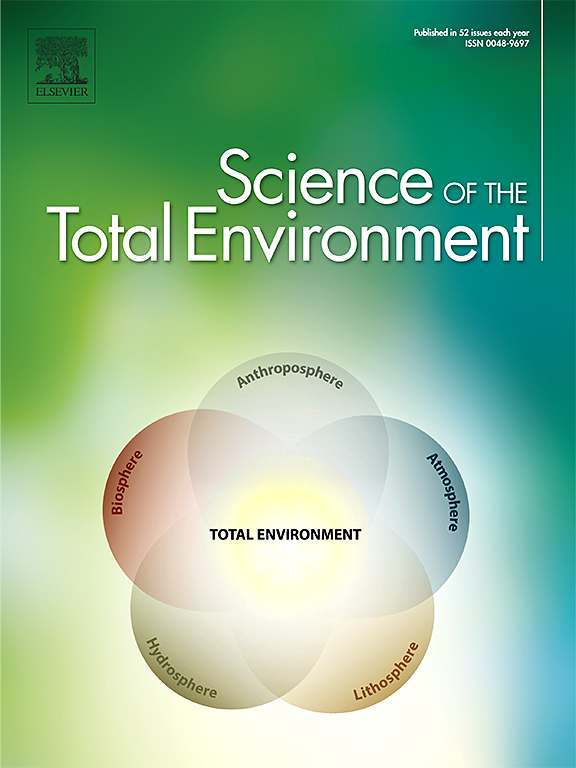
The Science of the Total Environment is an international journal dedicated to scientific research on the environment and its interaction with humanity. It covers a wide range of disciplines and seeks to publish innovative, hypothesis-driven, and impactful research that explores the entire environment, including the atmosphere, lithosphere, hydrosphere, biosphere, and anthroposphere.
The journal's updated Aims & Scope emphasizes the importance of interdisciplinary environmental research with broad impact. Priority is given to studies that advance fundamental understanding and explore the interconnectedness of multiple environmental spheres. Field studies are preferred, while laboratory experiments must demonstrate significant methodological advancements or mechanistic insights with direct relevance to the environment.




 京公网安备 11010802042870号
京ICP备2023020795号-1
京公网安备 11010802042870号
京ICP备2023020795号-1

 分享
分享
 求助内容:
求助内容: 应助结果提醒方式:
 扫码关注我们
