{"title":"Ti-MXene/α-Ni(OH)2 Nanostructures as High-Performance Electrocatalyst for Oxygen Evolution Reaction","authors":"Mrunal Bhosale, Sadhasivam Thangarasu, Nagaraj Murugan, Yoong Ahm Kim, Tae-Hwan Oh","doi":"10.1002/cssc.202402603","DOIUrl":null,"url":null,"abstract":"<p>Herein, the strategy of homogenous inclusion of nanoparticles within the surface and interlayers of 2D MXenes is established to achieve effective oxygen evolution reaction (OER) performance. A greater quantity of nano-sized Ni(OH)<sub>2</sub> particles is uniformly anchored on multilayered accordion-like nanosheets of Ti<sub>3</sub>C<sub>2</sub>T<sub><i>x</i></sub>. The strong interconnection of Ni(OH)<sub>2</sub> on Ti<sub>3</sub>C<sub>2</sub>T<sub><i>x</i></sub> promotes synergistic effects and improves electron transfer properties alongside the intrinsic OER activity. The Ti<sub>3</sub>C<sub>2</sub>T<sub><i>x</i></sub>-Ni(OH)<sub>2</sub>-4 demonstrates remarkable OER activity by exhibiting a lower overpotential (235.54 mV at 10 mA cm<sup>−2</sup>) in alkaline conditions. Increased electrochemical active surface area (2.925 mF cm<sup>−2</sup>), lower charge transfer resistance, lowering the reaction barrier, and stabilizing/converting essential intermediates via the Ti<sub>3</sub>C<sub>2</sub>T<sub><i>x</i></sub>-Ni(OH)<sub>2</sub> electrocatalyst synergistically improve OER activity. The effective interaction between Ti<sub>3</sub>C<sub>2</sub>T<sub><i>x</i></sub> and Ni(OH)<sub>2</sub> in Ti<sub>3</sub>C<sub>2</sub>T<sub><i>x</i></sub>-Ni(OH)<sub>2</sub> improves stability during long-term operations. Moreover, a Ti<sub>3</sub>C<sub>2</sub>T<sub><i>x</i></sub>-Ni(OH)<sub>2</sub>-4||Pt/C cell has 1.7V at 10 mA cm<sup>−1</sup> . It can be deduced that the usage of Ni(OH)<sub>2</sub> as an electrocatalyst together with Ti<sub>3</sub>C<sub>2</sub>T<sub><i>x</i></sub> can provide noteworthy water-splitting properties.</p>","PeriodicalId":149,"journal":{"name":"ChemSusChem","volume":"18 12","pages":""},"PeriodicalIF":6.6000,"publicationDate":"2025-03-18","publicationTypes":"Journal Article","fieldsOfStudy":null,"isOpenAccess":false,"openAccessPdf":"https://onlinelibrary.wiley.com/doi/epdf/10.1002/cssc.202402603","citationCount":"0","resultStr":null,"platform":"Semanticscholar","paperid":null,"PeriodicalName":"ChemSusChem","FirstCategoryId":"92","ListUrlMain":"https://chemistry-europe.onlinelibrary.wiley.com/doi/10.1002/cssc.202402603","RegionNum":2,"RegionCategory":"化学","ArticlePicture":[],"TitleCN":null,"AbstractTextCN":null,"PMCID":null,"EPubDate":"","PubModel":"","JCR":"Q1","JCRName":"CHEMISTRY, MULTIDISCIPLINARY","Score":null,"Total":0}
引用次数: 0
Abstract
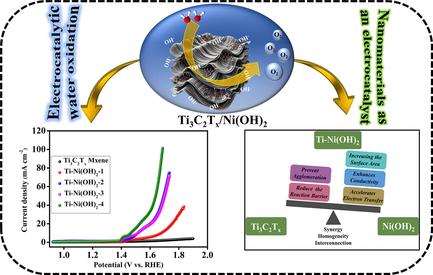
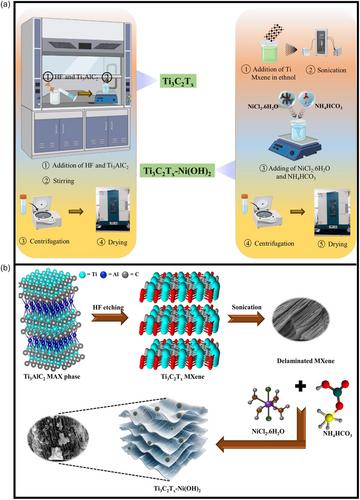
Herein, the strategy of homogenous inclusion of nanoparticles within the surface and interlayers of 2D MXenes is established to achieve effective oxygen evolution reaction (OER) performance. A greater quantity of nano-sized Ni(OH)2 particles is uniformly anchored on multilayered accordion-like nanosheets of Ti3C2Tx. The strong interconnection of Ni(OH)2 on Ti3C2Tx promotes synergistic effects and improves electron transfer properties alongside the intrinsic OER activity. The Ti3C2Tx-Ni(OH)2-4 demonstrates remarkable OER activity by exhibiting a lower overpotential (235.54 mV at 10 mA cm−2) in alkaline conditions. Increased electrochemical active surface area (2.925 mF cm−2), lower charge transfer resistance, lowering the reaction barrier, and stabilizing/converting essential intermediates via the Ti3C2Tx-Ni(OH)2 electrocatalyst synergistically improve OER activity. The effective interaction between Ti3C2Tx and Ni(OH)2 in Ti3C2Tx-Ni(OH)2 improves stability during long-term operations. Moreover, a Ti3C2Tx-Ni(OH)2-4||Pt/C cell has 1.7V at 10 mA cm−1 . It can be deduced that the usage of Ni(OH)2 as an electrocatalyst together with Ti3C2Tx can provide noteworthy water-splitting properties.
期刊介绍:
ChemSusChem
Impact Factor (2016): 7.226
Scope:
Interdisciplinary journal
Focuses on research at the interface of chemistry and sustainability
Features the best research on sustainability and energy
Areas Covered:
Chemistry
Materials Science
Chemical Engineering
Biotechnology






 京公网安备 11010802042870号
京ICP备2023020795号-1
京公网安备 11010802042870号
京ICP备2023020795号-1

 分享
分享
 求助内容:
求助内容: 应助结果提醒方式:
 扫码关注我们
