Caitlyn Norman, Kristin Webling, Dārta Štālberga, Lisa Maas, Johannes Tveit, Huiling Liu, Shimpei Watanabe, Svante Vikingsson, Henrik Green
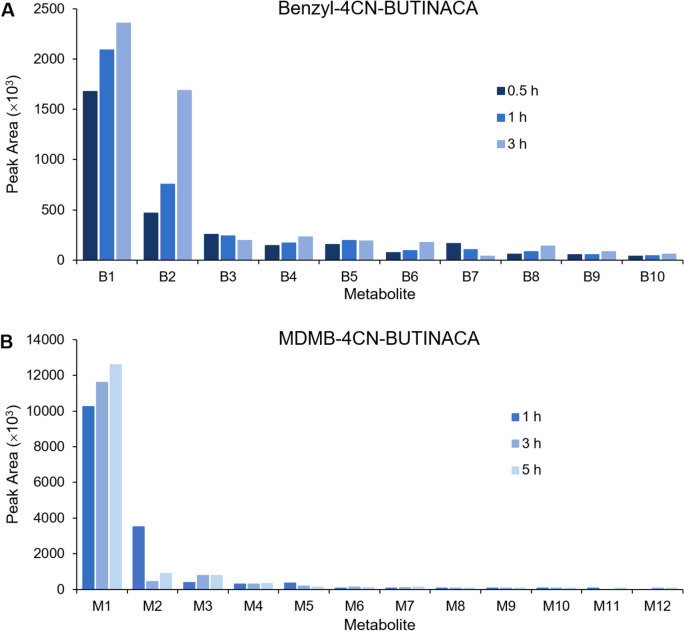
{"title":"In vitro metabolism of Benzyl-4CN-BUTINACA and MDMB-4CN-BUTINACA using human hepatocytes and LC-QToF-MS analysis","authors":"Caitlyn Norman, Kristin Webling, Dārta Štālberga, Lisa Maas, Johannes Tveit, Huiling Liu, Shimpei Watanabe, Svante Vikingsson, Henrik Green","doi":"10.1007/s00204-025-04018-y","DOIUrl":null,"url":null,"abstract":"<div><p>Synthetic cannabinoid receptor agonists (SCRAs) are a large and continuously evolving group of new psychoactive substances (NPS). Recently, many different nitrile-containing SCRAs have emerged on the illicit market, two of which have been found to release cyanide during metabolism. This can produce symptoms similar to those of cyanide poisoning, contributing to the toxicity of these SCRAs. Notified by the EU Early Warning System in 2020, Benzyl-4CN-BUTINACA (Benzyl-4CN-BINACA, BZ-4CN-BUTINACA) is the most recent nitrile-containing SCRA to emerge. This study characterized the metabolism of Benzyl-4CN-BUTINACA and the prophetic compound MDMB-4CN-BUTINACA for the first time using ultra-high performance liquid chromatography coupled with quadrupole time-of-flight mass spectrometry (UHPLC-QToF-MS) following incubation with primary human hepatocytes (HHeps; 5 µmol/L, up to 5 h). For Benzyl-4CN-BUTINACA, nine metabolites (no phase II metabolites) were identified and 12 for MDMB-4CN-BUTINACA, including only two minor phase II metabolites. By far the most abundant metabolites for Benzyl-4CN-BUTINACA were metabolites with a dihydrodiol on the indazole core (B1) and decyanation to a carboxylic acid (B2). The metabolites with ester hydrolysis (M1) and ester hydrolysis with dehydrogenation (M2) were the most abundant for MDMB-4CN-BUTINACA. Decyanation was less prevalent for these compounds than for other nitrile-containing SCRAs, such as Cumyl-4CN-BUTINACA, with only 29.0% and 1.78% of metabolites of Benzyl-4CN-BUTINACA and MDMB-4CN-BUTINACA, respectively, having a loss of cyanide. However, the second major metabolite of Benzyl-4CN-BUTINACA was a decyanation metabolite, making the potential CN formation not negligible.</p></div>","PeriodicalId":8329,"journal":{"name":"Archives of Toxicology","volume":"99 6","pages":"2355 - 2366"},"PeriodicalIF":6.9000,"publicationDate":"2025-03-18","publicationTypes":"Journal Article","fieldsOfStudy":null,"isOpenAccess":false,"openAccessPdf":"https://www.ncbi.nlm.nih.gov/pmc/articles/PMC12185655/pdf/","citationCount":"0","resultStr":null,"platform":"Semanticscholar","paperid":null,"PeriodicalName":"Archives of Toxicology","FirstCategoryId":"3","ListUrlMain":"https://link.springer.com/article/10.1007/s00204-025-04018-y","RegionNum":2,"RegionCategory":"医学","ArticlePicture":[],"TitleCN":null,"AbstractTextCN":null,"PMCID":null,"EPubDate":"","PubModel":"","JCR":"Q1","JCRName":"TOXICOLOGY","Score":null,"Total":0}
引用次数: 0
Abstract
Synthetic cannabinoid receptor agonists (SCRAs) are a large and continuously evolving group of new psychoactive substances (NPS). Recently, many different nitrile-containing SCRAs have emerged on the illicit market, two of which have been found to release cyanide during metabolism. This can produce symptoms similar to those of cyanide poisoning, contributing to the toxicity of these SCRAs. Notified by the EU Early Warning System in 2020, Benzyl-4CN-BUTINACA (Benzyl-4CN-BINACA, BZ-4CN-BUTINACA) is the most recent nitrile-containing SCRA to emerge. This study characterized the metabolism of Benzyl-4CN-BUTINACA and the prophetic compound MDMB-4CN-BUTINACA for the first time using ultra-high performance liquid chromatography coupled with quadrupole time-of-flight mass spectrometry (UHPLC-QToF-MS) following incubation with primary human hepatocytes (HHeps; 5 µmol/L, up to 5 h). For Benzyl-4CN-BUTINACA, nine metabolites (no phase II metabolites) were identified and 12 for MDMB-4CN-BUTINACA, including only two minor phase II metabolites. By far the most abundant metabolites for Benzyl-4CN-BUTINACA were metabolites with a dihydrodiol on the indazole core (B1) and decyanation to a carboxylic acid (B2). The metabolites with ester hydrolysis (M1) and ester hydrolysis with dehydrogenation (M2) were the most abundant for MDMB-4CN-BUTINACA. Decyanation was less prevalent for these compounds than for other nitrile-containing SCRAs, such as Cumyl-4CN-BUTINACA, with only 29.0% and 1.78% of metabolites of Benzyl-4CN-BUTINACA and MDMB-4CN-BUTINACA, respectively, having a loss of cyanide. However, the second major metabolite of Benzyl-4CN-BUTINACA was a decyanation metabolite, making the potential CN formation not negligible.
期刊介绍:
Archives of Toxicology provides up-to-date information on the latest advances in toxicology. The journal places particular emphasis on studies relating to defined effects of chemicals and mechanisms of toxicity, including toxic activities at the molecular level, in humans and experimental animals. Coverage includes new insights into analysis and toxicokinetics and into forensic toxicology. Review articles of general interest to toxicologists are an additional important feature of the journal.





 京公网安备 11010802042870号
京ICP备2023020795号-1
京公网安备 11010802042870号
京ICP备2023020795号-1

 分享
分享
 求助内容:
求助内容: 应助结果提醒方式:
 扫码关注我们
