{"title":"Sensilla on Organs of Adults of the Pistachio-Seed Wasp Eurytoma plotnikovi (Hymenoptera: Eurytomidae)","authors":"Zhi Tan, Yunlan Zhang, Xiaohui Jiang, Guowei Zhang, Wei Huo, Zehai Hou","doi":"10.1002/jemt.24851","DOIUrl":null,"url":null,"abstract":"<div>\n \n <p>The pistachio-seed wasp, <i>Eurytoma plotnikovi</i> Nikol'skaya, is a major pest of the biomass energy tree <i>Pistacia chinensis</i>. Understanding its sensory system is vital for uncovering host location mechanisms, but information on its olfactory system is limited. This study investigated the morphology of sensilla on the bodies of female and male <i>E. plotnikovi</i>. We identified seven types of sensilla on their antennae: sensilla trichodea I (ST I), sensilla trichodea II (ST II), sensilla trichodea III (ST III), sensilla chaetica (SC), sensilla placodea, multiporous grooved peg sensilla, and finger-like sensilla. Most types of sensilla on male antennae are significantly longer than those on females. Sensilla basiconica I (SB I) was located among the ommatidia of the compound eyes, with males having longer SB I than females. The maxillary and labial palps contained SC and ST II, with males exhibiting longer ST II and SC in maxillary palps, while male labial palps had longer ST II but shorter SC than females. The forelegs had antennae cleaners, which were longer in males. Female forelegs had sensilla basiconica (SB II) and sensilla trichodea (ST IV), while males had ST I and lacked SB II. The abdomen of <i>E. plotnikovi</i> is elliptic and petal-like, with coeloconic sensilla symmetrically distributed. Females had ST II and ST III around the ovipositor, while males had ST I and ST II near the copulatory organ. Identifying the sensilla in <i>E. plotnikovi</i> enhances our comprehension of its sensory capabilities and host plant-seeking behavior.</p>\n </div>","PeriodicalId":18684,"journal":{"name":"Microscopy Research and Technique","volume":"88 8","pages":"2210-2221"},"PeriodicalIF":2.1000,"publicationDate":"2025-03-17","publicationTypes":"Journal Article","fieldsOfStudy":null,"isOpenAccess":false,"openAccessPdf":"","citationCount":"0","resultStr":null,"platform":"Semanticscholar","paperid":null,"PeriodicalName":"Microscopy Research and Technique","FirstCategoryId":"5","ListUrlMain":"https://analyticalsciencejournals.onlinelibrary.wiley.com/doi/10.1002/jemt.24851","RegionNum":3,"RegionCategory":"工程技术","ArticlePicture":[],"TitleCN":null,"AbstractTextCN":null,"PMCID":null,"EPubDate":"","PubModel":"","JCR":"Q2","JCRName":"ANATOMY & MORPHOLOGY","Score":null,"Total":0}
引用次数: 0
Abstract
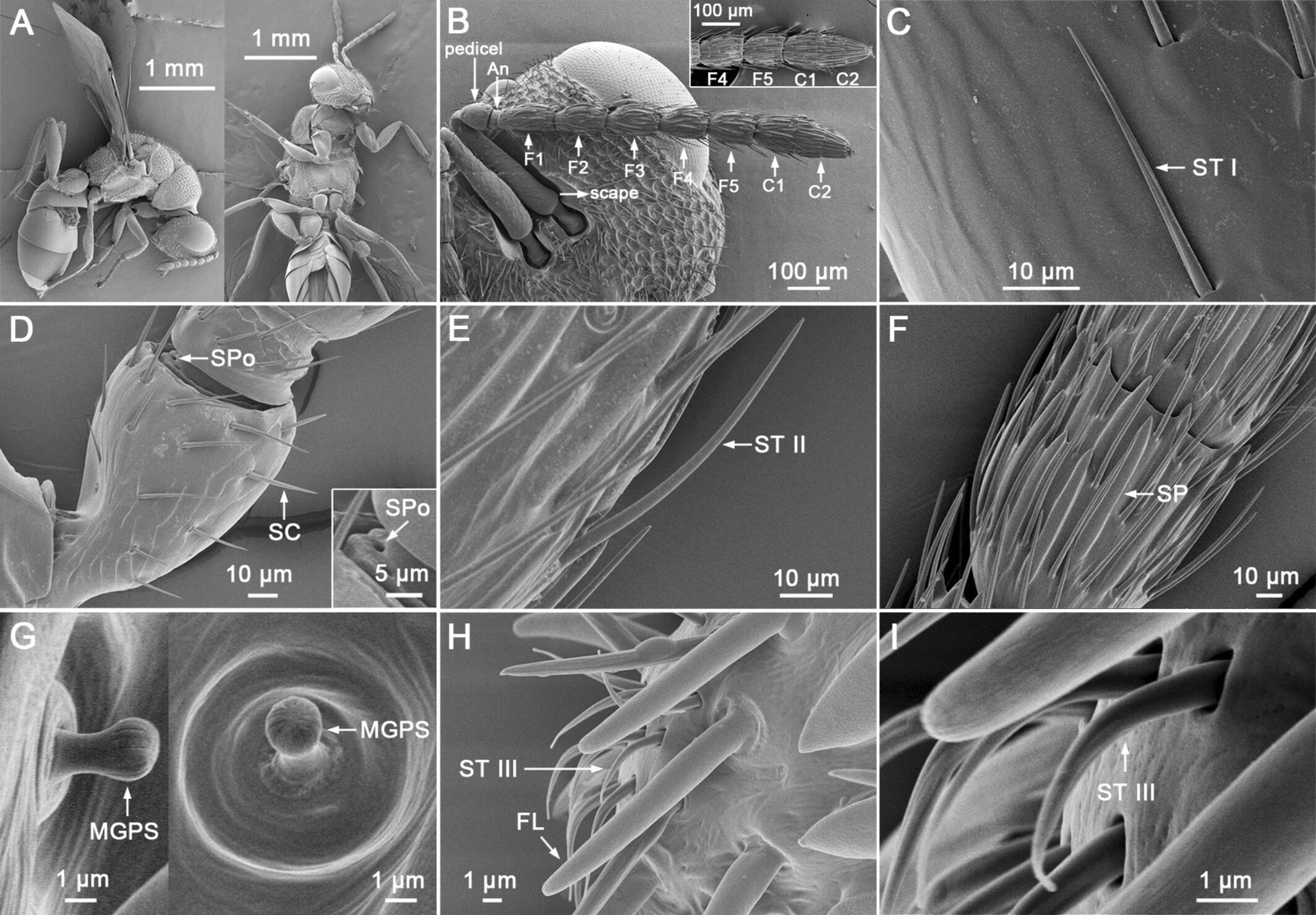
The pistachio-seed wasp, Eurytoma plotnikovi Nikol'skaya, is a major pest of the biomass energy tree Pistacia chinensis. Understanding its sensory system is vital for uncovering host location mechanisms, but information on its olfactory system is limited. This study investigated the morphology of sensilla on the bodies of female and male E. plotnikovi. We identified seven types of sensilla on their antennae: sensilla trichodea I (ST I), sensilla trichodea II (ST II), sensilla trichodea III (ST III), sensilla chaetica (SC), sensilla placodea, multiporous grooved peg sensilla, and finger-like sensilla. Most types of sensilla on male antennae are significantly longer than those on females. Sensilla basiconica I (SB I) was located among the ommatidia of the compound eyes, with males having longer SB I than females. The maxillary and labial palps contained SC and ST II, with males exhibiting longer ST II and SC in maxillary palps, while male labial palps had longer ST II but shorter SC than females. The forelegs had antennae cleaners, which were longer in males. Female forelegs had sensilla basiconica (SB II) and sensilla trichodea (ST IV), while males had ST I and lacked SB II. The abdomen of E. plotnikovi is elliptic and petal-like, with coeloconic sensilla symmetrically distributed. Females had ST II and ST III around the ovipositor, while males had ST I and ST II near the copulatory organ. Identifying the sensilla in E. plotnikovi enhances our comprehension of its sensory capabilities and host plant-seeking behavior.
期刊介绍:
Microscopy Research and Technique (MRT) publishes articles on all aspects of advanced microscopy original architecture and methodologies with applications in the biological, clinical, chemical, and materials sciences. Original basic and applied research as well as technical papers dealing with the various subsets of microscopy are encouraged. MRT is the right form for those developing new microscopy methods or using the microscope to answer key questions in basic and applied research.






 京公网安备 11010802042870号
京ICP备2023020795号-1
京公网安备 11010802042870号
京ICP备2023020795号-1

 分享
分享
 求助内容:
求助内容: 应助结果提醒方式:
 扫码关注我们
