{"title":"Mathematical modelling of the vitamin C clock reaction: a study of two kinetic regimes.","authors":"A A Alsaleh, D J Smith, S Jabbari","doi":"10.1098/rsos.241340","DOIUrl":null,"url":null,"abstract":"<p><p>Chemically reacting systems exhibiting a repeatable delay period before a visible and sudden change are referred to as <i>clock reactions</i>; they have a long history in education and provide an idealization of various biochemical and industrial processes. We focus on a purely substrate-depletive clock reaction utilizing vitamin C, hydrogen peroxide, iodine and starch. Building on a recent study of a simplified two-reaction model under high hydrogen peroxide concentrations, we develop a more detailed model which breaks the slow reaction into two steps, one of which is rate-limiting unless hydrogen peroxide levels are very high. Through asymptotic analysis, this model enables the effect of hydrogen peroxide concentration to be elucidated in a principled way, resolving an apparent discrepancy with earlier literature regarding the order of the slow reaction kinetics. The model is analysed in moderate and high hydrogen peroxide regimes, providing approximate solutions and expressions for the switchover time which take into account hydrogen peroxide concentration. The solutions are validated through simultaneously fitting the same set of parameters to several experimental series, then testing on independent experiments across widely varying hydrogen peroxide concentration. The study thereby presents and further develops a validated mechanistic understanding of a paradigm chemical kinetics system.</p>","PeriodicalId":21525,"journal":{"name":"Royal Society Open Science","volume":"12 3","pages":"241340"},"PeriodicalIF":2.9000,"publicationDate":"2025-03-17","publicationTypes":"Journal Article","fieldsOfStudy":null,"isOpenAccess":false,"openAccessPdf":"https://www.ncbi.nlm.nih.gov/pmc/articles/PMC11913052/pdf/","citationCount":"0","resultStr":null,"platform":"Semanticscholar","paperid":null,"PeriodicalName":"Royal Society Open Science","FirstCategoryId":"103","ListUrlMain":"https://doi.org/10.1098/rsos.241340","RegionNum":3,"RegionCategory":"综合性期刊","ArticlePicture":[],"TitleCN":null,"AbstractTextCN":null,"PMCID":null,"EPubDate":"2025/3/1 0:00:00","PubModel":"eCollection","JCR":"Q1","JCRName":"MULTIDISCIPLINARY SCIENCES","Score":null,"Total":0}
引用次数: 0
Abstract
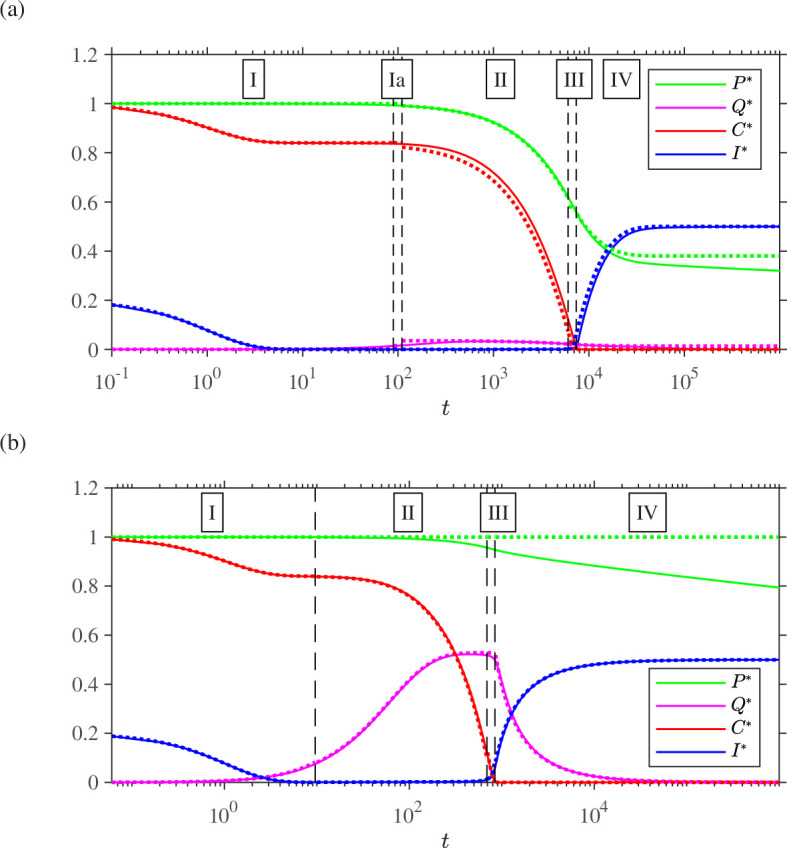
Chemically reacting systems exhibiting a repeatable delay period before a visible and sudden change are referred to as clock reactions; they have a long history in education and provide an idealization of various biochemical and industrial processes. We focus on a purely substrate-depletive clock reaction utilizing vitamin C, hydrogen peroxide, iodine and starch. Building on a recent study of a simplified two-reaction model under high hydrogen peroxide concentrations, we develop a more detailed model which breaks the slow reaction into two steps, one of which is rate-limiting unless hydrogen peroxide levels are very high. Through asymptotic analysis, this model enables the effect of hydrogen peroxide concentration to be elucidated in a principled way, resolving an apparent discrepancy with earlier literature regarding the order of the slow reaction kinetics. The model is analysed in moderate and high hydrogen peroxide regimes, providing approximate solutions and expressions for the switchover time which take into account hydrogen peroxide concentration. The solutions are validated through simultaneously fitting the same set of parameters to several experimental series, then testing on independent experiments across widely varying hydrogen peroxide concentration. The study thereby presents and further develops a validated mechanistic understanding of a paradigm chemical kinetics system.
期刊介绍:
Royal Society Open Science is a new open journal publishing high-quality original research across the entire range of science on the basis of objective peer-review.
The journal covers the entire range of science and mathematics and will allow the Society to publish all the high-quality work it receives without the usual restrictions on scope, length or impact.






 京公网安备 11010802042870号
京ICP备2023020795号-1
京公网安备 11010802042870号
京ICP备2023020795号-1

 分享
分享
 求助内容:
求助内容: 应助结果提醒方式:
 扫码关注我们
