Yoo-Jin Park, Won-Ki Pang, Do-Yeal Ryu, Md Saidur Rahman, Myung-Geol Pang
{"title":"Spatiotemporal translation of sperm acrosome associated proteins during early capacitation modulates sperm fertilizing ability","authors":"Yoo-Jin Park, Won-Ki Pang, Do-Yeal Ryu, Md Saidur Rahman, Myung-Geol Pang","doi":"10.1016/j.jare.2025.03.035","DOIUrl":null,"url":null,"abstract":"<div><h3>Introduction</h3><div>Despite the lack of essential cytoplasmic organelles in mature spermatozoa, which creates unfavorable conditions for transcription and translation, the presence of various mRNA and proteins during capacitation suggests potential for de novo protein synthesis.</div></div><div><h3>Objectives</h3><div>We applied a metabolic labeling method using a fluorescent noncanonical amino acid tagging system (FUNCAT) and proximity ligation method (PLA) in normal and reduced fertility spermatozoa to detect different translation phenomena during sperm capacitation according to their fertility.</div></div><div><h3>Methods</h3><div>We explored different proteome changes in spermatozoa according to the time-sequential capacitation process (0, 20, 40, 60, and 120 min) between normal [average fertility rate (FR) = 77.44 % ± 1.51] and reduced fertility (average FR = 58.57 % ± 1.64) spermatozoa bull spermatozoa, as the representative male fertility models owing to their broad spectrum of fertility phenotypes. Moreover, the FUNCAT/PLA method was used to detect and visualize different translation phenomena during sperm capacitation according to fertility.</div></div><div><h3>Results</h3><div>We found that sperm-associated protein (SPACA) 1 and SPACA5 were newly synthesized in the head of normal-fertility spermatozoa, whereas a lack of newly synthesized proteins in the head and a relatively earlier loss of SPACA1 and SPACA5 were observed in the reduced-fertility spermatozoa. Moreover, the mitochondrial translation inhibitor, chloramphenicol, partially inhibited sperm translation and delayed translocation, suggesting that mitochondria participate in sperm translation.</div></div><div><h3>Conclusion</h3><div>Our results unveil time-sequential microenvironmental changes in sperm proteomes during capacitation, which lead to the orchestra of proteins that complete fertilization. Fertile spermatozoa are selected through inter-competition during the journey of fertilization in the female reproductive tract. This study provides an overview of how translation dynamics acts on the sperm selection and influence the evolution of sperm fertility.</div></div>","PeriodicalId":14952,"journal":{"name":"Journal of Advanced Research","volume":"79 ","pages":"Pages 313-329"},"PeriodicalIF":13.0000,"publicationDate":"2026-01-01","publicationTypes":"Journal Article","fieldsOfStudy":null,"isOpenAccess":false,"openAccessPdf":"","citationCount":"0","resultStr":null,"platform":"Semanticscholar","paperid":null,"PeriodicalName":"Journal of Advanced Research","FirstCategoryId":"103","ListUrlMain":"https://www.sciencedirect.com/science/article/pii/S209012322500195X","RegionNum":1,"RegionCategory":"综合性期刊","ArticlePicture":[],"TitleCN":null,"AbstractTextCN":null,"PMCID":null,"EPubDate":"2025/3/18 0:00:00","PubModel":"Epub","JCR":"Q1","JCRName":"MULTIDISCIPLINARY SCIENCES","Score":null,"Total":0}
引用次数: 0
Abstract
Introduction
Despite the lack of essential cytoplasmic organelles in mature spermatozoa, which creates unfavorable conditions for transcription and translation, the presence of various mRNA and proteins during capacitation suggests potential for de novo protein synthesis.
Objectives
We applied a metabolic labeling method using a fluorescent noncanonical amino acid tagging system (FUNCAT) and proximity ligation method (PLA) in normal and reduced fertility spermatozoa to detect different translation phenomena during sperm capacitation according to their fertility.
Methods
We explored different proteome changes in spermatozoa according to the time-sequential capacitation process (0, 20, 40, 60, and 120 min) between normal [average fertility rate (FR) = 77.44 % ± 1.51] and reduced fertility (average FR = 58.57 % ± 1.64) spermatozoa bull spermatozoa, as the representative male fertility models owing to their broad spectrum of fertility phenotypes. Moreover, the FUNCAT/PLA method was used to detect and visualize different translation phenomena during sperm capacitation according to fertility.
Results
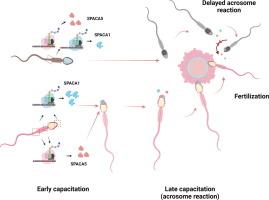
We found that sperm-associated protein (SPACA) 1 and SPACA5 were newly synthesized in the head of normal-fertility spermatozoa, whereas a lack of newly synthesized proteins in the head and a relatively earlier loss of SPACA1 and SPACA5 were observed in the reduced-fertility spermatozoa. Moreover, the mitochondrial translation inhibitor, chloramphenicol, partially inhibited sperm translation and delayed translocation, suggesting that mitochondria participate in sperm translation.
Conclusion
Our results unveil time-sequential microenvironmental changes in sperm proteomes during capacitation, which lead to the orchestra of proteins that complete fertilization. Fertile spermatozoa are selected through inter-competition during the journey of fertilization in the female reproductive tract. This study provides an overview of how translation dynamics acts on the sperm selection and influence the evolution of sperm fertility.
期刊介绍:
Journal of Advanced Research (J. Adv. Res.) is an applied/natural sciences, peer-reviewed journal that focuses on interdisciplinary research. The journal aims to contribute to applied research and knowledge worldwide through the publication of original and high-quality research articles in the fields of Medicine, Pharmaceutical Sciences, Dentistry, Physical Therapy, Veterinary Medicine, and Basic and Biological Sciences.
The following abstracting and indexing services cover the Journal of Advanced Research: PubMed/Medline, Essential Science Indicators, Web of Science, Scopus, PubMed Central, PubMed, Science Citation Index Expanded, Directory of Open Access Journals (DOAJ), and INSPEC.





 京公网安备 11010802042870号
京ICP备2023020795号-1
京公网安备 11010802042870号
京ICP备2023020795号-1

 分享
分享
 求助内容:
求助内容: 应助结果提醒方式:
 扫码关注我们
