Eugene Engmann, Pete Barnes, Eric J. Dufek, Abderrahman Atifi
{"title":"Non-destructive electrochemical diagnosis of failure mechanisms in aqueous zinc batteries","authors":"Eugene Engmann, Pete Barnes, Eric J. Dufek, Abderrahman Atifi","doi":"10.1016/j.ensm.2025.104190","DOIUrl":null,"url":null,"abstract":"<div><div>The early detection of secondary reactions that affect the life and performance of zinc manganese oxide batteries requires a shift from conventional time-consuming and often destructive procedures to rapid lifetime-predictive techniques. In this work, an electrochemical approach is employed to elucidate independent signatures for four common types of failure mechanisms in zinc manganese dioxide (Zn||MnO<sub>2</sub>) batteries—namely, the loss of zinc inventory, the loss of active material at the cathode, electrolyte depletion, and increased cell impedance. Our findings, specific to coin cell configurations, reveal that each induced failure mechanism can be distinctively modeled and identified based on responses from the rest voltage and columbic-efficiency data for prompt detection. For instance, electrolyte depletion response manifests a distinctive abrupt (>80 %) decrease in columbic efficiency (CE) and charge-rest voltage (V<sub>c</sub>) while the discharge-rest voltage remained constant at ∼1.3 V. Furthermore, electrolyte rejuvenation of the cell increased the CE to >95 % and restored V<sub>c</sub> from ∼0.3 to >1.7 V. Recovery experiments and reference performance tests demonstrated consistency between electrochemical descriptors and their associated failure mechanisms. The outcomes of this work provide valuable insights and data models for some of the dominant failure mechanisms present in zinc manganese battery chemistries, which are beneficial to accelerated early-lifetime diagnosis and advancement of Zn batteries development.</div></div>","PeriodicalId":306,"journal":{"name":"Energy Storage Materials","volume":"77 ","pages":"Article 104190"},"PeriodicalIF":20.2000,"publicationDate":"2025-04-01","publicationTypes":"Journal Article","fieldsOfStudy":null,"isOpenAccess":false,"openAccessPdf":"","citationCount":"0","resultStr":null,"platform":"Semanticscholar","paperid":null,"PeriodicalName":"Energy Storage Materials","FirstCategoryId":"88","ListUrlMain":"https://www.sciencedirect.com/science/article/pii/S2405829725001904","RegionNum":1,"RegionCategory":"材料科学","ArticlePicture":[],"TitleCN":null,"AbstractTextCN":null,"PMCID":null,"EPubDate":"2025/3/18 0:00:00","PubModel":"Epub","JCR":"Q1","JCRName":"CHEMISTRY, PHYSICAL","Score":null,"Total":0}
引用次数: 0
Abstract
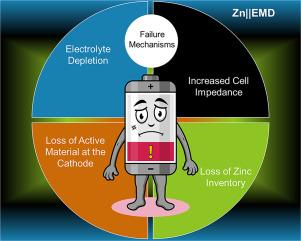
The early detection of secondary reactions that affect the life and performance of zinc manganese oxide batteries requires a shift from conventional time-consuming and often destructive procedures to rapid lifetime-predictive techniques. In this work, an electrochemical approach is employed to elucidate independent signatures for four common types of failure mechanisms in zinc manganese dioxide (Zn||MnO2) batteries—namely, the loss of zinc inventory, the loss of active material at the cathode, electrolyte depletion, and increased cell impedance. Our findings, specific to coin cell configurations, reveal that each induced failure mechanism can be distinctively modeled and identified based on responses from the rest voltage and columbic-efficiency data for prompt detection. For instance, electrolyte depletion response manifests a distinctive abrupt (>80 %) decrease in columbic efficiency (CE) and charge-rest voltage (Vc) while the discharge-rest voltage remained constant at ∼1.3 V. Furthermore, electrolyte rejuvenation of the cell increased the CE to >95 % and restored Vc from ∼0.3 to >1.7 V. Recovery experiments and reference performance tests demonstrated consistency between electrochemical descriptors and their associated failure mechanisms. The outcomes of this work provide valuable insights and data models for some of the dominant failure mechanisms present in zinc manganese battery chemistries, which are beneficial to accelerated early-lifetime diagnosis and advancement of Zn batteries development.
期刊介绍:
Energy Storage Materials is a global interdisciplinary journal dedicated to sharing scientific and technological advancements in materials and devices for advanced energy storage and related energy conversion, such as in metal-O2 batteries. The journal features comprehensive research articles, including full papers and short communications, as well as authoritative feature articles and reviews by leading experts in the field.
Energy Storage Materials covers a wide range of topics, including the synthesis, fabrication, structure, properties, performance, and technological applications of energy storage materials. Additionally, the journal explores strategies, policies, and developments in the field of energy storage materials and devices for sustainable energy.
Published papers are selected based on their scientific and technological significance, their ability to provide valuable new knowledge, and their relevance to the international research community.





 京公网安备 11010802042870号
京ICP备2023020795号-1
京公网安备 11010802042870号
京ICP备2023020795号-1

 分享
分享
 求助内容:
求助内容: 应助结果提醒方式:
 扫码关注我们
