{"title":"Hepcidin knockout exacerbates hindlimb unloading-induced bone loss in mice through inhibiting osteoblastic differentiation.","authors":"Xin Chen, Jianping Wang, Chenxiao Zhen, Gejing Zhang, Zhouqi Yang, Youjia Xu, Peng Shang","doi":"10.1186/s12891-025-08515-0","DOIUrl":null,"url":null,"abstract":"<p><strong>Background: </strong>An oligopeptide hepcidin is encoded by the human HAMP gene (Hamp in mice). Its deficiency can result in iron overload, while excess may lead to iron deficiency. Hepcidin knockout mice exhibited iron accumulation in multiple tissues, accompanied by degeneration of bone microarchitecture and reduced biomechanical properties. Astronauts who are exposed to weightlessness during prolonged spaceflight experience bone loss. After space missions, an interrelation exists between iron stores and bone mineral density (BMD). Bone loss in mice due to unloading is linked to iron excess and involves hepcidin. The potential role of hepcidin in unloading-induced bone loss remains unclear.</p><p><strong>Methods: </strong>Our study conducted relevant experiments using hepcidin knockout mice and their primary osteoblasts as the research subjects. We used the hindlimb unloading (HLU) model and the random positioning machine (RPM) system to simulate weightlessness in vivo and in vitro.</p><p><strong>Results: </strong>HLU mice exhibited reduced hepcidin levels in the serum and liver. Hepcidin knockout further diminished BMD and bone mineral content (BMC) in the femurs of HLU mice. Similarly, the bone volume fraction (BV/TV) and connectivity density (Conn.Dn) followed this downward trend, whereas trabecular separation (Tb.Sp) showed an inverse pattern. Moreover, hepcidin knockout decreased the ultimate load and elastic modulus in the tibias of HLU mice. Hepcidin knockout decreased PINP levels in the serum, a commonly used marker for bone formation, alongside elevated iron levels in the serum, liver, and bone of HLU mice. We also found higher serum MDA and SOD levels in these mice. In vitro, experimental data indicated that hepcidin knockout suppresses the osteoblastic differentiation capacity under RPM conditions. Additionally, this condition upregulates SOST protein levels and downregulates LRP6 and β-catenin protein levels in osteoblasts.</p><p><strong>Conclusion: </strong>Hepcidin knockout exacerbates bone loss in HLU mice, most likely due to reduced osteoblastic activity.</p>","PeriodicalId":9189,"journal":{"name":"BMC Musculoskeletal Disorders","volume":"26 1","pages":"276"},"PeriodicalIF":2.4000,"publicationDate":"2025-03-18","publicationTypes":"Journal Article","fieldsOfStudy":null,"isOpenAccess":false,"openAccessPdf":"https://www.ncbi.nlm.nih.gov/pmc/articles/PMC11917043/pdf/","citationCount":"0","resultStr":null,"platform":"Semanticscholar","paperid":null,"PeriodicalName":"BMC Musculoskeletal Disorders","FirstCategoryId":"3","ListUrlMain":"https://doi.org/10.1186/s12891-025-08515-0","RegionNum":3,"RegionCategory":"医学","ArticlePicture":[],"TitleCN":null,"AbstractTextCN":null,"PMCID":null,"EPubDate":"","PubModel":"","JCR":"Q2","JCRName":"ORTHOPEDICS","Score":null,"Total":0}
引用次数: 0
Abstract
Background: An oligopeptide hepcidin is encoded by the human HAMP gene (Hamp in mice). Its deficiency can result in iron overload, while excess may lead to iron deficiency. Hepcidin knockout mice exhibited iron accumulation in multiple tissues, accompanied by degeneration of bone microarchitecture and reduced biomechanical properties. Astronauts who are exposed to weightlessness during prolonged spaceflight experience bone loss. After space missions, an interrelation exists between iron stores and bone mineral density (BMD). Bone loss in mice due to unloading is linked to iron excess and involves hepcidin. The potential role of hepcidin in unloading-induced bone loss remains unclear.
Methods: Our study conducted relevant experiments using hepcidin knockout mice and their primary osteoblasts as the research subjects. We used the hindlimb unloading (HLU) model and the random positioning machine (RPM) system to simulate weightlessness in vivo and in vitro.
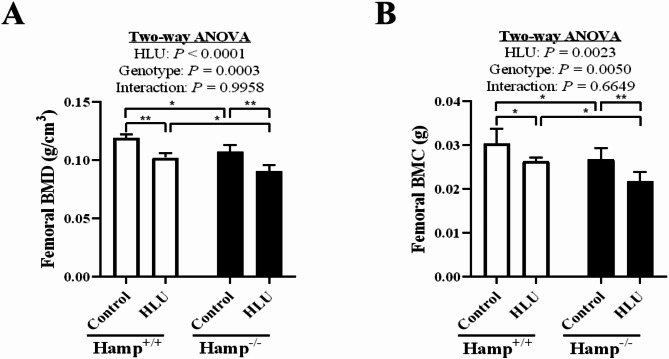
Results: HLU mice exhibited reduced hepcidin levels in the serum and liver. Hepcidin knockout further diminished BMD and bone mineral content (BMC) in the femurs of HLU mice. Similarly, the bone volume fraction (BV/TV) and connectivity density (Conn.Dn) followed this downward trend, whereas trabecular separation (Tb.Sp) showed an inverse pattern. Moreover, hepcidin knockout decreased the ultimate load and elastic modulus in the tibias of HLU mice. Hepcidin knockout decreased PINP levels in the serum, a commonly used marker for bone formation, alongside elevated iron levels in the serum, liver, and bone of HLU mice. We also found higher serum MDA and SOD levels in these mice. In vitro, experimental data indicated that hepcidin knockout suppresses the osteoblastic differentiation capacity under RPM conditions. Additionally, this condition upregulates SOST protein levels and downregulates LRP6 and β-catenin protein levels in osteoblasts.
Conclusion: Hepcidin knockout exacerbates bone loss in HLU mice, most likely due to reduced osteoblastic activity.
期刊介绍:
BMC Musculoskeletal Disorders is an open access, peer-reviewed journal that considers articles on all aspects of the prevention, diagnosis and management of musculoskeletal disorders, as well as related molecular genetics, pathophysiology, and epidemiology.
The scope of the Journal covers research into rheumatic diseases where the primary focus relates specifically to a component(s) of the musculoskeletal system.





 京公网安备 11010802042870号
京ICP备2023020795号-1
京公网安备 11010802042870号
京ICP备2023020795号-1

 分享
分享
 求助内容:
求助内容: 应助结果提醒方式:
 扫码关注我们
