Virgilius Martin Kelake Kedang, Indri Permatasari, Thanicha Chanchaidechachai, Chaidate Inchaisri
{"title":"Spatial-temporal distribution and risk factors of foot and mouth disease outbreaks in Java Island, Indonesia from 2022 to 2023.","authors":"Virgilius Martin Kelake Kedang, Indri Permatasari, Thanicha Chanchaidechachai, Chaidate Inchaisri","doi":"10.1186/s12917-025-04621-2","DOIUrl":null,"url":null,"abstract":"<p><strong>Background: </strong>Indonesia faced new outbreaks of foot and mouth disease in 2022 after being officially free from the disease for several decades. The outbreaks were first reported in East Java in April 2022 and subsequently spread to many regions in Indonesia. This study investigated the epidemiology and risk factors of foot and mouth disease outbreaks in Java, Indonesia, from 2022 to 2023. Descriptive, spatial, spatiotemporal, and risk factor analyses were conducted to investigate the patterns and risk factors associated with the outbreaks in Java.</p><p><strong>Results: </strong>Results showed that the outbreaks were distributed across the island. East Java was the most affected region. The outbreaks peaked in June 2022, followed by a downward trend until 2023. Positive spatial autocorrelations were found in both years, indicating that the outbreaks clustered in several areas. The spatiotemporal analysis found a total of 16 clusters in both years, with 11 clusters in 2022 and 5 clusters in 2023. The temporal distribution of clusters indicated a peak period from May to July, with 12 out of 16 clusters occurring during this time. Risk factor analysis found that environmental and agricultural-related factors, including annual precipitation, the presence of livestock markets, the presence of slaughterhouses, the presence of animal health centres, cattle population, and goat population, are significant risk factors for the occurrence of outbreaks in Java. Probability risk mapping found higher risk areas primarily distributed in the eastern and central parts of Java.</p><p><strong>Conclusions: </strong>The outbreaks predominantly clustered in eastern and central parts of Java. The outbreaks peaked in June 2022, followed by a downward trend until the end of 2023. Environmental and agricultural-related factors significantly increased the risk of outbreak occurrence.</p>","PeriodicalId":9041,"journal":{"name":"BMC Veterinary Research","volume":"21 1","pages":"180"},"PeriodicalIF":2.6000,"publicationDate":"2025-03-18","publicationTypes":"Journal Article","fieldsOfStudy":null,"isOpenAccess":false,"openAccessPdf":"https://www.ncbi.nlm.nih.gov/pmc/articles/PMC11916208/pdf/","citationCount":"0","resultStr":null,"platform":"Semanticscholar","paperid":null,"PeriodicalName":"BMC Veterinary Research","FirstCategoryId":"97","ListUrlMain":"https://doi.org/10.1186/s12917-025-04621-2","RegionNum":2,"RegionCategory":"农林科学","ArticlePicture":[],"TitleCN":null,"AbstractTextCN":null,"PMCID":null,"EPubDate":"","PubModel":"","JCR":"Q1","JCRName":"VETERINARY SCIENCES","Score":null,"Total":0}
引用次数: 0
Abstract
Background: Indonesia faced new outbreaks of foot and mouth disease in 2022 after being officially free from the disease for several decades. The outbreaks were first reported in East Java in April 2022 and subsequently spread to many regions in Indonesia. This study investigated the epidemiology and risk factors of foot and mouth disease outbreaks in Java, Indonesia, from 2022 to 2023. Descriptive, spatial, spatiotemporal, and risk factor analyses were conducted to investigate the patterns and risk factors associated with the outbreaks in Java.
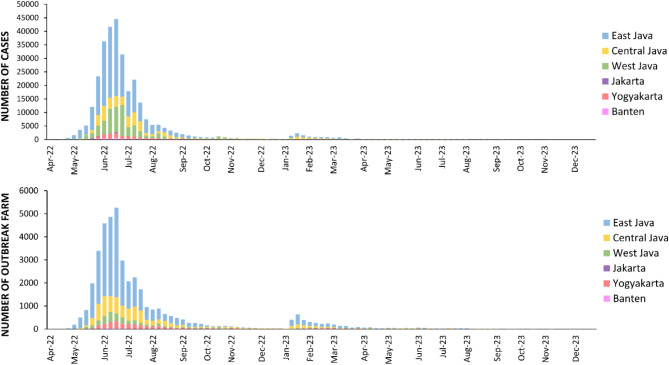
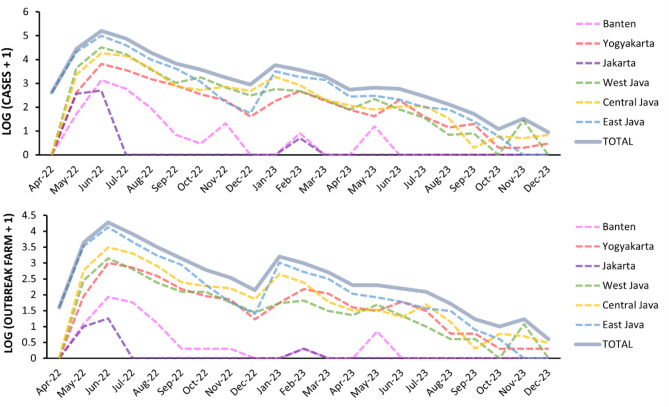
Results: Results showed that the outbreaks were distributed across the island. East Java was the most affected region. The outbreaks peaked in June 2022, followed by a downward trend until 2023. Positive spatial autocorrelations were found in both years, indicating that the outbreaks clustered in several areas. The spatiotemporal analysis found a total of 16 clusters in both years, with 11 clusters in 2022 and 5 clusters in 2023. The temporal distribution of clusters indicated a peak period from May to July, with 12 out of 16 clusters occurring during this time. Risk factor analysis found that environmental and agricultural-related factors, including annual precipitation, the presence of livestock markets, the presence of slaughterhouses, the presence of animal health centres, cattle population, and goat population, are significant risk factors for the occurrence of outbreaks in Java. Probability risk mapping found higher risk areas primarily distributed in the eastern and central parts of Java.
Conclusions: The outbreaks predominantly clustered in eastern and central parts of Java. The outbreaks peaked in June 2022, followed by a downward trend until the end of 2023. Environmental and agricultural-related factors significantly increased the risk of outbreak occurrence.
期刊介绍:
BMC Veterinary Research is an open access, peer-reviewed journal that considers articles on all aspects of veterinary science and medicine, including the epidemiology, diagnosis, prevention and treatment of medical conditions of domestic, companion, farm and wild animals, as well as the biomedical processes that underlie their health.






 京公网安备 11010802042870号
京ICP备2023020795号-1
京公网安备 11010802042870号
京ICP备2023020795号-1

 分享
分享
 求助内容:
求助内容: 应助结果提醒方式:
 扫码关注我们
