Due to the tight curvature in their design, ring applicators are usually associated with large positioning errors. The standard practice to correct for these deviations based on global offsets may not be sufficient to comply with the recommended tolerance. In this work, we investigate two methods for applicator reconstruction that implement position-dependent source offset corrections.
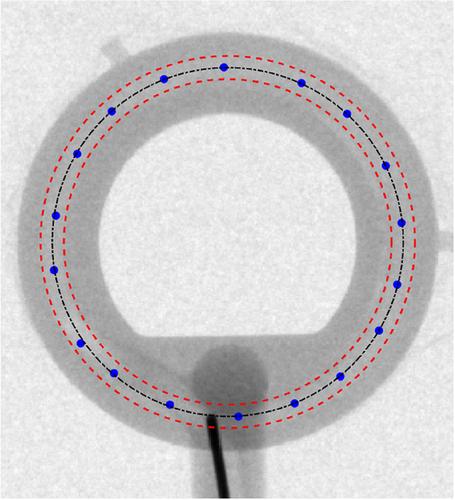
Measurements were performed using the Varian Interstitial PEEK Ring 60° and a Varian BRAVOS afterloader. Source positioning was characterized by means of autoradiographs acquired for three different loading patterns and three 192Ir sources over a period of 5 months. Additionally, the actual source path was determined by means of a series of planar kV images for different dummy cable positions. The first position-dependent correction method consists of locally modifying the radius of the reconstructed source path according to the measured offsets. The second method, recommended by Varian, simulates a bidirectional movement of the source during applicator reconstruction to compensate for positioning errors.
Autoradiographs showed a quasi-linear increase of the dwell position offsets, with a negligible error at the tip and a value close to 3 mm at the end of the ring. This result, consistent with a circular wire movement with an effective radius 0.5 mm larger than the nominal value, was in agreement with the observations from the kV images. After implementation of the position-dependent correction methods, residual positioning errors for the two methods resulted in a mean value (±1 SD) of 0.0 (±0.3) mm, and a range of [−0.7 mm, 0.7 mm].
The two tested methods for applicator reconstruction with position-dependent source offset corrections were able to successfully correct the positioning errors. The method recommended by the manufacturer had the additional advantages of a more straightforward implementation and the potential for use in other applicator types.






 京公网安备 11010802042870号
京ICP备2023020795号-1
京公网安备 11010802042870号
京ICP备2023020795号-1

 分享
分享

 求助内容:
求助内容: 应助结果提醒方式:
 扫码关注我们
