Seraina L C Müller, Pablo Pfister, Nadia Menzi, Laurent Muller, Holger J Klein, Riccardo Schweizer, Z-Hye Lee, Branislav Kollar, Steffen U Eisenhardt, Dirk J Schaefer, Tarek Ismail
{"title":"Artificial Intelligence in Facial Palsy Treatment: A Systematic Review and Recommendations.","authors":"Seraina L C Müller, Pablo Pfister, Nadia Menzi, Laurent Muller, Holger J Klein, Riccardo Schweizer, Z-Hye Lee, Branislav Kollar, Steffen U Eisenhardt, Dirk J Schaefer, Tarek Ismail","doi":"10.1097/PRS.0000000000012105","DOIUrl":null,"url":null,"abstract":"<p><strong>Background: </strong>Artificial intelligence (AI) is rapidly advancing and increasingly applied in facial palsy research. However, there is no comprehensive review to guide surgeons on AI-based facial assessment tools. Although photographic standards exist, videographic standards for emotions have not been proposed. Implementing these standards is essential for improving information exchange and data comparison with the new AI tools.</p><p><strong>Methods: </strong>The authors conducted a systematic review following the Preferred Reporting Items for Systematic Reviews and Meta-Analyses guidelines, by analyzing databases including MEDLINE, Embase, and the Cochrane Central Register of Controlled Trials. The authors' focus was on the use of AI-based facial assessment tools in patients with facial palsy who subsequently received intervention or surgery for their facial palsy. Data were evaluated descriptively, and recommendations, including videographic standards, were developed in collaboration with experts from multiple centers.</p><p><strong>Results: </strong>The authors identified 3222 articles, 35 of which met the inclusion criteria. Five AI applications analyzed static, dynamic, and chemodenervation procedures in unilateral or bilateral facial palsy. These focused on specific facial landmarks or emotion recognition from photographs and videos, but varied in the expressions and emotions analyzed. Five studies provided validation data with either healthy subjects or other outcome measurements. The authors recommend a minimum videographic assessment including the validated emotions neutral and happy.</p><p><strong>Conclusions: </strong>AI-related publications on facial palsy have significantly increased, but no consensus exists on the optimal AI-assessment software. The proposed flowchart from the authors' systematic review can guide clinicians in decision-making. The authors recommend using the proposed videographic emotions to improve study consistency and comparability, and also encouraging further validation studies.</p>","PeriodicalId":20128,"journal":{"name":"Plastic and reconstructive surgery","volume":" ","pages":"477-490"},"PeriodicalIF":3.4000,"publicationDate":"2025-09-01","publicationTypes":"Journal Article","fieldsOfStudy":null,"isOpenAccess":false,"openAccessPdf":"https://www.ncbi.nlm.nih.gov/pmc/articles/PMC12376819/pdf/","citationCount":"0","resultStr":null,"platform":"Semanticscholar","paperid":null,"PeriodicalName":"Plastic and reconstructive surgery","FirstCategoryId":"3","ListUrlMain":"https://doi.org/10.1097/PRS.0000000000012105","RegionNum":2,"RegionCategory":"医学","ArticlePicture":[],"TitleCN":null,"AbstractTextCN":null,"PMCID":null,"EPubDate":"2025/3/18 0:00:00","PubModel":"Epub","JCR":"Q1","JCRName":"SURGERY","Score":null,"Total":0}
引用次数: 0
Abstract
Background: Artificial intelligence (AI) is rapidly advancing and increasingly applied in facial palsy research. However, there is no comprehensive review to guide surgeons on AI-based facial assessment tools. Although photographic standards exist, videographic standards for emotions have not been proposed. Implementing these standards is essential for improving information exchange and data comparison with the new AI tools.
Methods: The authors conducted a systematic review following the Preferred Reporting Items for Systematic Reviews and Meta-Analyses guidelines, by analyzing databases including MEDLINE, Embase, and the Cochrane Central Register of Controlled Trials. The authors' focus was on the use of AI-based facial assessment tools in patients with facial palsy who subsequently received intervention or surgery for their facial palsy. Data were evaluated descriptively, and recommendations, including videographic standards, were developed in collaboration with experts from multiple centers.
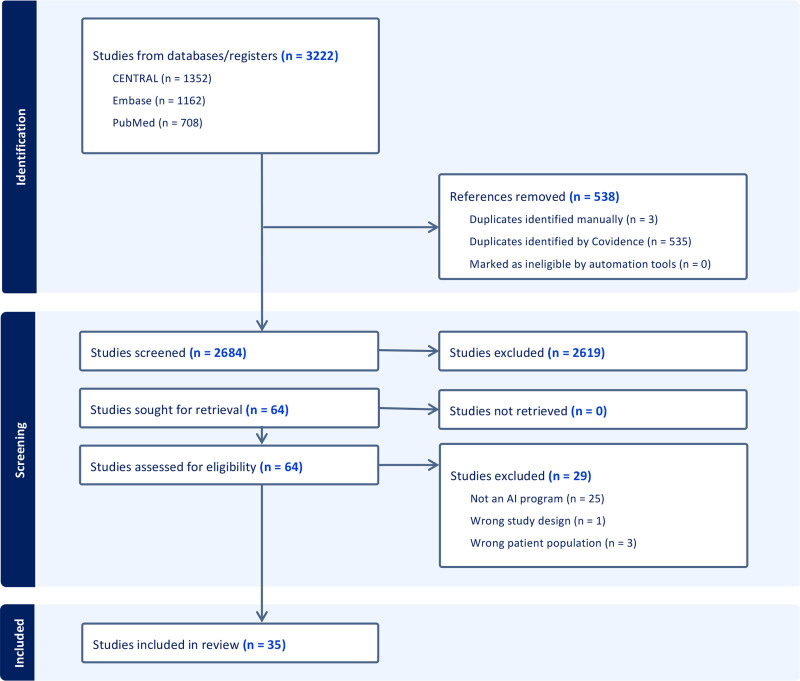
Results: The authors identified 3222 articles, 35 of which met the inclusion criteria. Five AI applications analyzed static, dynamic, and chemodenervation procedures in unilateral or bilateral facial palsy. These focused on specific facial landmarks or emotion recognition from photographs and videos, but varied in the expressions and emotions analyzed. Five studies provided validation data with either healthy subjects or other outcome measurements. The authors recommend a minimum videographic assessment including the validated emotions neutral and happy.
Conclusions: AI-related publications on facial palsy have significantly increased, but no consensus exists on the optimal AI-assessment software. The proposed flowchart from the authors' systematic review can guide clinicians in decision-making. The authors recommend using the proposed videographic emotions to improve study consistency and comparability, and also encouraging further validation studies.
背景:人工智能(AI)在面瘫研究中的应用越来越广泛。然而,目前还没有全面的综述来指导外科医生使用基于人工智能的面部评估工具。虽然存在摄影标准,但还没有提出情感的录像标准。实施这些标准对于改善与新的人工智能工具的信息交换和数据比较至关重要。方法:我们通过分析Medline、Embase和Cochrane Central Register of Controlled Trials等数据库,按照PRISMA指南进行了系统评价。我们的重点是在面瘫患者中使用基于人工智能的面部评估工具,这些患者随后接受了面瘫的干预或手术。对数据进行了描述性评估,并与来自多个中心的专家合作制定了包括录像标准在内的建议。结果:共纳入3222篇文献,其中35篇符合纳入标准。五个人工智能应用分析了单侧或双侧面瘫的静态、动态和化学神经支配手术。这些研究侧重于从照片和视频中识别特定的面部特征或情绪,但分析的表情和情绪各不相同。五项研究提供了健康受试者或其他结果测量的验证数据。我们建议进行最低限度的视频评估,包括经过验证的情绪中性和快乐。结论:人工智能相关的面瘫出版物明显增多,但对最佳的人工智能评估软件尚未达成共识。从我们的系统综述中提出的流程图可以指导临床医生做出决策。我们建议使用拟议的视频情绪来提高研究的一致性和可比性,同时也鼓励进一步的验证研究。
期刊介绍:
For more than 70 years Plastic and Reconstructive Surgery® has been the one consistently excellent reference for every specialist who uses plastic surgery techniques or works in conjunction with a plastic surgeon. Plastic and Reconstructive Surgery® , the official journal of the American Society of Plastic Surgeons, is a benefit of Society membership, and is also available on a subscription basis.
Plastic and Reconstructive Surgery® brings subscribers up-to-the-minute reports on the latest techniques and follow-up for all areas of plastic and reconstructive surgery, including breast reconstruction, experimental studies, maxillofacial reconstruction, hand and microsurgery, burn repair, cosmetic surgery, as well as news on medicolegal issues. The cosmetic section provides expanded coverage on new procedures and techniques and offers more cosmetic-specific content than any other journal. All subscribers enjoy full access to the Journal''s website, which features broadcast quality videos of reconstructive and cosmetic procedures, podcasts, comprehensive article archives dating to 1946, and additional benefits offered by the newly-redesigned website.





 京公网安备 11010802042870号
京ICP备2023020795号-1
京公网安备 11010802042870号
京ICP备2023020795号-1

 分享
分享
 求助内容:
求助内容: 应助结果提醒方式:
 扫码关注我们
