Xiaoqian Fu , Yujie Chen , Jun Ding , Cigdem Ozsoy-Keskinbora , Guang Yang , Yan Fang , Eun Soo Park , Ze Zhang , Robert O. Ritchie , En Ma , Qian Yu
{"title":"Ridge-twin boundaries as prolific dislocation sources in low stacking-fault energy metals and alloys","authors":"Xiaoqian Fu , Yujie Chen , Jun Ding , Cigdem Ozsoy-Keskinbora , Guang Yang , Yan Fang , Eun Soo Park , Ze Zhang , Robert O. Ritchie , En Ma , Qian Yu","doi":"10.1016/j.actamat.2025.120957","DOIUrl":null,"url":null,"abstract":"<div><div>Dislocation activities are crucial in facilitating plastic deformation, even in low stacking-fault energy (SFE) materials that are prone to deformation twinning. The high initial strain-hardening rate commonly observed in low-SFE materials is believed to originate from dislocation slip, as twinning typically occurs at large plastic strains. However, twin boundaries account for a significant proportion of the total boundaries in these materials, and it remains unclear whether twin boundaries can effectively nucleate dislocations. Combining multi-scale and <em>in situ</em> electron microscope characterizations, here we report the discovery of a novel type of prolific dislocation sources, which are nano-sized ridges residing along the borders between different twin variants in low-SFE materials. These sources act as dislocation generators that promote dislocation interaction and accumulation, spreading plastic strain and leading to robust strain hardening at the early stage of plastic deformation. Molecular dynamic simulations indicate that the formation of nano-sized ridge-twin structures is energetically favorable at the junctions between multiple twins, explaining why such structures are ubiquitous in low-SFE materials. Decreasing the SFE can significantly increase the population of ridge-twin boundaries, facilitating dislocation emission and hence strain hardening to sustain the stability of plastic flow. These findings provide new insights into the origin of dislocation plasticity and the high early-stage strain hardening rate in low-SFE materials.</div></div>","PeriodicalId":238,"journal":{"name":"Acta Materialia","volume":"290 ","pages":"Article 120957"},"PeriodicalIF":9.3000,"publicationDate":"2025-03-20","publicationTypes":"Journal Article","fieldsOfStudy":null,"isOpenAccess":false,"openAccessPdf":"","citationCount":"0","resultStr":null,"platform":"Semanticscholar","paperid":null,"PeriodicalName":"Acta Materialia","FirstCategoryId":"88","ListUrlMain":"https://www.sciencedirect.com/science/article/pii/S1359645425002484","RegionNum":1,"RegionCategory":"材料科学","ArticlePicture":[],"TitleCN":null,"AbstractTextCN":null,"PMCID":null,"EPubDate":"","PubModel":"","JCR":"Q1","JCRName":"MATERIALS SCIENCE, MULTIDISCIPLINARY","Score":null,"Total":0}
引用次数: 0
Abstract
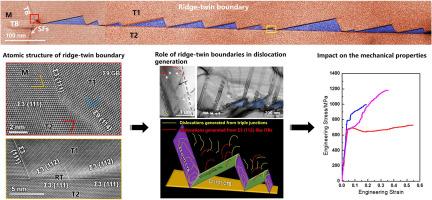
Dislocation activities are crucial in facilitating plastic deformation, even in low stacking-fault energy (SFE) materials that are prone to deformation twinning. The high initial strain-hardening rate commonly observed in low-SFE materials is believed to originate from dislocation slip, as twinning typically occurs at large plastic strains. However, twin boundaries account for a significant proportion of the total boundaries in these materials, and it remains unclear whether twin boundaries can effectively nucleate dislocations. Combining multi-scale and in situ electron microscope characterizations, here we report the discovery of a novel type of prolific dislocation sources, which are nano-sized ridges residing along the borders between different twin variants in low-SFE materials. These sources act as dislocation generators that promote dislocation interaction and accumulation, spreading plastic strain and leading to robust strain hardening at the early stage of plastic deformation. Molecular dynamic simulations indicate that the formation of nano-sized ridge-twin structures is energetically favorable at the junctions between multiple twins, explaining why such structures are ubiquitous in low-SFE materials. Decreasing the SFE can significantly increase the population of ridge-twin boundaries, facilitating dislocation emission and hence strain hardening to sustain the stability of plastic flow. These findings provide new insights into the origin of dislocation plasticity and the high early-stage strain hardening rate in low-SFE materials.
期刊介绍:
Acta Materialia serves as a platform for publishing full-length, original papers and commissioned overviews that contribute to a profound understanding of the correlation between the processing, structure, and properties of inorganic materials. The journal seeks papers with high impact potential or those that significantly propel the field forward. The scope includes the atomic and molecular arrangements, chemical and electronic structures, and microstructure of materials, focusing on their mechanical or functional behavior across all length scales, including nanostructures.




 京公网安备 11010802042870号
京ICP备2023020795号-1
京公网安备 11010802042870号
京ICP备2023020795号-1

 分享
分享
 求助内容:
求助内容: 应助结果提醒方式:
 扫码关注我们
