{"title":"Synchronous vanadium bio-reduction/detoxification/recovery and nitrogen attenuation in a membrane aerated biofilm reactor","authors":"Zhiye Sun , Baoan Li , Jun Liu","doi":"10.1016/j.envpol.2025.126095","DOIUrl":null,"url":null,"abstract":"<div><div>The presence of both pentavalent vanadium [V(Ⅴ)] and nitrogen in wastewaters from vanadium smelting poses significant environmental challenges. However, it remains little in the way of continuous flow biological reactor to concurrently eliminated V(Ⅴ) and nitrogen in wastewaters. Herein, membrane-aerated biofilm reactor (MABR) system was designed to achieve simultaneous nitrification and denitrification (SND) alongside biological reduction, detoxification, and recovery of vanadium. Vanadium and nitrogen removal performances, solid-state characterization, microbial compositions and functional genes, and the mechanism related to the metabolism of vanadium and nitrogen were illuminated. Notably, we identified a potential role for biofilm-derived “secretion” in the transformation of V(Ⅴ) and nitrogen. Our findings revealed that the system achieved SND efficiency of 98.00 ± 0.57 % and removed 91.10 ± 3.60 % of total vanadium (TV) even at high influent V(Ⅴ) concentrations in continuous flow stage. Batch experiments implied that the conversion of NH<sub>4</sub><sup>+</sup>-N was the limiting process of nitrogen removal in MABR system, and the extracellular polymeric substances (EPS) might play an important role in the conversion of V(Ⅴ) and nitrogen. V(Ⅴ) was reduced to V(Ⅳ), which was immobilized to biofilm and “secretion” by microbial surface functional groups, including C-O, O-C=O and -OH. <em>Acinetobacter</em>, <em>Dechlorobacter</em>, <em>Denitratisoma</em> and <em>Nitrospira</em> were verified as microbes associated with V(Ⅴ) and nitrogen metabolism. The abundance of functional genes pertaining to electron donor, electron transport, and electron acceptor systems increased under high V(V) stimulation. Collectively, the cooperation of biofilm and “secretion” ensured the intensive removal of vanadium and nitrogen. This study provides new insights into the concurrent removal of heavy metal and environmental nutrient.</div></div>","PeriodicalId":311,"journal":{"name":"Environmental Pollution","volume":"372 ","pages":"Article 126095"},"PeriodicalIF":7.3000,"publicationDate":"2025-05-01","publicationTypes":"Journal Article","fieldsOfStudy":null,"isOpenAccess":false,"openAccessPdf":"","citationCount":"0","resultStr":null,"platform":"Semanticscholar","paperid":null,"PeriodicalName":"Environmental Pollution","FirstCategoryId":"93","ListUrlMain":"https://www.sciencedirect.com/science/article/pii/S0269749125004683","RegionNum":2,"RegionCategory":"环境科学与生态学","ArticlePicture":[],"TitleCN":null,"AbstractTextCN":null,"PMCID":null,"EPubDate":"2025/3/19 0:00:00","PubModel":"Epub","JCR":"Q1","JCRName":"ENVIRONMENTAL SCIENCES","Score":null,"Total":0}
引用次数: 0
Abstract
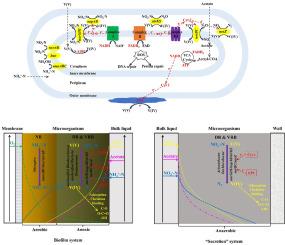
The presence of both pentavalent vanadium [V(Ⅴ)] and nitrogen in wastewaters from vanadium smelting poses significant environmental challenges. However, it remains little in the way of continuous flow biological reactor to concurrently eliminated V(Ⅴ) and nitrogen in wastewaters. Herein, membrane-aerated biofilm reactor (MABR) system was designed to achieve simultaneous nitrification and denitrification (SND) alongside biological reduction, detoxification, and recovery of vanadium. Vanadium and nitrogen removal performances, solid-state characterization, microbial compositions and functional genes, and the mechanism related to the metabolism of vanadium and nitrogen were illuminated. Notably, we identified a potential role for biofilm-derived “secretion” in the transformation of V(Ⅴ) and nitrogen. Our findings revealed that the system achieved SND efficiency of 98.00 ± 0.57 % and removed 91.10 ± 3.60 % of total vanadium (TV) even at high influent V(Ⅴ) concentrations in continuous flow stage. Batch experiments implied that the conversion of NH4+-N was the limiting process of nitrogen removal in MABR system, and the extracellular polymeric substances (EPS) might play an important role in the conversion of V(Ⅴ) and nitrogen. V(Ⅴ) was reduced to V(Ⅳ), which was immobilized to biofilm and “secretion” by microbial surface functional groups, including C-O, O-C=O and -OH. Acinetobacter, Dechlorobacter, Denitratisoma and Nitrospira were verified as microbes associated with V(Ⅴ) and nitrogen metabolism. The abundance of functional genes pertaining to electron donor, electron transport, and electron acceptor systems increased under high V(V) stimulation. Collectively, the cooperation of biofilm and “secretion” ensured the intensive removal of vanadium and nitrogen. This study provides new insights into the concurrent removal of heavy metal and environmental nutrient.
钒冶炼废水中五价钒[V(Ⅴ)]和氮的存在对环境构成了重大挑战。然而,连续流生物反应器同时去除废水中的V(Ⅴ)和氮的方法还很少。本文设计了曝气膜生物膜反应器(MABR)系统,以实现同时硝化和反硝化(SND)以及钒的生物还原、解毒和回收。阐述了其除钒、除氮性能、固态特性、微生物组成和功能基因以及与钒、氮代谢相关的机制。值得注意的是,我们发现了生物膜衍生的“分泌”在V(Ⅴ)和氮的转化中的潜在作用。结果表明,在高V(Ⅴ)浓度的连续流阶段,系统的SND效率为98.00±0.57%,总钒(TV)的去除率为91.10±3.60%。批量实验表明,NH4+-N的转化是MABR系统脱氮的限制过程,胞外聚合物质(EPS)可能在V(Ⅴ)和氮的转化中起重要作用。V(Ⅴ)还原为V(Ⅳ),由微生物表面官能团C-O、O- c =O和-OH固定在生物膜上“分泌”。不动杆菌、脱氯杆菌、脱硝菌和硝化螺旋菌被证实是与V(Ⅴ)和氮代谢相关的微生物。在高V(V)刺激下,与电子供体、电子传递和电子受体系统有关的功能基因的丰度增加。总的来说,生物膜和“分泌物”的合作保证了钒和氮的密集去除。该研究为重金属与环境养分的同步去除提供了新的见解。
期刊介绍:
Environmental Pollution is an international peer-reviewed journal that publishes high-quality research papers and review articles covering all aspects of environmental pollution and its impacts on ecosystems and human health.
Subject areas include, but are not limited to:
• Sources and occurrences of pollutants that are clearly defined and measured in environmental compartments, food and food-related items, and human bodies;
• Interlinks between contaminant exposure and biological, ecological, and human health effects, including those of climate change;
• Contaminants of emerging concerns (including but not limited to antibiotic resistant microorganisms or genes, microplastics/nanoplastics, electronic wastes, light, and noise) and/or their biological, ecological, or human health effects;
• Laboratory and field studies on the remediation/mitigation of environmental pollution via new techniques and with clear links to biological, ecological, or human health effects;
• Modeling of pollution processes, patterns, or trends that is of clear environmental and/or human health interest;
• New techniques that measure and examine environmental occurrences, transport, behavior, and effects of pollutants within the environment or the laboratory, provided that they can be clearly used to address problems within regional or global environmental compartments.




 京公网安备 11010802042870号
京ICP备2023020795号-1
京公网安备 11010802042870号
京ICP备2023020795号-1

 分享
分享
 求助内容:
求助内容: 应助结果提醒方式:
 扫码关注我们
