Huijuan Zhang , Yingmei Tian , Yan Ren , Yaning Wang , Chaoqun Wang , Lin Hou
{"title":"Shear force and cholesterol affinity responsive drug delivery system for treating inflammation and abnormal lipid metabolism in atherosclerosis","authors":"Huijuan Zhang , Yingmei Tian , Yan Ren , Yaning Wang , Chaoqun Wang , Lin Hou","doi":"10.1016/j.jconrel.2025.113633","DOIUrl":null,"url":null,"abstract":"<div><div>Inflammatory infiltration and lipid metabolism disorder are two main characteristics of atherosclerosis (AS) plaque microenvironment. They interact to form a malignant positive feedback cycle, which aggravates the development of AS disease. Therefore, simultaneous improvement of inflammation and lipid metabolism will provide a significant therapeutic effect on AS. To achieve this goal, we first prepared FCD (Fuc-TK-CD) by grafting β-cyclodextrin (β-CD) to fucoidan (Fuc) <em>via</em> reactive oxygen species (ROS)-responsive sulfhydryl disulfide bond (TK), then loaded resveratrol (Res) through the host-guest interaction. Finally, we coated it on the surface of SeNPs through Se<img>O bonds to obtain FCD-Se/Res nanoplatforms. FCD-Se/Res can actively recognize P-selectin and penetrate the AS plaque interior. Subsequently, FCD-Se/Res responded to the high shear force and abundant cholesterol in the plaque microenvironment to release Res, reducing AS plaque inflammation by reversing M1 macrophages to M2 phenotype. Meanwhile, TK bonds broke in response to high ROS levels in the plaque, making β-CD free to clear excessive pathogenic cholesterol from plaques. Benefiting from the integrated multifunctionality, FCD-Se/Res can break the vicious cycle between inflammation and disrupted lipid metabolism, jointly stabilize vulnerable plaques, and exert efficient anti-AS effects. The pharmacodynamic results revealed a significantly reduced plaque vulnerability index (VI) from 4.07 to 0.40 after FCD-Se/Res treatment.</div></div>","PeriodicalId":15450,"journal":{"name":"Journal of Controlled Release","volume":"381 ","pages":"Article 113633"},"PeriodicalIF":11.5000,"publicationDate":"2025-03-19","publicationTypes":"Journal Article","fieldsOfStudy":null,"isOpenAccess":false,"openAccessPdf":"","citationCount":"0","resultStr":null,"platform":"Semanticscholar","paperid":null,"PeriodicalName":"Journal of Controlled Release","FirstCategoryId":"3","ListUrlMain":"https://www.sciencedirect.com/science/article/pii/S0168365925002524","RegionNum":1,"RegionCategory":"医学","ArticlePicture":[],"TitleCN":null,"AbstractTextCN":null,"PMCID":null,"EPubDate":"","PubModel":"","JCR":"Q1","JCRName":"CHEMISTRY, MULTIDISCIPLINARY","Score":null,"Total":0}
引用次数: 0
Abstract
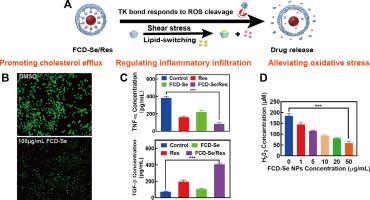
Inflammatory infiltration and lipid metabolism disorder are two main characteristics of atherosclerosis (AS) plaque microenvironment. They interact to form a malignant positive feedback cycle, which aggravates the development of AS disease. Therefore, simultaneous improvement of inflammation and lipid metabolism will provide a significant therapeutic effect on AS. To achieve this goal, we first prepared FCD (Fuc-TK-CD) by grafting β-cyclodextrin (β-CD) to fucoidan (Fuc) via reactive oxygen species (ROS)-responsive sulfhydryl disulfide bond (TK), then loaded resveratrol (Res) through the host-guest interaction. Finally, we coated it on the surface of SeNPs through SeO bonds to obtain FCD-Se/Res nanoplatforms. FCD-Se/Res can actively recognize P-selectin and penetrate the AS plaque interior. Subsequently, FCD-Se/Res responded to the high shear force and abundant cholesterol in the plaque microenvironment to release Res, reducing AS plaque inflammation by reversing M1 macrophages to M2 phenotype. Meanwhile, TK bonds broke in response to high ROS levels in the plaque, making β-CD free to clear excessive pathogenic cholesterol from plaques. Benefiting from the integrated multifunctionality, FCD-Se/Res can break the vicious cycle between inflammation and disrupted lipid metabolism, jointly stabilize vulnerable plaques, and exert efficient anti-AS effects. The pharmacodynamic results revealed a significantly reduced plaque vulnerability index (VI) from 4.07 to 0.40 after FCD-Se/Res treatment.
期刊介绍:
The Journal of Controlled Release (JCR) proudly serves as the Official Journal of the Controlled Release Society and the Japan Society of Drug Delivery System.
Dedicated to the broad field of delivery science and technology, JCR publishes high-quality research articles covering drug delivery systems and all facets of formulations. This includes the physicochemical and biological properties of drugs, design and characterization of dosage forms, release mechanisms, in vivo testing, and formulation research and development across pharmaceutical, diagnostic, agricultural, environmental, cosmetic, and food industries.
Priority is given to manuscripts that contribute to the fundamental understanding of principles or demonstrate the advantages of novel technologies in terms of safety and efficacy over current clinical standards. JCR strives to be a leading platform for advancements in delivery science and technology.




 京公网安备 11010802042870号
京ICP备2023020795号-1
京公网安备 11010802042870号
京ICP备2023020795号-1

 分享
分享
 求助内容:
求助内容: 应助结果提醒方式:
 扫码关注我们
