Zetian He , Daimei Chen , Shiqing Ma , Lingling Guo , Fengshan Zhou , Yilei Li
{"title":"Single-atom molybdenum modified ZnIn2S4 nanoflowers for improving photocatalytic hydrogen evolution performance","authors":"Zetian He , Daimei Chen , Shiqing Ma , Lingling Guo , Fengshan Zhou , Yilei Li","doi":"10.1016/j.apsusc.2025.163023","DOIUrl":null,"url":null,"abstract":"<div><div>The construction of efficient photocatalysts with abundant active sites can effectively address the energy challenge of hydrogen production through water photolysis. In this study, we report an efficient photocatalytic catalyst, consisting of single-atom Mo-modified ZnIn<sub>2</sub>S<sub>4</sub> nanoflowers, and propose a mechanism for photocatalytic hydrogen production. Using LA as sacrificial agent under the irradiation of Xe lamp (300W), the photocatalytic hydrogen production rate of the catalyst achieved 138.8 μmol‧h<sup>-1</sup> (per 20 mg of catalyst), which is 3.5 times higher than that of bulk ZnIn<sub>2</sub>S<sub>4</sub>. And the quantum efficiency of the catalyst reached 23.59 % at the wavelength of 350 nm, demonstrating good stability. The XANES, XPS, FTIR tests confirm that Mo is monoatomically dispersed in the form of Mo-O bonds. The uniformly dispersed single-atom Mo provides abundant active sites, while the formed Mo-O bonds facilitate electron transport and inhibit the recombination of electron-hole pairs, thereby enhancing the photocatalytic hydrogen production activity of ZnIn<sub>2</sub>S<sub>4</sub>. This work offers a novel approach for the development of single-atom catalytic materials.</div></div>","PeriodicalId":247,"journal":{"name":"Applied Surface Science","volume":"697 ","pages":"Article 163023"},"PeriodicalIF":6.9000,"publicationDate":"2025-07-15","publicationTypes":"Journal Article","fieldsOfStudy":null,"isOpenAccess":false,"openAccessPdf":"","citationCount":"0","resultStr":null,"platform":"Semanticscholar","paperid":null,"PeriodicalName":"Applied Surface Science","FirstCategoryId":"88","ListUrlMain":"https://www.sciencedirect.com/science/article/pii/S0169433225007378","RegionNum":2,"RegionCategory":"材料科学","ArticlePicture":[],"TitleCN":null,"AbstractTextCN":null,"PMCID":null,"EPubDate":"2025/3/20 0:00:00","PubModel":"Epub","JCR":"Q2","JCRName":"CHEMISTRY, PHYSICAL","Score":null,"Total":0}
引用次数: 0
Abstract
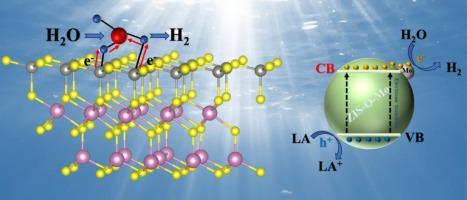
The construction of efficient photocatalysts with abundant active sites can effectively address the energy challenge of hydrogen production through water photolysis. In this study, we report an efficient photocatalytic catalyst, consisting of single-atom Mo-modified ZnIn2S4 nanoflowers, and propose a mechanism for photocatalytic hydrogen production. Using LA as sacrificial agent under the irradiation of Xe lamp (300W), the photocatalytic hydrogen production rate of the catalyst achieved 138.8 μmol‧h-1 (per 20 mg of catalyst), which is 3.5 times higher than that of bulk ZnIn2S4. And the quantum efficiency of the catalyst reached 23.59 % at the wavelength of 350 nm, demonstrating good stability. The XANES, XPS, FTIR tests confirm that Mo is monoatomically dispersed in the form of Mo-O bonds. The uniformly dispersed single-atom Mo provides abundant active sites, while the formed Mo-O bonds facilitate electron transport and inhibit the recombination of electron-hole pairs, thereby enhancing the photocatalytic hydrogen production activity of ZnIn2S4. This work offers a novel approach for the development of single-atom catalytic materials.
期刊介绍:
Applied Surface Science covers topics contributing to a better understanding of surfaces, interfaces, nanostructures and their applications. The journal is concerned with scientific research on the atomic and molecular level of material properties determined with specific surface analytical techniques and/or computational methods, as well as the processing of such structures.





 京公网安备 11010802042870号
京ICP备2023020795号-1
京公网安备 11010802042870号
京ICP备2023020795号-1

 分享
分享
 求助内容:
求助内容: 应助结果提醒方式:
 扫码关注我们
