Aerman Abudurezhake , Ran Tian , Jiawei Gong , Ganji Zhong , Zhongming Li , Qiang Fu , Xueqin Gao
{"title":"Enhancing thermal conductivity in polypropylene random copolymer through rotational shear processing","authors":"Aerman Abudurezhake , Ran Tian , Jiawei Gong , Ganji Zhong , Zhongming Li , Qiang Fu , Xueqin Gao","doi":"10.1016/j.polymer.2025.128304","DOIUrl":null,"url":null,"abstract":"<div><div>Intrinsic thermally conductive polymers are highly attractive for a wide range of applications due to their low cost, lightweight, and chemical resistance. Herein, we used a Rotational Shear System to regulate molecular chains of Polypropylene Random Copolymer (PPR) for enhancing thermal conductivity and mechanical strength. The SEM images showed the formation of a shish-kebab structure, indicative of highly ordered polymer chains, particularly at a rotational speed of 8 rpm. The sheared sample exhibited an in-plane thermal conductivity increase from 0.202 W/(mK) to 0.381 W/(mK), meanwhile the out-plane thermal conductivity also improved from 0.1731 W/(mK) to 0.206 W/(mK). This configuration led to a fast heat dissipation rate, and an elevation in Vicat softening temperature from 71.2 °C to 104.9 °C. Furthermore, an optimal tensile strength of 77.02 MPa was achieved, compared to 40.48 MPa for the unsheared sample. These enhancements in the thermal mechanical properties suggest that PPR produced via rotational shear has potential to be used for applications requiring effective thermal management, such as electronic components, heat exchangers, or automotive parts.</div></div>","PeriodicalId":405,"journal":{"name":"Polymer","volume":"325 ","pages":"Article 128304"},"PeriodicalIF":4.5000,"publicationDate":"2025-04-22","publicationTypes":"Journal Article","fieldsOfStudy":null,"isOpenAccess":false,"openAccessPdf":"","citationCount":"0","resultStr":null,"platform":"Semanticscholar","paperid":null,"PeriodicalName":"Polymer","FirstCategoryId":"92","ListUrlMain":"https://www.sciencedirect.com/science/article/pii/S0032386125002903","RegionNum":2,"RegionCategory":"化学","ArticlePicture":[],"TitleCN":null,"AbstractTextCN":null,"PMCID":null,"EPubDate":"2025/3/19 0:00:00","PubModel":"Epub","JCR":"Q2","JCRName":"POLYMER SCIENCE","Score":null,"Total":0}
引用次数: 0
Abstract
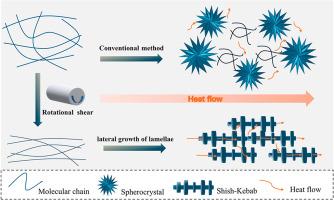
Intrinsic thermally conductive polymers are highly attractive for a wide range of applications due to their low cost, lightweight, and chemical resistance. Herein, we used a Rotational Shear System to regulate molecular chains of Polypropylene Random Copolymer (PPR) for enhancing thermal conductivity and mechanical strength. The SEM images showed the formation of a shish-kebab structure, indicative of highly ordered polymer chains, particularly at a rotational speed of 8 rpm. The sheared sample exhibited an in-plane thermal conductivity increase from 0.202 W/(mK) to 0.381 W/(mK), meanwhile the out-plane thermal conductivity also improved from 0.1731 W/(mK) to 0.206 W/(mK). This configuration led to a fast heat dissipation rate, and an elevation in Vicat softening temperature from 71.2 °C to 104.9 °C. Furthermore, an optimal tensile strength of 77.02 MPa was achieved, compared to 40.48 MPa for the unsheared sample. These enhancements in the thermal mechanical properties suggest that PPR produced via rotational shear has potential to be used for applications requiring effective thermal management, such as electronic components, heat exchangers, or automotive parts.
期刊介绍:
Polymer is an interdisciplinary journal dedicated to publishing innovative and significant advances in Polymer Physics, Chemistry and Technology. We welcome submissions on polymer hybrids, nanocomposites, characterisation and self-assembly. Polymer also publishes work on the technological application of polymers in energy and optoelectronics.
The main scope is covered but not limited to the following core areas:
Polymer Materials
Nanocomposites and hybrid nanomaterials
Polymer blends, films, fibres, networks and porous materials
Physical Characterization
Characterisation, modelling and simulation* of molecular and materials properties in bulk, solution, and thin films
Polymer Engineering
Advanced multiscale processing methods
Polymer Synthesis, Modification and Self-assembly
Including designer polymer architectures, mechanisms and kinetics, and supramolecular polymerization
Technological Applications
Polymers for energy generation and storage
Polymer membranes for separation technology
Polymers for opto- and microelectronics.





 京公网安备 11010802042870号
京ICP备2023020795号-1
京公网安备 11010802042870号
京ICP备2023020795号-1

 分享
分享
 求助内容:
求助内容: 应助结果提醒方式:
 扫码关注我们
