Jackson P. Knott, Shou-Jen Hsiang and Paul G. Hayes
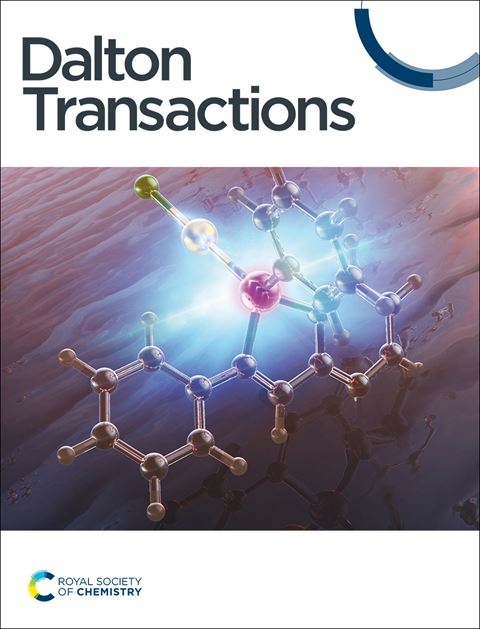
{"title":"Alkylamido lutetium complexes as prospective lutetium imido precursors: synthesis, characterization and ligand design†","authors":"Jackson P. Knott, Shou-Jen Hsiang and Paul G. Hayes","doi":"10.1039/D5DT00338E","DOIUrl":null,"url":null,"abstract":"<p >Mixed alkylamido lutetium complexes, L<small><sup>iPr</sup></small>Lu(CH<small><sub>2</sub></small>SiMe<small><sub>3</sub></small>)(NHCPh<small><sub>3</sub></small>) (<strong>7<small><sub>CPh3</sub></small></strong>) and L<small><sup>iPr</sup></small>Lu(CH<small><sub>2</sub></small>SiMe<small><sub>3</sub></small>)(NHDipp) (<strong>7<small><sub>Dipp</sub></small></strong>) (L<small><sup>iPr</sup></small> = 2,5-[<small><sup>i</sup></small>Pr<small><sub>2</sub></small>P = N(4-<small><sup>i</sup></small>PrC<small><sub>6</sub></small>H<small><sub>4</sub></small>)]<small><sub>2</sub></small>C<small><sub>4</sub></small>H<small><sub>2</sub></small>N<small><sup>−</sup></small>), were synthesized by addition of a bulky primary amine, NH<small><sub>2</sub></small>R (R = CPh<small><sub>3</sub></small>, Dipp) (Dipp = 2,6-<small><sup>i</sup></small>Pr<small><sub>2</sub></small>C<small><sub>6</sub></small>H<small><sub>3</sub></small>) to the dialkyl complex L<small><sup>iPr</sup></small>Lu(CH<small><sub>2</sub></small>SiMe<small><sub>3</sub></small>)<small><sub>2</sub></small> (<strong>6</strong>). Unlike complexes supported by the related pincer ligand L<small><sup>Ph</sup></small> (L<small><sup>Ph</sup></small> = 2,5-[Ph<small><sub>2</sub></small>P = N(4-<small><sup>i</sup></small>PrC<small><sub>6</sub></small>H<small><sub>4</sub></small>)]<small><sub>2</sub></small>C<small><sub>4</sub></small>H<small><sub>2</sub></small>N<small><sup>−</sup></small>) these species proved resistant to C–H cyclometalative processes. Attempts to access lutetium imdes <em>via</em> addition of 4-dimethylaminopyridine (DMAP) to <strong>7<small><sub>CPh3</sub></small></strong> and <strong>7<small><sub>Dipp</sub></small></strong> promoted disproportionation, affording 0.5 equivalents of the corresponding bisamide complexes L<small><sup>iPr</sup></small>Lu(NHCPh<small><sub>3</sub></small>)<small><sub>2</sub></small> (<strong>8<small><sub>CPh3</sub></small></strong>) and L<small><sup>iPr</sup></small>Lu(NHDipp)<small><sub>2</sub></small> (<strong>8<small><sub>Dipp</sub></small></strong>), respectively, as well as 0.5 equivalents of L<small><sup>iPr</sup></small>Lu(CH<small><sub>2</sub></small>SiMe<small><sub>3</sub></small>)<small><sub>2</sub></small>, which decomposed in the presence of DMAP. Incorporation of internal Lewis bases was accomplished by replacing the <em>N</em>-aryl substituents in L<small><sup>iPr</sup></small> with 4,6-dimethylpyrimidine groups (L<small><sup>Pm</sup></small>, <strong>11</strong>). The correspondng dialkyl lutetium complex L<small><sup>Pm</sup></small>Lu(CH<small><sub>2</sub></small>SiMe<small><sub>3</sub></small>)<small><sub>2</sub></small> (<strong>12</strong>) was prepared, from which loss of SiMe<small><sub>4</sub></small> occured over a period of hours in benzene-<em>d</em><small><sub>6</sub></small> solution.</p>","PeriodicalId":71,"journal":{"name":"Dalton Transactions","volume":" 15","pages":" 6261-6273"},"PeriodicalIF":3.3000,"publicationDate":"2025-03-20","publicationTypes":"Journal Article","fieldsOfStudy":null,"isOpenAccess":false,"openAccessPdf":"https://pubs.rsc.org/en/content/articlepdf/2025/dt/d5dt00338e?page=search","citationCount":"0","resultStr":null,"platform":"Semanticscholar","paperid":null,"PeriodicalName":"Dalton Transactions","FirstCategoryId":"92","ListUrlMain":"https://pubs.rsc.org/en/content/articlelanding/2025/dt/d5dt00338e","RegionNum":3,"RegionCategory":"化学","ArticlePicture":[],"TitleCN":null,"AbstractTextCN":null,"PMCID":null,"EPubDate":"","PubModel":"","JCR":"Q2","JCRName":"CHEMISTRY, INORGANIC & NUCLEAR","Score":null,"Total":0}
引用次数: 0
Abstract
Mixed alkylamido lutetium complexes, LiPrLu(CH2SiMe3)(NHCPh3) (7CPh3) and LiPrLu(CH2SiMe3)(NHDipp) (7Dipp) (LiPr = 2,5-[iPr2P = N(4-iPrC6H4)]2C4H2N−), were synthesized by addition of a bulky primary amine, NH2R (R = CPh3, Dipp) (Dipp = 2,6-iPr2C6H3) to the dialkyl complex LiPrLu(CH2SiMe3)2 (6). Unlike complexes supported by the related pincer ligand LPh (LPh = 2,5-[Ph2P = N(4-iPrC6H4)]2C4H2N−) these species proved resistant to C–H cyclometalative processes. Attempts to access lutetium imdes via addition of 4-dimethylaminopyridine (DMAP) to 7CPh3 and 7Dipp promoted disproportionation, affording 0.5 equivalents of the corresponding bisamide complexes LiPrLu(NHCPh3)2 (8CPh3) and LiPrLu(NHDipp)2 (8Dipp), respectively, as well as 0.5 equivalents of LiPrLu(CH2SiMe3)2, which decomposed in the presence of DMAP. Incorporation of internal Lewis bases was accomplished by replacing the N-aryl substituents in LiPr with 4,6-dimethylpyrimidine groups (LPm, 11). The correspondng dialkyl lutetium complex LPmLu(CH2SiMe3)2 (12) was prepared, from which loss of SiMe4 occured over a period of hours in benzene-d6 solution.
期刊介绍:
Dalton Transactions is a journal for all areas of inorganic chemistry, which encompasses the organometallic, bioinorganic and materials chemistry of the elements, with applications including synthesis, catalysis, energy conversion/storage, electrical devices and medicine. Dalton Transactions welcomes high-quality, original submissions in all of these areas and more, where the advancement of knowledge in inorganic chemistry is significant.




 京公网安备 11010802042870号
京ICP备2023020795号-1
京公网安备 11010802042870号
京ICP备2023020795号-1

 分享
分享
 求助内容:
求助内容: 应助结果提醒方式:
 扫码关注我们
