Hyocheol Lee, Rangaswamy Puttaswamy, Anh Le Mong and Dukjoon Kim
{"title":"An anti-freezing flexible polymer electrolyte for high-performance zinc-ion batteries†","authors":"Hyocheol Lee, Rangaswamy Puttaswamy, Anh Le Mong and Dukjoon Kim","doi":"10.1039/D4TA09111F","DOIUrl":null,"url":null,"abstract":"<p >Aqueous rechargeable zinc-ion batteries (ZIBs) encounter several challenges that hinder long-term performance and stability due to the water-induced side reactions, dendrite growth, and limited low-temperature operation, which are mostly associated with water freezing. In this study, the anti-freezing properties of a novel polymer electrolyte composed of a PAES-<em>g</em>-PEG and H<small><sub>2</sub></small>O/EG based eutectic solution are examined for ZIB application. The optimized polymer electrolyte (1.0 M Zn–eutectic–SPE) demonstrates excellent performance, achieving an ionic conductivity of 2.46 mS cm<small><sup>−1</sup></small> and a zinc transference number of 0.69 at room temperature (RT). Notably, it maintains a high ionic conductivity of 0.19 mS cm<small><sup>−1</sup></small> even at −20 °C. Moreover, the 1.0 M Zn–eutectic–SPE not only possesses a high tensile strength (4.18 MPa) with excellent flexibility, but also provides a high oxidative stability window (up to 2.5 V). Apart from its application as an electrolyte component, the synthesized PAES-<em>g</em>-PEG (without H<small><sub>2</sub></small>O/EG) is also utilized as a binder material for electrode preparation. The anti-freezing Zn|V<small><sub>10</sub></small>O<small><sub>24</sub></small>·<em>n</em>H<small><sub>2</sub></small>O@rGO battery fabricated with 1.0 M Zn–eutectic–SPE demonstrates exceptional electrochemical performance. At RT, it delivers high reversible capacities of 306.4 mA h g<small><sup>−1</sup></small> at 1.0 A g<small><sup>−1</sup></small> and 101.5 mA h g<small><sup>−1</sup></small> at 20 A g<small><sup>−1</sup></small>. Notably, even at −20 °C, the ZIB maintained impressive capacities of 277.7 mA h g<small><sup>−1</sup></small> at 0.05 A g<small><sup>−1</sup></small> and 63.2 mA h g<small><sup>−1</sup></small> at 2.0 A g<small><sup>−1</sup></small>. Remarkably, the Zn|V<small><sub>10</sub></small>O<small><sub>24</sub></small>·<em>n</em>H<small><sub>2</sub></small>O@rGO cells exhibit excellent cycling stability. After 300 cycles at a current density of 1.0 A g<small><sup>−1</sup></small>, they retain 87% of their initial capacity at RT and 91% at −20 °C. Furthermore, at RT, the Zn|V<small><sub>10</sub></small>O<small><sub>24</sub></small>·<em>n</em>H<small><sub>2</sub></small>O@rGO cell demonstrates outstanding long-term cycling performance, maintaining 83% capacity retention even at a high current density of 10 A g<small><sup>−1</sup></small>. These results confirm that the developed SPE enables stable ZIB operation over a wide temperature range, ensuring reliable performance in diverse environmental conditions.</p>","PeriodicalId":82,"journal":{"name":"Journal of Materials Chemistry A","volume":" 15","pages":" 10980-10990"},"PeriodicalIF":9.5000,"publicationDate":"2025-03-20","publicationTypes":"Journal Article","fieldsOfStudy":null,"isOpenAccess":false,"openAccessPdf":"","citationCount":"0","resultStr":null,"platform":"Semanticscholar","paperid":null,"PeriodicalName":"Journal of Materials Chemistry A","FirstCategoryId":"88","ListUrlMain":"https://pubs.rsc.org/en/content/articlelanding/2025/ta/d4ta09111f","RegionNum":2,"RegionCategory":"材料科学","ArticlePicture":[],"TitleCN":null,"AbstractTextCN":null,"PMCID":null,"EPubDate":"","PubModel":"","JCR":"Q1","JCRName":"CHEMISTRY, PHYSICAL","Score":null,"Total":0}
引用次数: 0
Abstract
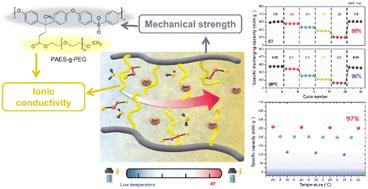
Aqueous rechargeable zinc-ion batteries (ZIBs) encounter several challenges that hinder long-term performance and stability due to the water-induced side reactions, dendrite growth, and limited low-temperature operation, which are mostly associated with water freezing. In this study, the anti-freezing properties of a novel polymer electrolyte composed of a PAES-g-PEG and H2O/EG based eutectic solution are examined for ZIB application. The optimized polymer electrolyte (1.0 M Zn–eutectic–SPE) demonstrates excellent performance, achieving an ionic conductivity of 2.46 mS cm−1 and a zinc transference number of 0.69 at room temperature (RT). Notably, it maintains a high ionic conductivity of 0.19 mS cm−1 even at −20 °C. Moreover, the 1.0 M Zn–eutectic–SPE not only possesses a high tensile strength (4.18 MPa) with excellent flexibility, but also provides a high oxidative stability window (up to 2.5 V). Apart from its application as an electrolyte component, the synthesized PAES-g-PEG (without H2O/EG) is also utilized as a binder material for electrode preparation. The anti-freezing Zn|V10O24·nH2O@rGO battery fabricated with 1.0 M Zn–eutectic–SPE demonstrates exceptional electrochemical performance. At RT, it delivers high reversible capacities of 306.4 mA h g−1 at 1.0 A g−1 and 101.5 mA h g−1 at 20 A g−1. Notably, even at −20 °C, the ZIB maintained impressive capacities of 277.7 mA h g−1 at 0.05 A g−1 and 63.2 mA h g−1 at 2.0 A g−1. Remarkably, the Zn|V10O24·nH2O@rGO cells exhibit excellent cycling stability. After 300 cycles at a current density of 1.0 A g−1, they retain 87% of their initial capacity at RT and 91% at −20 °C. Furthermore, at RT, the Zn|V10O24·nH2O@rGO cell demonstrates outstanding long-term cycling performance, maintaining 83% capacity retention even at a high current density of 10 A g−1. These results confirm that the developed SPE enables stable ZIB operation over a wide temperature range, ensuring reliable performance in diverse environmental conditions.
由于水引起的副反应、枝晶生长和有限的低温操作(主要与水冻结有关),水性可充电锌离子电池(zbs)面临着一些阻碍长期性能和稳定性的挑战。在这项研究中,研究了由PAES-g-PEG和H2O/EG基共晶溶液组成的新型聚合物电解质的抗冻性能,并将其应用于ZIB。优化后的聚合物电解质(1.0 M zn -共晶- spe)表现出优异的性能,室温下离子电导率为2.46 mS cm−1,锌转移数为0.69。值得注意的是,即使在- 20°C下,它也保持了0.19 mS cm−1的高离子电导率。此外,1.0 M zn -共晶- spe不仅具有高抗拉强度(4.18 MPa)和优异的柔韧性,而且具有高氧化稳定窗口(高达2.5 V)。合成的PAES-g-PEG(不含H2O/EG)除了作为电解质组分外,还可作为电极制备的粘结剂材料。采用1.0 M Zn -共晶- spe制备的防冻Zn|V10O24·nH2O@rGO电池具有优异的电化学性能。在RT下,它提供高可逆容量,在1.0 A g−1时为306.4 mA h g−1,在20 A g−1时为101.5 mA h g−1。值得注意的是,即使在- 20°C下,ZIB在0.05 A g−1和2.0 A g−1下的容量分别为277.7 mA h g−1和63.2 mA h g−1。值得注意的是,Zn|V10O24·nH2O@rGO电池具有良好的循环稳定性。在1.0 a g−1的电流密度下循环300次后,它们在室温下保持87%的初始容量,在−20°C下保持91%的初始容量。此外,在RT下,Zn|V10O24·nH2O@rGO电池表现出出色的长期循环性能,即使在10 a g−1的高电流密度下也能保持83%的容量保持率。这些结果证实,开发的SPE可以在很宽的温度范围内稳定地运行ZIB,确保在各种环境条件下的可靠性能。
期刊介绍:
The Journal of Materials Chemistry A, B & C covers a wide range of high-quality studies in the field of materials chemistry, with each section focusing on specific applications of the materials studied. Journal of Materials Chemistry A emphasizes applications in energy and sustainability, including topics such as artificial photosynthesis, batteries, and fuel cells. Journal of Materials Chemistry B focuses on applications in biology and medicine, while Journal of Materials Chemistry C covers applications in optical, magnetic, and electronic devices. Example topic areas within the scope of Journal of Materials Chemistry A include catalysis, green/sustainable materials, sensors, and water treatment, among others.




 京公网安备 11010802042870号
京ICP备2023020795号-1
京公网安备 11010802042870号
京ICP备2023020795号-1

 分享
分享
 求助内容:
求助内容: 应助结果提醒方式:
 扫码关注我们
