Muting Yan , Xilin Fang , Riying Zhong , Houxiang Zhang , Ziying Zhu , Han Gong , Muxian Yan
{"title":"Microparticles introduced by the processing of traditional Chinese medicine Hirudo nipponica Whitman might pose threat to patients","authors":"Muting Yan , Xilin Fang , Riying Zhong , Houxiang Zhang , Ziying Zhu , Han Gong , Muxian Yan","doi":"10.1016/j.fct.2025.115399","DOIUrl":null,"url":null,"abstract":"<div><div><em>Hirudo nipponica Whitman</em> (HNW) is a traditional Chinese medicine (TCM) processed from leeches, commonly used for treating blood stasis syndrome, particularly in promoting blood circulation and alleviating blood stasis. This study aimed to examine microparticles (MPs) contamination of leeches and whether the production of MPs was related to processing. The results showed that the abundance of MPs in the whole, sectioned and powdery of HNW was 12.39, 13.93, 35.11 items/g, respectively. Fiber-like particles accounted for 90 % total. Transparent particles were the most abundant, followed by blue and black. Particles <1 mm were the most frequent. Notebly, 100 % cotton was the most detected material in the HNW, while rayon, cellulose and polyester accounted for 46 % of the total. The abundance of particles in powdery HNW increased significantly, with a higher percentage of <1 mm, similar type and colour to whole and sectioned HNW. It suggests that the large MPs may have been cut into smaller MPs during processing and bring more risk of MPs. It alerts us to the fact that pharmaceuticals and even commonly touched food products may pose a greater risk of MPs due to processing.</div></div>","PeriodicalId":317,"journal":{"name":"Food and Chemical Toxicology","volume":"200 ","pages":"Article 115399"},"PeriodicalIF":3.5000,"publicationDate":"2025-03-17","publicationTypes":"Journal Article","fieldsOfStudy":null,"isOpenAccess":false,"openAccessPdf":"","citationCount":"0","resultStr":null,"platform":"Semanticscholar","paperid":null,"PeriodicalName":"Food and Chemical Toxicology","FirstCategoryId":"97","ListUrlMain":"https://www.sciencedirect.com/science/article/pii/S027869152500167X","RegionNum":3,"RegionCategory":"医学","ArticlePicture":[],"TitleCN":null,"AbstractTextCN":null,"PMCID":null,"EPubDate":"","PubModel":"","JCR":"Q2","JCRName":"FOOD SCIENCE & TECHNOLOGY","Score":null,"Total":0}
引用次数: 0
Abstract
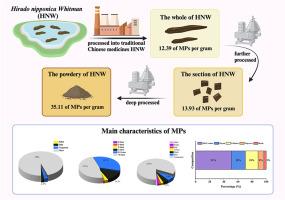
Hirudo nipponica Whitman (HNW) is a traditional Chinese medicine (TCM) processed from leeches, commonly used for treating blood stasis syndrome, particularly in promoting blood circulation and alleviating blood stasis. This study aimed to examine microparticles (MPs) contamination of leeches and whether the production of MPs was related to processing. The results showed that the abundance of MPs in the whole, sectioned and powdery of HNW was 12.39, 13.93, 35.11 items/g, respectively. Fiber-like particles accounted for 90 % total. Transparent particles were the most abundant, followed by blue and black. Particles <1 mm were the most frequent. Notebly, 100 % cotton was the most detected material in the HNW, while rayon, cellulose and polyester accounted for 46 % of the total. The abundance of particles in powdery HNW increased significantly, with a higher percentage of <1 mm, similar type and colour to whole and sectioned HNW. It suggests that the large MPs may have been cut into smaller MPs during processing and bring more risk of MPs. It alerts us to the fact that pharmaceuticals and even commonly touched food products may pose a greater risk of MPs due to processing.
期刊介绍:
Food and Chemical Toxicology (FCT), an internationally renowned journal, that publishes original research articles and reviews on toxic effects, in animals and humans, of natural or synthetic chemicals occurring in the human environment with particular emphasis on food, drugs, and chemicals, including agricultural and industrial safety, and consumer product safety. Areas such as safety evaluation of novel foods and ingredients, biotechnologically-derived products, and nanomaterials are included in the scope of the journal. FCT also encourages submission of papers on inter-relationships between nutrition and toxicology and on in vitro techniques, particularly those fostering the 3 Rs.
The principal aim of the journal is to publish high impact, scholarly work and to serve as a multidisciplinary forum for research in toxicology. Papers submitted will be judged on the basis of scientific originality and contribution to the field, quality and subject matter. Studies should address at least one of the following:
-Adverse physiological/biochemical, or pathological changes induced by specific defined substances
-New techniques for assessing potential toxicity, including molecular biology
-Mechanisms underlying toxic phenomena
-Toxicological examinations of specific chemicals or consumer products, both those showing adverse effects and those demonstrating safety, that meet current standards of scientific acceptability.
Authors must clearly and briefly identify what novel toxic effect (s) or toxic mechanism (s) of the chemical are being reported and what their significance is in the abstract. Furthermore, sufficient doses should be included in order to provide information on NOAEL/LOAEL values.



 京公网安备 11010802042870号
京ICP备2023020795号-1
京公网安备 11010802042870号
京ICP备2023020795号-1

 分享
分享
 求助内容:
求助内容: 应助结果提醒方式:
 扫码关注我们
