Jérôme Boursier , Hugo Hervé , Marine Roux , Manal F. Abdelmalek , Sven M. Francque , Pierre Broqua , Jean-Louis Junien , Jean-Louis Abitbol , Philippe Huot-Marchand , Lucile Dzen , Michael P. Cooreman , Sanjaykumar Patel
{"title":"Biomarkers of Histological Response in Lanifibranor-treated Patients With Metabolic Dysfunction-associated Steatohepatitis","authors":"Jérôme Boursier , Hugo Hervé , Marine Roux , Manal F. Abdelmalek , Sven M. Francque , Pierre Broqua , Jean-Louis Junien , Jean-Louis Abitbol , Philippe Huot-Marchand , Lucile Dzen , Michael P. Cooreman , Sanjaykumar Patel","doi":"10.1016/j.cgh.2024.12.039","DOIUrl":null,"url":null,"abstract":"<div><h3>Background & Aims</h3><div><span><span>Lanifibranor, a pan-peroxisome proliferator-activated receptor agonist, has demonstrated therapeutic efficacy on metabolic dysfunction-associated </span>steatohepatitis (MASH) resolution and </span>fibrosis improvement in the Phase IIb NATIVE study. The histologic endpoints of MASH resolution and fibrosis improvement (E1), MASH resolution without worsening of fibrosis (E2), and fibrosis improvement without worsening of MASH (E3) were investigated with the aim of identifying biological signatures of E1, E2, and E3 responders based on serum biomarkers in patients treated with lanifibranor.</div></div><div><h3>Methods</h3><div>NATIVE evaluated lanifibranor 800 and 1200 mg daily vs placebo in patients with non-cirrhotic MASH treated over 24 weeks. Liver biopsy was obtained at baseline and the end of treatment. Patients receiving lanifibranor were pooled, and those with liver biopsies were selected (n = 142). A panel of 65 biomarkers were evaluated by assessing baseline and absolute as well as relative changes at the end of treatment.</div></div><div><h3>Results</h3><div><span><span><span>The biomarkers included in E1 score (baseline adiponectin and </span>ferritin<span>; delta of matrix metalloproteinase 9<span> and transferrin), E2 score (baseline cytokeratin 18 Fragment M65; delta of </span></span></span>hyaluronic acid, </span>fructosamine<span>, and alanine aminotransferase), and E3 score (baseline cytokeratin 18 Fragment M65 and gamma-glutamyl transferase; delta of aspartate aminotransferase, insulin, and urea) represented metabolic, apoptotic, and fibrosis aspects of the disease. These signatures provided good accuracy for the noninvasive identification of histologic response under lanifibranor with area under the receiver operating characteristic curve at 0.81 ± 0.08 for E1 score, 0.80 ± 0.08 for E2 score, and 0.81 ± 0.08 for E3 score.</span></div></div><div><h3>Conclusions</h3><div>Results from this analysis show evidence that baseline values and changes in selected serum biomarkers can aid in predicting histologic response in MASH under lanifibranor treatment. These findings support utilizing a similar approach in a larger sample size (NATiV3, NCT03008070).</div></div>","PeriodicalId":10347,"journal":{"name":"Clinical Gastroenterology and Hepatology","volume":"23 13","pages":"Pages 2499-2508.e8"},"PeriodicalIF":12.0000,"publicationDate":"2025-03-17","publicationTypes":"Journal Article","fieldsOfStudy":null,"isOpenAccess":false,"openAccessPdf":"","citationCount":"0","resultStr":null,"platform":"Semanticscholar","paperid":null,"PeriodicalName":"Clinical Gastroenterology and Hepatology","FirstCategoryId":"3","ListUrlMain":"https://www.sciencedirect.com/science/article/pii/S1542356525002046","RegionNum":1,"RegionCategory":"医学","ArticlePicture":[],"TitleCN":null,"AbstractTextCN":null,"PMCID":null,"EPubDate":"","PubModel":"","JCR":"Q1","JCRName":"GASTROENTEROLOGY & HEPATOLOGY","Score":null,"Total":0}
引用次数: 0
Abstract
Background & Aims
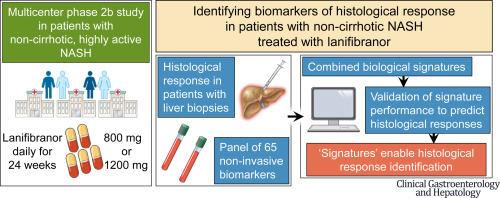
Lanifibranor, a pan-peroxisome proliferator-activated receptor agonist, has demonstrated therapeutic efficacy on metabolic dysfunction-associated steatohepatitis (MASH) resolution and fibrosis improvement in the Phase IIb NATIVE study. The histologic endpoints of MASH resolution and fibrosis improvement (E1), MASH resolution without worsening of fibrosis (E2), and fibrosis improvement without worsening of MASH (E3) were investigated with the aim of identifying biological signatures of E1, E2, and E3 responders based on serum biomarkers in patients treated with lanifibranor.
Methods
NATIVE evaluated lanifibranor 800 and 1200 mg daily vs placebo in patients with non-cirrhotic MASH treated over 24 weeks. Liver biopsy was obtained at baseline and the end of treatment. Patients receiving lanifibranor were pooled, and those with liver biopsies were selected (n = 142). A panel of 65 biomarkers were evaluated by assessing baseline and absolute as well as relative changes at the end of treatment.
Results
The biomarkers included in E1 score (baseline adiponectin and ferritin; delta of matrix metalloproteinase 9 and transferrin), E2 score (baseline cytokeratin 18 Fragment M65; delta of hyaluronic acid, fructosamine, and alanine aminotransferase), and E3 score (baseline cytokeratin 18 Fragment M65 and gamma-glutamyl transferase; delta of aspartate aminotransferase, insulin, and urea) represented metabolic, apoptotic, and fibrosis aspects of the disease. These signatures provided good accuracy for the noninvasive identification of histologic response under lanifibranor with area under the receiver operating characteristic curve at 0.81 ± 0.08 for E1 score, 0.80 ± 0.08 for E2 score, and 0.81 ± 0.08 for E3 score.
Conclusions
Results from this analysis show evidence that baseline values and changes in selected serum biomarkers can aid in predicting histologic response in MASH under lanifibranor treatment. These findings support utilizing a similar approach in a larger sample size (NATiV3, NCT03008070).
期刊介绍:
Clinical Gastroenterology and Hepatology (CGH) is dedicated to offering readers a comprehensive exploration of themes in clinical gastroenterology and hepatology. Encompassing diagnostic, endoscopic, interventional, and therapeutic advances, the journal covers areas such as cancer, inflammatory diseases, functional gastrointestinal disorders, nutrition, absorption, and secretion.
As a peer-reviewed publication, CGH features original articles and scholarly reviews, ensuring immediate relevance to the practice of gastroenterology and hepatology. Beyond peer-reviewed content, the journal includes invited key reviews and articles on endoscopy/practice-based technology, health-care policy, and practice management. Multimedia elements, including images, video abstracts, and podcasts, enhance the reader's experience. CGH remains actively engaged with its audience through updates and commentary shared via platforms such as Facebook and Twitter.



 京公网安备 11010802042870号
京ICP备2023020795号-1
京公网安备 11010802042870号
京ICP备2023020795号-1

 分享
分享
 求助内容:
求助内容: 应助结果提醒方式:
 扫码关注我们
