{"title":"Bidirectional relationship between platelet count and skin cancer: tumor drug resistance mechanisms.","authors":"Chao Guo, Jiaqin Deng, Tianhua Wen, Jinzhou Li, Peilin Zeng, Chao Liang","doi":"10.1007/s12672-025-02122-0","DOIUrl":null,"url":null,"abstract":"<p><strong>Background: </strong>Platelets (PLT) play a crucial role in tumor progression, including tumor growth, metastasis, and immune evasion. However, the relationship between PLT count and specific skin cancer subtypes, particularly melanoma skin cancer (MSC) and non-melanoma skin cancer (NMSC), remains poorly understood. Clarifying this association could identify potential biomarkers and therapeutic targets for personalized treatments.</p><p><strong>Methods: </strong>We applied bidirectional Mendelian randomization (MR) to investigate the causal relationship between PLT count and skin cancer risk, focusing on MSC and NMSC. Genetic variants associated with PLT and skin cancer served as instrumental variables for causal inference. Nine MR analysis methods, with inverse-variance weighted (IVW) as the primary method, were used to assess robustness, heterogeneity, and pleiotropy.</p><p><strong>Results: </strong>Forward MR analysis showed no significant relationship between PLT count and overall skin cancer or NMSC. However, elevated PLT was linked to an 18.6% increased risk of MSC. Reverse MR analysis revealed that skin cancer, particularly NMSC, negatively affected PLT count, while MSC was associated with a positive influence on PLT levels. No significant heterogeneity or pleiotropy was detected.</p><p><strong>Conclusions: </strong>Our findings reveal a bidirectional, subtype-specific relationship between PLT and skin cancer. Elevated PLT levels specifically increase the risk of MSC, while MSC influences PLT count positively. In contrast, NMSC is associated with lower PLT levels. These results suggest that PLT could serve as both a prognostic marker and a potential therapeutic target, particularly for MSC. Further research is needed to explore the molecular mechanisms underlying these associations and to investigate the role of PLT in overcoming tumor resistance to therapies.</p>","PeriodicalId":11148,"journal":{"name":"Discover. Oncology","volume":"16 1","pages":"361"},"PeriodicalIF":2.9000,"publicationDate":"2025-03-19","publicationTypes":"Journal Article","fieldsOfStudy":null,"isOpenAccess":false,"openAccessPdf":"https://www.ncbi.nlm.nih.gov/pmc/articles/PMC11923316/pdf/","citationCount":"0","resultStr":null,"platform":"Semanticscholar","paperid":null,"PeriodicalName":"Discover. Oncology","FirstCategoryId":"3","ListUrlMain":"https://doi.org/10.1007/s12672-025-02122-0","RegionNum":4,"RegionCategory":"医学","ArticlePicture":[],"TitleCN":null,"AbstractTextCN":null,"PMCID":null,"EPubDate":"","PubModel":"","JCR":"Q3","JCRName":"ENDOCRINOLOGY & METABOLISM","Score":null,"Total":0}
引用次数: 0
Abstract
Background: Platelets (PLT) play a crucial role in tumor progression, including tumor growth, metastasis, and immune evasion. However, the relationship between PLT count and specific skin cancer subtypes, particularly melanoma skin cancer (MSC) and non-melanoma skin cancer (NMSC), remains poorly understood. Clarifying this association could identify potential biomarkers and therapeutic targets for personalized treatments.
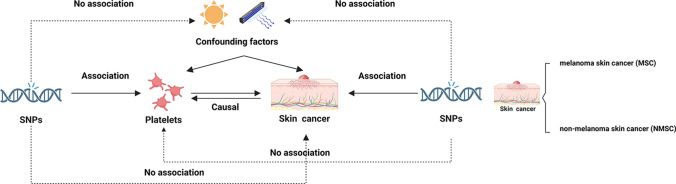
Methods: We applied bidirectional Mendelian randomization (MR) to investigate the causal relationship between PLT count and skin cancer risk, focusing on MSC and NMSC. Genetic variants associated with PLT and skin cancer served as instrumental variables for causal inference. Nine MR analysis methods, with inverse-variance weighted (IVW) as the primary method, were used to assess robustness, heterogeneity, and pleiotropy.
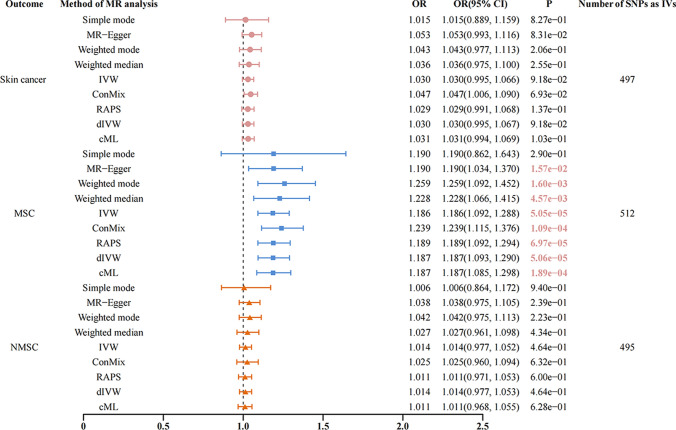
Results: Forward MR analysis showed no significant relationship between PLT count and overall skin cancer or NMSC. However, elevated PLT was linked to an 18.6% increased risk of MSC. Reverse MR analysis revealed that skin cancer, particularly NMSC, negatively affected PLT count, while MSC was associated with a positive influence on PLT levels. No significant heterogeneity or pleiotropy was detected.
Conclusions: Our findings reveal a bidirectional, subtype-specific relationship between PLT and skin cancer. Elevated PLT levels specifically increase the risk of MSC, while MSC influences PLT count positively. In contrast, NMSC is associated with lower PLT levels. These results suggest that PLT could serve as both a prognostic marker and a potential therapeutic target, particularly for MSC. Further research is needed to explore the molecular mechanisms underlying these associations and to investigate the role of PLT in overcoming tumor resistance to therapies.





 京公网安备 11010802042870号
京ICP备2023020795号-1
京公网安备 11010802042870号
京ICP备2023020795号-1

 分享
分享
 求助内容:
求助内容: 应助结果提醒方式:
 扫码关注我们
