Role of quercetin as a promising antiviral, therapeutic and immunomodulatory mediator against dengue virus induced robust infection in in-vivo Balb/C mice model
{"title":"Role of quercetin as a promising antiviral, therapeutic and immunomodulatory mediator against dengue virus induced robust infection in in-vivo Balb/C mice model","authors":"Saikat Mukherjee, Anusri Tripathi","doi":"10.1016/j.ejmech.2025.117536","DOIUrl":null,"url":null,"abstract":"<div><div>Currently, there are no clinically approved antiviral agents against dengue-virus (DENV). This study aimed to determine the prophylactic, antiviral, and therapeutic potential of quercetin by its pre-treatment, co-treatment, and post-treatment [24, 48, and 72 h-post-infection (HPI)] of DENV-infected Balb/C mice through both oral and intraperitoneal (I.P) route, respectively. 80 mg/kg/day and 16 mg/kg/day of quercetin were non-toxic for oral and I.P administration, respectively. I.P. was found to be more effective than oral administration which significantly reduced DENV copy-number in co-treatment group (from day 1, <em>p</em> < 0.01); post-treatment (24hpi),and pretreatment groups (day 3 onwards, <em>p</em> < 0.05). Molecular-docking experiments indicated quercetin could act as a double-edged sword by strongly interacting with DENV envelope-glycoprotein (−8.1 kcal/mol) and NS5-RdRp domain (−8.0 kcal/mol), which are crucial for viral-attachment and replication. MD-simulation of docked complexes indicated their stability defined by low RMSD, RMSF, and stable H-bond with active-site residues. Significant reduction (<em>p</em> < 0.001) in TNF-α, IL-6, ROS-production, and vascular leakage was observed among pre-, co-, and post-treatment (24 and 48 HPI) groups with promising hepatic and renal-protective effects. Pharmacological and functional-molecular interaction networks indicate a significant effect of quercetin on vascular integrity byVEGF-KDR signaling pathway (via PI3K-Akt and Ras signalling), oxygen homeostasis through HIF-1 signalling, and the anti-inflammatory response via PI3K-Akt, IL-6 and its receptor signalling (PPI enrichment P = 3.19e-10).Thus, it can be concluded that I.P. co- and post-treatment (24hpi) of quercetin to DENV-infected mice could effectively reduce viral-titer, pro-inflammatory cytokines, ROS-response, and vascular permeability. Taken together this demonstrates quercetin as an important antiviral candidate against dengue.</div></div>","PeriodicalId":314,"journal":{"name":"European Journal of Medicinal Chemistry","volume":"290 ","pages":"Article 117536"},"PeriodicalIF":5.9000,"publicationDate":"2025-06-05","publicationTypes":"Journal Article","fieldsOfStudy":null,"isOpenAccess":false,"openAccessPdf":"","citationCount":"0","resultStr":null,"platform":"Semanticscholar","paperid":null,"PeriodicalName":"European Journal of Medicinal Chemistry","FirstCategoryId":"3","ListUrlMain":"https://www.sciencedirect.com/science/article/pii/S0223523425003010","RegionNum":2,"RegionCategory":"医学","ArticlePicture":[],"TitleCN":null,"AbstractTextCN":null,"PMCID":null,"EPubDate":"2025/3/20 0:00:00","PubModel":"Epub","JCR":"Q1","JCRName":"CHEMISTRY, MEDICINAL","Score":null,"Total":0}
引用次数: 0
Abstract
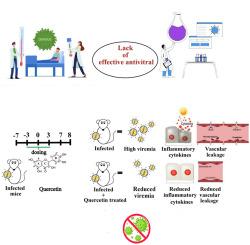
Currently, there are no clinically approved antiviral agents against dengue-virus (DENV). This study aimed to determine the prophylactic, antiviral, and therapeutic potential of quercetin by its pre-treatment, co-treatment, and post-treatment [24, 48, and 72 h-post-infection (HPI)] of DENV-infected Balb/C mice through both oral and intraperitoneal (I.P) route, respectively. 80 mg/kg/day and 16 mg/kg/day of quercetin were non-toxic for oral and I.P administration, respectively. I.P. was found to be more effective than oral administration which significantly reduced DENV copy-number in co-treatment group (from day 1, p < 0.01); post-treatment (24hpi),and pretreatment groups (day 3 onwards, p < 0.05). Molecular-docking experiments indicated quercetin could act as a double-edged sword by strongly interacting with DENV envelope-glycoprotein (−8.1 kcal/mol) and NS5-RdRp domain (−8.0 kcal/mol), which are crucial for viral-attachment and replication. MD-simulation of docked complexes indicated their stability defined by low RMSD, RMSF, and stable H-bond with active-site residues. Significant reduction (p < 0.001) in TNF-α, IL-6, ROS-production, and vascular leakage was observed among pre-, co-, and post-treatment (24 and 48 HPI) groups with promising hepatic and renal-protective effects. Pharmacological and functional-molecular interaction networks indicate a significant effect of quercetin on vascular integrity byVEGF-KDR signaling pathway (via PI3K-Akt and Ras signalling), oxygen homeostasis through HIF-1 signalling, and the anti-inflammatory response via PI3K-Akt, IL-6 and its receptor signalling (PPI enrichment P = 3.19e-10).Thus, it can be concluded that I.P. co- and post-treatment (24hpi) of quercetin to DENV-infected mice could effectively reduce viral-titer, pro-inflammatory cytokines, ROS-response, and vascular permeability. Taken together this demonstrates quercetin as an important antiviral candidate against dengue.
期刊介绍:
The European Journal of Medicinal Chemistry is a global journal that publishes studies on all aspects of medicinal chemistry. It provides a medium for publication of original papers and also welcomes critical review papers.
A typical paper would report on the organic synthesis, characterization and pharmacological evaluation of compounds. Other topics of interest are drug design, QSAR, molecular modeling, drug-receptor interactions, molecular aspects of drug metabolism, prodrug synthesis and drug targeting. The journal expects manuscripts to present the rational for a study, provide insight into the design of compounds or understanding of mechanism, or clarify the targets.





 京公网安备 11010802042870号
京ICP备2023020795号-1
京公网安备 11010802042870号
京ICP备2023020795号-1

 分享
分享
 求助内容:
求助内容: 应助结果提醒方式:
 扫码关注我们
