Tao Yu, Xiang Li, Xiaomao Liu, Jinsheng Li, Junhua You, Xuanwen Liu and Rui Guo
{"title":"How the balance between *CO and *H intermediates in dual atom catalysts boosts selectivity for hydrocarbons†","authors":"Tao Yu, Xiang Li, Xiaomao Liu, Jinsheng Li, Junhua You, Xuanwen Liu and Rui Guo","doi":"10.1039/D4TA08852B","DOIUrl":null,"url":null,"abstract":"<p >Double atom catalysts (DACs) have long faced a significant gap between theoretical predictions and experimental performance in the field of electrocatalytic CO<small><sub>2</sub></small> reduction for the preparation of hydrocarbons. This study reveals through integrated electronic structure analysis and reaction kinetics simulation that the key mechanism constraining performance is the synergistic adsorption imbalance between *CO and *H intermediates. Innovative discoveries include: (1) breaking through the traditional single descriptor paradigm, proposing a bivariate regulation criterion for the adsorption energy difference between *CO and *H, and elucidating its dominant role in the coupling efficiency of *CO and *H; (2) the second metal induced d orbital reconstruction optimizes the adsorption strength by enhancing the occupation of *CO antibonding orbitals; (3) the bimetallic side bridging nitrogen atoms form specific proton transport channels due to the redistribution of charge density, opening up new pathways for H supply; (4) revealing the innovative mechanism of constructing <em>in situ</em> proton sources through water molecule coordination of IIIB/IVB metals, with significantly lower transition state energy barriers than traditional dissociation pathways. The design framework of “electronic structure adsorption equilibrium proton coupling” established in this work provides cross scale theoretical guidance for the active site engineering of diatomic catalysts.</p>","PeriodicalId":82,"journal":{"name":"Journal of Materials Chemistry A","volume":" 17","pages":" 12461-12470"},"PeriodicalIF":9.5000,"publicationDate":"2025-03-20","publicationTypes":"Journal Article","fieldsOfStudy":null,"isOpenAccess":false,"openAccessPdf":"","citationCount":"0","resultStr":null,"platform":"Semanticscholar","paperid":null,"PeriodicalName":"Journal of Materials Chemistry A","FirstCategoryId":"88","ListUrlMain":"https://pubs.rsc.org/en/content/articlelanding/2025/ta/d4ta08852b","RegionNum":2,"RegionCategory":"材料科学","ArticlePicture":[],"TitleCN":null,"AbstractTextCN":null,"PMCID":null,"EPubDate":"","PubModel":"","JCR":"Q1","JCRName":"CHEMISTRY, PHYSICAL","Score":null,"Total":0}
引用次数: 0
Abstract
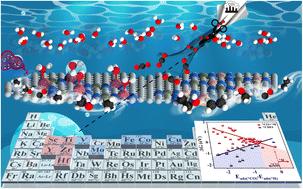
Double atom catalysts (DACs) have long faced a significant gap between theoretical predictions and experimental performance in the field of electrocatalytic CO2 reduction for the preparation of hydrocarbons. This study reveals through integrated electronic structure analysis and reaction kinetics simulation that the key mechanism constraining performance is the synergistic adsorption imbalance between *CO and *H intermediates. Innovative discoveries include: (1) breaking through the traditional single descriptor paradigm, proposing a bivariate regulation criterion for the adsorption energy difference between *CO and *H, and elucidating its dominant role in the coupling efficiency of *CO and *H; (2) the second metal induced d orbital reconstruction optimizes the adsorption strength by enhancing the occupation of *CO antibonding orbitals; (3) the bimetallic side bridging nitrogen atoms form specific proton transport channels due to the redistribution of charge density, opening up new pathways for H supply; (4) revealing the innovative mechanism of constructing in situ proton sources through water molecule coordination of IIIB/IVB metals, with significantly lower transition state energy barriers than traditional dissociation pathways. The design framework of “electronic structure adsorption equilibrium proton coupling” established in this work provides cross scale theoretical guidance for the active site engineering of diatomic catalysts.
期刊介绍:
The Journal of Materials Chemistry A, B & C covers a wide range of high-quality studies in the field of materials chemistry, with each section focusing on specific applications of the materials studied. Journal of Materials Chemistry A emphasizes applications in energy and sustainability, including topics such as artificial photosynthesis, batteries, and fuel cells. Journal of Materials Chemistry B focuses on applications in biology and medicine, while Journal of Materials Chemistry C covers applications in optical, magnetic, and electronic devices. Example topic areas within the scope of Journal of Materials Chemistry A include catalysis, green/sustainable materials, sensors, and water treatment, among others.



 京公网安备 11010802042870号
京ICP备2023020795号-1
京公网安备 11010802042870号
京ICP备2023020795号-1

 分享
分享
 求助内容:
求助内容: 应助结果提醒方式:
 扫码关注我们
