A novel strategy for the reduction of coordinated water in Prussian blue analogues for their application as cathode materials for sodium-ion batteries†
Xin Xu, Shiji Zhu, Chen Yang, Yongdong Wang, Zhennan Wu, Junzi Zheng, Jie Wu and Yunfang Gao
{"title":"A novel strategy for the reduction of coordinated water in Prussian blue analogues for their application as cathode materials for sodium-ion batteries†","authors":"Xin Xu, Shiji Zhu, Chen Yang, Yongdong Wang, Zhennan Wu, Junzi Zheng, Jie Wu and Yunfang Gao","doi":"10.1039/D5TA00120J","DOIUrl":null,"url":null,"abstract":"<p >Prussian blue analogues (PBAs) are promising cathode materials for sodium-ion batteries, and iron-based Prussian blue has received widespread attention owing to its high specific capacity, wide availability and cost-effectiveness. However, as Fe<small><sup>2+</sup></small> in the aqueous phase forms the [Fe(H<small><sub>2</sub></small>O)<small><sub>6</sub></small>]<small><sup>2+</sup></small> structure, water molecules get inevitably introduced during the synthesis process, resulting in water molecule residues and vacancy defects, which greatly affect the cycling life and energy densities of PBAs and pose safety issues. Herein, a new facile “ligand pre-exchange strategy” was proposed to synthesize highly crystallized PBAs. Ethylene glycol (EG) was introduced to exchange with H<small><sub>2</sub></small>O in [Fe(H<small><sub>2</sub></small>O)<small><sub>6</sub></small>]<small><sup>2+</sup></small> to form a water-deficient solvated structure of [Fe(EG)<small><sub><em>x</em></sub></small>(H<small><sub>2</sub></small>O)<small><sub>6−<em>x</em></sub></small>]<small><sup>2+</sup></small>, which resulted in a reduction of the amount of coordinated water and vacancy defects in the PBAs and formed high-quality PBA crystals. Meanwhile, the formation of [Fe(EG)<small><sub><em>x</em></sub></small>(H<small><sub>2</sub></small>O)<small><sub>6−<em>x</em></sub></small>]<small><sup>2+</sup></small> was confirmed using Fourier transform infrared (FT-IR) spectroscopy and quantum chemical calculations using density functional theory (DFT), proving this strategy's feasibility. The PB-EG-5 electrode prepared by this strategy exhibited excellent sodium storage performance and fast kinetics, with a specific capacity of 91.3 mA h g<small><sup>−1</sup></small> at 1000 mA g<small><sup>−1</sup></small> in a half-cell and capacity retention of 70% after 1000 cycles. Furthermore, the full cell exhibited excellent electrochemical performance. This work provides a new feasible solution for the large-scale preparation of high-quality PBAs.</p>","PeriodicalId":82,"journal":{"name":"Journal of Materials Chemistry A","volume":" 16","pages":" 11848-11860"},"PeriodicalIF":9.5000,"publicationDate":"2025-03-22","publicationTypes":"Journal Article","fieldsOfStudy":null,"isOpenAccess":false,"openAccessPdf":"","citationCount":"0","resultStr":null,"platform":"Semanticscholar","paperid":null,"PeriodicalName":"Journal of Materials Chemistry A","FirstCategoryId":"88","ListUrlMain":"https://pubs.rsc.org/en/content/articlelanding/2025/ta/d5ta00120j","RegionNum":2,"RegionCategory":"材料科学","ArticlePicture":[],"TitleCN":null,"AbstractTextCN":null,"PMCID":null,"EPubDate":"","PubModel":"","JCR":"Q1","JCRName":"CHEMISTRY, PHYSICAL","Score":null,"Total":0}
引用次数: 0
Abstract
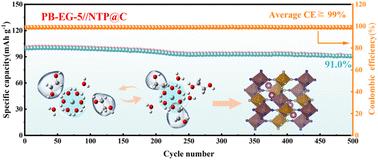
Prussian blue analogues (PBAs) are promising cathode materials for sodium-ion batteries, and iron-based Prussian blue has received widespread attention owing to its high specific capacity, wide availability and cost-effectiveness. However, as Fe2+ in the aqueous phase forms the [Fe(H2O)6]2+ structure, water molecules get inevitably introduced during the synthesis process, resulting in water molecule residues and vacancy defects, which greatly affect the cycling life and energy densities of PBAs and pose safety issues. Herein, a new facile “ligand pre-exchange strategy” was proposed to synthesize highly crystallized PBAs. Ethylene glycol (EG) was introduced to exchange with H2O in [Fe(H2O)6]2+ to form a water-deficient solvated structure of [Fe(EG)x(H2O)6−x]2+, which resulted in a reduction of the amount of coordinated water and vacancy defects in the PBAs and formed high-quality PBA crystals. Meanwhile, the formation of [Fe(EG)x(H2O)6−x]2+ was confirmed using Fourier transform infrared (FT-IR) spectroscopy and quantum chemical calculations using density functional theory (DFT), proving this strategy's feasibility. The PB-EG-5 electrode prepared by this strategy exhibited excellent sodium storage performance and fast kinetics, with a specific capacity of 91.3 mA h g−1 at 1000 mA g−1 in a half-cell and capacity retention of 70% after 1000 cycles. Furthermore, the full cell exhibited excellent electrochemical performance. This work provides a new feasible solution for the large-scale preparation of high-quality PBAs.
普鲁士蓝类似物(PBAs)是一种很有前途的钠离子电池正极材料,而铁基普鲁士蓝具有较高的比容量,且易于获得且价格低廉,因此受到了越来越广泛的关注。然而,Fe2+在水相中会形成[Fe(H2O)6]2+的结构,在合成过程中不可避免地会引入水分子,造成水分子残基和空位缺陷,这极大地影响了PBAs的循环寿命、能量密度并带来安全问题。本文提出了一种简单的“配体预交换策略”来合成高度结晶化的PBAs。引入乙二醇(EG)交换[Fe(H2O)6]2+中的水分子,形成[Fe(EG)x(H2O)6-x]2+的缺水溶剂化结构,减少了普鲁士蓝材料中的配位水和空位缺陷,形成了高质量的普鲁士蓝晶体。同时,傅里叶变换红外光谱(FT-IR)和密度泛函理论(DFT)量子化学计算证明了[Fe(EG)x(H2O)6-x]2+的形成,证明了该策略的可行性。该策略制备的PB-EG-5电极具有优异的储钠性能和快速的动力学,在半电池中1000 mA g-1时的比容量为91.3 mAh g-1,循环1000次后的容量保持率为70%,同时,全电池也具有优异的电化学性能。本研究为大规模制备高质量PBAs提供了一种新的可行方案。
期刊介绍:
The Journal of Materials Chemistry A, B & C covers a wide range of high-quality studies in the field of materials chemistry, with each section focusing on specific applications of the materials studied. Journal of Materials Chemistry A emphasizes applications in energy and sustainability, including topics such as artificial photosynthesis, batteries, and fuel cells. Journal of Materials Chemistry B focuses on applications in biology and medicine, while Journal of Materials Chemistry C covers applications in optical, magnetic, and electronic devices. Example topic areas within the scope of Journal of Materials Chemistry A include catalysis, green/sustainable materials, sensors, and water treatment, among others.



 京公网安备 11010802042870号
京ICP备2023020795号-1
京公网安备 11010802042870号
京ICP备2023020795号-1

 分享
分享
 求助内容:
求助内容: 应助结果提醒方式:
 扫码关注我们
