Josephine Mollon , Laura M. Schultz , Emma E.M. Knowles , Sebastien Jacquemont , David C. Glahn , Laura Almasy
{"title":"Low Stability and Specificity of Polygenic Risk Scores for Major Psychiatric Disorders Limit Their Clinical Utility","authors":"Josephine Mollon , Laura M. Schultz , Emma E.M. Knowles , Sebastien Jacquemont , David C. Glahn , Laura Almasy","doi":"10.1016/j.biopsych.2025.03.006","DOIUrl":null,"url":null,"abstract":"<div><h3>Background</h3><div>There has been little examination of the stability and validity of polygenic risk scores (PRSs), i.e., whether individuals identified as high risk for a disorder with one PRS are identified as high risk with another PRS and whether high-risk individuals have the disorder.</div></div><div><h3>Methods</h3><div><span>The UK Biobank recruited 502,534 individuals ages 37 to 73 years in the United Kingdom between 2006 and 2010. PRSs were calculated for 408,853 White British individuals. PRS continuous shrinkage (CS), which uses </span>single nucleotide polymorphism<span> effect sizes under CS, was used to calculate 3 different PRSs for major depressive disorder<span> (MDD), alcohol use disorder (AUD), and type 2 diabetes<span> (T2D) and 2 different PRSs for schizophrenia (SCZ). PRS stability was measured using correlations between different PRSs for the same disorder and the percentage of individuals consistently identified as high risk (top 5% PRS). Sensitivity and specificity were used to measure PRS validity.</span></span></span></div></div><div><h3>Results</h3><div>Correlations between PRSs ranged from low to high (SCZ: <em>r</em> = 0.78; MDD: <em>r</em>s = 0.16–0.78; AUD: <em>r</em>s = 0.13–0.90; T2D <em>r</em>s = 0.29–0.77). The percentage of individuals consistently identified as high risk (top 5% PRS) for SCZ with a different SCZ PRS was 47.7%, i.e., less than half of individuals identified as high risk with one PRS were identified as high risk with another PRS. Percentages of individuals consistently identified as high risk were 9.5% to 47.0% for MDD, 8.3% to 63.5% for AUD, and 14.1% to 45.2% for T2D. PRS sensitivity was moderate for MDD (66.1%–74.4%) and AUD (72.3%–74.2%), moderate/good for T2D (77.3%–96.3%), and good for SCZ (90.2%–93.3%). Specificity was low for all PRSs (50.7%–56.4%).</div></div><div><h3>Conclusions</h3><div>Limited stability and specificity of PRSs highlight their current lack of clinical utility in psychiatry.</div></div>","PeriodicalId":8918,"journal":{"name":"Biological Psychiatry","volume":"98 6","pages":"Pages 476-484"},"PeriodicalIF":9.0000,"publicationDate":"2025-09-15","publicationTypes":"Journal Article","fieldsOfStudy":null,"isOpenAccess":false,"openAccessPdf":"","citationCount":"0","resultStr":null,"platform":"Semanticscholar","paperid":null,"PeriodicalName":"Biological Psychiatry","FirstCategoryId":"3","ListUrlMain":"https://www.sciencedirect.com/science/article/pii/S000632232501073X","RegionNum":1,"RegionCategory":"医学","ArticlePicture":[],"TitleCN":null,"AbstractTextCN":null,"PMCID":null,"EPubDate":"2025/3/18 0:00:00","PubModel":"Epub","JCR":"Q1","JCRName":"NEUROSCIENCES","Score":null,"Total":0}
引用次数: 0
Abstract
Background
There has been little examination of the stability and validity of polygenic risk scores (PRSs), i.e., whether individuals identified as high risk for a disorder with one PRS are identified as high risk with another PRS and whether high-risk individuals have the disorder.
Methods
The UK Biobank recruited 502,534 individuals ages 37 to 73 years in the United Kingdom between 2006 and 2010. PRSs were calculated for 408,853 White British individuals. PRS continuous shrinkage (CS), which uses single nucleotide polymorphism effect sizes under CS, was used to calculate 3 different PRSs for major depressive disorder (MDD), alcohol use disorder (AUD), and type 2 diabetes (T2D) and 2 different PRSs for schizophrenia (SCZ). PRS stability was measured using correlations between different PRSs for the same disorder and the percentage of individuals consistently identified as high risk (top 5% PRS). Sensitivity and specificity were used to measure PRS validity.
Results
Correlations between PRSs ranged from low to high (SCZ: r = 0.78; MDD: rs = 0.16–0.78; AUD: rs = 0.13–0.90; T2D rs = 0.29–0.77). The percentage of individuals consistently identified as high risk (top 5% PRS) for SCZ with a different SCZ PRS was 47.7%, i.e., less than half of individuals identified as high risk with one PRS were identified as high risk with another PRS. Percentages of individuals consistently identified as high risk were 9.5% to 47.0% for MDD, 8.3% to 63.5% for AUD, and 14.1% to 45.2% for T2D. PRS sensitivity was moderate for MDD (66.1%–74.4%) and AUD (72.3%–74.2%), moderate/good for T2D (77.3%–96.3%), and good for SCZ (90.2%–93.3%). Specificity was low for all PRSs (50.7%–56.4%).
Conclusions
Limited stability and specificity of PRSs highlight their current lack of clinical utility in psychiatry.
期刊介绍:
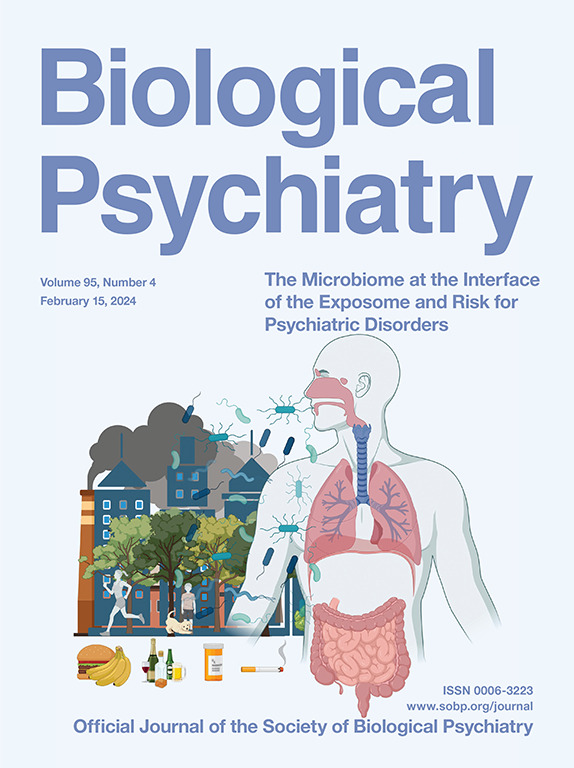
Biological Psychiatry is an official journal of the Society of Biological Psychiatry and was established in 1969. It is the first journal in the Biological Psychiatry family, which also includes Biological Psychiatry: Cognitive Neuroscience and Neuroimaging and Biological Psychiatry: Global Open Science. The Society's main goal is to promote excellence in scientific research and education in the fields related to the nature, causes, mechanisms, and treatments of disorders pertaining to thought, emotion, and behavior. To fulfill this mission, Biological Psychiatry publishes peer-reviewed, rapid-publication articles that present new findings from original basic, translational, and clinical mechanistic research, ultimately advancing our understanding of psychiatric disorders and their treatment. The journal also encourages the submission of reviews and commentaries on current research and topics of interest.



 京公网安备 11010802042870号
京ICP备2023020795号-1
京公网安备 11010802042870号
京ICP备2023020795号-1

 分享
分享
 求助内容:
求助内容: 应助结果提醒方式:
 扫码关注我们
