Xishan Li, Xiang Zhou, Jie Yang, Kai Oliver Böker, Arndt F Schilling, Wolfgang Lehmann
{"title":"Evaluating femoral head collapse risk post-fixation removal: a finite element analysis.","authors":"Xishan Li, Xiang Zhou, Jie Yang, Kai Oliver Böker, Arndt F Schilling, Wolfgang Lehmann","doi":"10.3389/fbioe.2025.1441026","DOIUrl":null,"url":null,"abstract":"<p><strong>Background: </strong>Femoral neck fractures are prevalent in orthopedic injuries, often leading to complications such as nonunion and osteonecrosis of the femoral head (ONFH). Studies indicate that after healing and removal of internal fixation devices, some patients develop ONFH, while others experience osteosclerosis around the screw holes due to prolonged fixation, increasing ONFH risk. Despite such observations, biomechanical studies on this phenomenon are limited. This study assesses the risk of femoral head collapse post-internal fixation device removal and investigates the biomechanical effects of bone grafting at screw removal sites.</p><p><strong>Methods: </strong>Using CT data, femoral anatomy was reconstructed. For control, the femoral head's collapse area was identified. Experimental models, divided into those with and without bone grafts in screw holes, incorporated three fixation techniques, namely, triple cannulated screws (3CS), dynamic hip screws with cannulated screws (DHS+CS), and the femoral neck system (FNS), further subclassified into normal and sclerotic screw-hole models. Stress distribution, stress values, stress index, and strain range were assessed.</p><p><strong>Results: </strong>In both models, DHS+CS showed the highest stress in the overall model, while 3CS had the highest stress in the collapse area. The 3CS configuration also resulted in the largest strain range, which was observed in the central pillar of normal screw-hole models and the lateral pillar of sclerotic screw-hole models. The bone graft models exhibited lower peak, average stress, and strain values than the normal and sclerotic screw-hole models.</p><p><strong>Conclusion: </strong>The FNS screw hole demonstrates a relatively lower mechanical risk of femoral head collapse. In contrast, sclerotic screw holes increase this risk, while bone grafting may improve the biomechanical behavior after fixation removal, potentially reducing the likelihood of femoral head collapse.</p>","PeriodicalId":12444,"journal":{"name":"Frontiers in Bioengineering and Biotechnology","volume":"13 ","pages":"1441026"},"PeriodicalIF":4.8000,"publicationDate":"2025-03-06","publicationTypes":"Journal Article","fieldsOfStudy":null,"isOpenAccess":false,"openAccessPdf":"https://www.ncbi.nlm.nih.gov/pmc/articles/PMC11922834/pdf/","citationCount":"0","resultStr":null,"platform":"Semanticscholar","paperid":null,"PeriodicalName":"Frontiers in Bioengineering and Biotechnology","FirstCategoryId":"5","ListUrlMain":"https://doi.org/10.3389/fbioe.2025.1441026","RegionNum":3,"RegionCategory":"工程技术","ArticlePicture":[],"TitleCN":null,"AbstractTextCN":null,"PMCID":null,"EPubDate":"2025/1/1 0:00:00","PubModel":"eCollection","JCR":"Q1","JCRName":"BIOTECHNOLOGY & APPLIED MICROBIOLOGY","Score":null,"Total":0}
引用次数: 0
Abstract
Background: Femoral neck fractures are prevalent in orthopedic injuries, often leading to complications such as nonunion and osteonecrosis of the femoral head (ONFH). Studies indicate that after healing and removal of internal fixation devices, some patients develop ONFH, while others experience osteosclerosis around the screw holes due to prolonged fixation, increasing ONFH risk. Despite such observations, biomechanical studies on this phenomenon are limited. This study assesses the risk of femoral head collapse post-internal fixation device removal and investigates the biomechanical effects of bone grafting at screw removal sites.
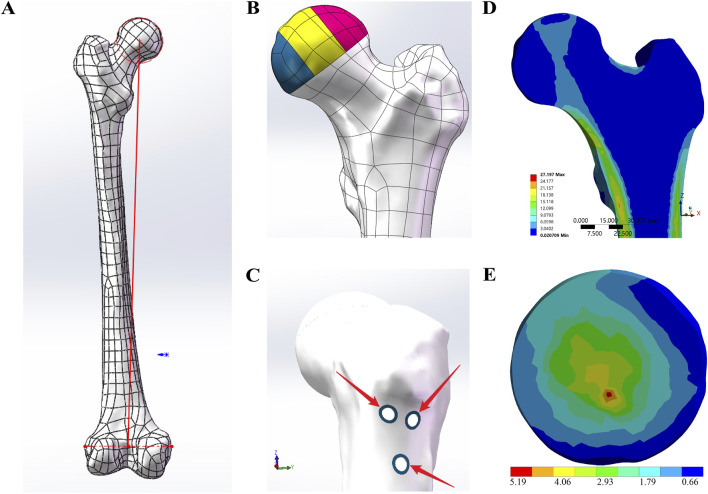
Methods: Using CT data, femoral anatomy was reconstructed. For control, the femoral head's collapse area was identified. Experimental models, divided into those with and without bone grafts in screw holes, incorporated three fixation techniques, namely, triple cannulated screws (3CS), dynamic hip screws with cannulated screws (DHS+CS), and the femoral neck system (FNS), further subclassified into normal and sclerotic screw-hole models. Stress distribution, stress values, stress index, and strain range were assessed.
Results: In both models, DHS+CS showed the highest stress in the overall model, while 3CS had the highest stress in the collapse area. The 3CS configuration also resulted in the largest strain range, which was observed in the central pillar of normal screw-hole models and the lateral pillar of sclerotic screw-hole models. The bone graft models exhibited lower peak, average stress, and strain values than the normal and sclerotic screw-hole models.
Conclusion: The FNS screw hole demonstrates a relatively lower mechanical risk of femoral head collapse. In contrast, sclerotic screw holes increase this risk, while bone grafting may improve the biomechanical behavior after fixation removal, potentially reducing the likelihood of femoral head collapse.
期刊介绍:
The translation of new discoveries in medicine to clinical routine has never been easy. During the second half of the last century, thanks to the progress in chemistry, biochemistry and pharmacology, we have seen the development and the application of a large number of drugs and devices aimed at the treatment of symptoms, blocking unwanted pathways and, in the case of infectious diseases, fighting the micro-organisms responsible. However, we are facing, today, a dramatic change in the therapeutic approach to pathologies and diseases. Indeed, the challenge of the present and the next decade is to fully restore the physiological status of the diseased organism and to completely regenerate tissue and organs when they are so seriously affected that treatments cannot be limited to the repression of symptoms or to the repair of damage. This is being made possible thanks to the major developments made in basic cell and molecular biology, including stem cell science, growth factor delivery, gene isolation and transfection, the advances in bioengineering and nanotechnology, including development of new biomaterials, biofabrication technologies and use of bioreactors, and the big improvements in diagnostic tools and imaging of cells, tissues and organs.
In today`s world, an enhancement of communication between multidisciplinary experts, together with the promotion of joint projects and close collaborations among scientists, engineers, industry people, regulatory agencies and physicians are absolute requirements for the success of any attempt to develop and clinically apply a new biological therapy or an innovative device involving the collective use of biomaterials, cells and/or bioactive molecules. “Frontiers in Bioengineering and Biotechnology” aspires to be a forum for all people involved in the process by bridging the gap too often existing between a discovery in the basic sciences and its clinical application.





 京公网安备 11010802042870号
京ICP备2023020795号-1
京公网安备 11010802042870号
京ICP备2023020795号-1

 分享
分享
 求助内容:
求助内容: 应助结果提醒方式:
 扫码关注我们
