Real-world comparison of neoadjuvant pembrolizumab plus chemotherapy versus tislelizumab plus chemotherapy in patients with resectable non-small cell lung cancer: a retrospective cohort study of treatment outcomes.
Yan Hu, Siying Ren, Juan Feng, Chao Zeng, Lulu Yang, Jinyou Liu, Fang Wu, Wenliang Liu
{"title":"Real-world comparison of neoadjuvant pembrolizumab plus chemotherapy versus tislelizumab plus chemotherapy in patients with resectable non-small cell lung cancer: a retrospective cohort study of treatment outcomes.","authors":"Yan Hu, Siying Ren, Juan Feng, Chao Zeng, Lulu Yang, Jinyou Liu, Fang Wu, Wenliang Liu","doi":"10.21037/tlcr-24-721","DOIUrl":null,"url":null,"abstract":"<p><strong>Background: </strong>Pembrolizumab and tislelizumab have shown substantial clinical benefits in perioperative treatment of resectable non-small cell lung cancer (NSCLC), yet no direct head-to-head trial has established which is optimal. This study, for the first time, aimed to directly compare the efficacy and safety of neoadjuvant pembrolizumab plus chemotherapy versus tislelizumab plus chemotherapy in resectable NSCLC using real-world data.</p><p><strong>Methods: </strong>Data of patients with resectable NSCLC treated with neoadjuvant pembrolizumab plus chemotherapy or tislelizumab plus chemotherapy followed by radical resection between December 2017 and August 2023 at the Second Xiangya Hospital of Central South University were retrospectively analyzed. Patients aged 18 years and above, diagnosed with biopsy-proven and treatment-naïve clinical stage II-IIIb NSCLC were included in the study. Patients with autoimmune disease, pulmonary interstitial disease, acute infection, or systemic immunosuppression were excluded. Data that may affect treatment efficacy were collected, including age, sex, body mass index (BMI), smoking history, comorbidities, pulmonary function, pathological type, clinical stage, programmed cell death-ligand 1 (PD-L1) tumor proportion score (TPS), dosage of neoadjuvant therapy, duration from final therapy to surgery and chemotherapy regimens, and compared between the two groups. The follow-up was performed through outpatient visits or telephone calls. The last follow-up was set in June 2024.</p><p><strong>Results: </strong>A total of 126 patients were included and divided into the pembrolizumab (n=62) and tislelizumab (n=64) groups with a median follow-up time of 26.3 months. The mean age at diagnosis was 59.76 years (standard deviation, 7.05 years) and 103 patients (81.75%) were current or former smoker. Squamous cell carcinoma (SCC) (102, 80.95%) was the most common histological type, followed by adenocarcinoma (18, 14.29%), large cell neuroendocrine carcinoma (2, 1.59%) and sarcomatoid carcinoma (2, 1.59%). Although there was a lower proportion of SCC (72.58% <i>vs.</i> 89.06%, P=0.02) and a lower use of paclitaxel (75.81% <i>vs.</i> 96.88%, P=0.004) in the pembrolizumab group in the overall cohort, the baseline characteristics between two groups were balanced in the SCC cohort. No significant differences in objective response rate, percentage of primary tumors with no viable tumor cells, pathologic and lymph node downstaging, pathological complete response and major pathological response existed between the two groups in both cohorts. Additionally, disease-free survival and overall survival were similar between the two groups in both cohorts. No significant differences in the postoperative complications and grade 3/4 toxicity profiles existed in both cohorts.</p><p><strong>Conclusions: </strong>This real-world evidence study supports the non-inferiority of neoadjuvant pembrolizumab plus chemotherapy versus tislelizumab plus chemotherapy in terms of efficacy and safety in patients with resectable NSCLC. We believe that our findings could be an important reference for future studies comparing pembrolizumab- and tislelizumab-based treatment combinations in the neoadjuvant setting.</p>","PeriodicalId":23271,"journal":{"name":"Translational lung cancer research","volume":"14 2","pages":"467-479"},"PeriodicalIF":3.5000,"publicationDate":"2025-02-28","publicationTypes":"Journal Article","fieldsOfStudy":null,"isOpenAccess":false,"openAccessPdf":"https://www.ncbi.nlm.nih.gov/pmc/articles/PMC11921188/pdf/","citationCount":"0","resultStr":null,"platform":"Semanticscholar","paperid":null,"PeriodicalName":"Translational lung cancer research","FirstCategoryId":"3","ListUrlMain":"https://doi.org/10.21037/tlcr-24-721","RegionNum":2,"RegionCategory":"医学","ArticlePicture":[],"TitleCN":null,"AbstractTextCN":null,"PMCID":null,"EPubDate":"2025/2/14 0:00:00","PubModel":"Epub","JCR":"Q2","JCRName":"ONCOLOGY","Score":null,"Total":0}
引用次数: 0
Abstract
Background: Pembrolizumab and tislelizumab have shown substantial clinical benefits in perioperative treatment of resectable non-small cell lung cancer (NSCLC), yet no direct head-to-head trial has established which is optimal. This study, for the first time, aimed to directly compare the efficacy and safety of neoadjuvant pembrolizumab plus chemotherapy versus tislelizumab plus chemotherapy in resectable NSCLC using real-world data.
Methods: Data of patients with resectable NSCLC treated with neoadjuvant pembrolizumab plus chemotherapy or tislelizumab plus chemotherapy followed by radical resection between December 2017 and August 2023 at the Second Xiangya Hospital of Central South University were retrospectively analyzed. Patients aged 18 years and above, diagnosed with biopsy-proven and treatment-naïve clinical stage II-IIIb NSCLC were included in the study. Patients with autoimmune disease, pulmonary interstitial disease, acute infection, or systemic immunosuppression were excluded. Data that may affect treatment efficacy were collected, including age, sex, body mass index (BMI), smoking history, comorbidities, pulmonary function, pathological type, clinical stage, programmed cell death-ligand 1 (PD-L1) tumor proportion score (TPS), dosage of neoadjuvant therapy, duration from final therapy to surgery and chemotherapy regimens, and compared between the two groups. The follow-up was performed through outpatient visits or telephone calls. The last follow-up was set in June 2024.
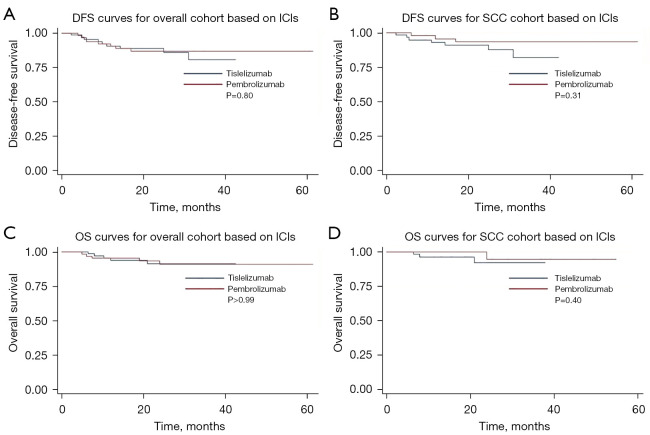
Results: A total of 126 patients were included and divided into the pembrolizumab (n=62) and tislelizumab (n=64) groups with a median follow-up time of 26.3 months. The mean age at diagnosis was 59.76 years (standard deviation, 7.05 years) and 103 patients (81.75%) were current or former smoker. Squamous cell carcinoma (SCC) (102, 80.95%) was the most common histological type, followed by adenocarcinoma (18, 14.29%), large cell neuroendocrine carcinoma (2, 1.59%) and sarcomatoid carcinoma (2, 1.59%). Although there was a lower proportion of SCC (72.58% vs. 89.06%, P=0.02) and a lower use of paclitaxel (75.81% vs. 96.88%, P=0.004) in the pembrolizumab group in the overall cohort, the baseline characteristics between two groups were balanced in the SCC cohort. No significant differences in objective response rate, percentage of primary tumors with no viable tumor cells, pathologic and lymph node downstaging, pathological complete response and major pathological response existed between the two groups in both cohorts. Additionally, disease-free survival and overall survival were similar between the two groups in both cohorts. No significant differences in the postoperative complications and grade 3/4 toxicity profiles existed in both cohorts.
Conclusions: This real-world evidence study supports the non-inferiority of neoadjuvant pembrolizumab plus chemotherapy versus tislelizumab plus chemotherapy in terms of efficacy and safety in patients with resectable NSCLC. We believe that our findings could be an important reference for future studies comparing pembrolizumab- and tislelizumab-based treatment combinations in the neoadjuvant setting.
期刊介绍:
Translational Lung Cancer Research(TLCR, Transl Lung Cancer Res, Print ISSN 2218-6751; Online ISSN 2226-4477) is an international, peer-reviewed, open-access journal, which was founded in March 2012. TLCR is indexed by PubMed/PubMed Central and the Chemical Abstracts Service (CAS) Databases. It is published quarterly the first year, and published bimonthly since February 2013. It provides practical up-to-date information on prevention, early detection, diagnosis, and treatment of lung cancer. Specific areas of its interest include, but not limited to, multimodality therapy, markers, imaging, tumor biology, pathology, chemoprevention, and technical advances related to lung cancer.




 京公网安备 11010802042870号
京ICP备2023020795号-1
京公网安备 11010802042870号
京ICP备2023020795号-1

 分享
分享
 求助内容:
求助内容: 应助结果提醒方式:
 扫码关注我们
