Ioannis Eleftherios Neofytou, Georgios Lioulios, Emmanouil Almaliotis, Dimitra Vasilia Daikidou, Aikaterini Mplatsa, Elias Minasidis
{"title":"A case report of renal oxalosis and secondary hyperoxaluria due to chronic high vitamin C consumption.","authors":"Ioannis Eleftherios Neofytou, Georgios Lioulios, Emmanouil Almaliotis, Dimitra Vasilia Daikidou, Aikaterini Mplatsa, Elias Minasidis","doi":"10.5414/CNCS111462","DOIUrl":null,"url":null,"abstract":"<p><p>Renal oxalosis occurs from supersaturation of the urine with oxalate in the presence of calcium, resulting in deposition of calcium oxalate crystals within renal tissue and, consequently, progressive renal disease. One of the causes of secondary hyperoxaluria is a high intake of vitamin C, which exceeds the renal excretion capacity, and can induce renal oxalosis. We present a case involving a 67-year-old patient with chronic kidney disease and proteinuria, associated with secondary hyperoxaluria and renal oxalosis, who reported prolonged, excessive intake of vitamin C supplements. The patient presented with a gradual worsening of his renal function and proteinuria during the last 6-month period, after an episode of SARS-CoV-2 infection. The kidney biopsy revealed calcium oxalate crystals within the renal tissue. Thorough investigation and history-taking revealed a substantial increase in vitamin C supplementation during the SARS-CoV-2 infection (up to 3 g daily), indicating secondary hyperoxaluria as the causative factor. Overall during the pandemic, supplement consumption dramatically increased and patients were not adequately informed about the risks of various over-the-counter products. Excessive intake of vitamin C, popularized for its supposed health benefits, can lead, among others, to secondary hyperoxaluria and renal oxalosis. Prompt recognition is pivotal to initiate management and to prevent irreversible kidney damage.</p>","PeriodicalId":510898,"journal":{"name":"Clinical nephrology. Case studies","volume":"13 ","pages":"18-27"},"PeriodicalIF":0.0000,"publicationDate":"2025-03-14","publicationTypes":"Journal Article","fieldsOfStudy":null,"isOpenAccess":false,"openAccessPdf":"https://www.ncbi.nlm.nih.gov/pmc/articles/PMC11924107/pdf/","citationCount":"0","resultStr":null,"platform":"Semanticscholar","paperid":null,"PeriodicalName":"Clinical nephrology. Case studies","FirstCategoryId":"1085","ListUrlMain":"https://doi.org/10.5414/CNCS111462","RegionNum":0,"RegionCategory":null,"ArticlePicture":[],"TitleCN":null,"AbstractTextCN":null,"PMCID":null,"EPubDate":"2025/1/1 0:00:00","PubModel":"eCollection","JCR":"","JCRName":"","Score":null,"Total":0}
引用次数: 0
Abstract
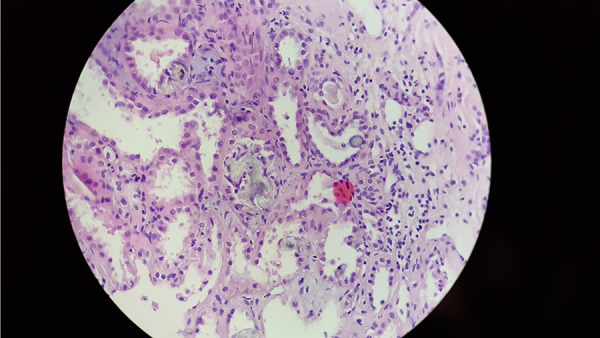
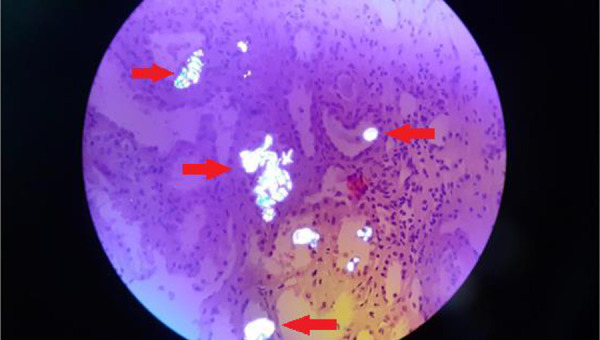
Renal oxalosis occurs from supersaturation of the urine with oxalate in the presence of calcium, resulting in deposition of calcium oxalate crystals within renal tissue and, consequently, progressive renal disease. One of the causes of secondary hyperoxaluria is a high intake of vitamin C, which exceeds the renal excretion capacity, and can induce renal oxalosis. We present a case involving a 67-year-old patient with chronic kidney disease and proteinuria, associated with secondary hyperoxaluria and renal oxalosis, who reported prolonged, excessive intake of vitamin C supplements. The patient presented with a gradual worsening of his renal function and proteinuria during the last 6-month period, after an episode of SARS-CoV-2 infection. The kidney biopsy revealed calcium oxalate crystals within the renal tissue. Thorough investigation and history-taking revealed a substantial increase in vitamin C supplementation during the SARS-CoV-2 infection (up to 3 g daily), indicating secondary hyperoxaluria as the causative factor. Overall during the pandemic, supplement consumption dramatically increased and patients were not adequately informed about the risks of various over-the-counter products. Excessive intake of vitamin C, popularized for its supposed health benefits, can lead, among others, to secondary hyperoxaluria and renal oxalosis. Prompt recognition is pivotal to initiate management and to prevent irreversible kidney damage.



 京公网安备 11010802042870号
京ICP备2023020795号-1
京公网安备 11010802042870号
京ICP备2023020795号-1

 分享
分享

 求助内容:
求助内容: 应助结果提醒方式:
 扫码关注我们
