Tian-Cai Peng, Zi-Yue Bai, Jun-Zhang Wang, Xiang Liu
{"title":"Reevaluating the ψ(4160) resonance parameter using B+→K+μ+μ− data in the context of unquenched charmonium spectroscopy","authors":"Tian-Cai Peng, Zi-Yue Bai, Jun-Zhang Wang, Xiang Liu","doi":"10.1103/physrevd.111.054023","DOIUrl":null,"url":null,"abstract":"A puzzling phenomenon, where the measured mass of the ψ</a:mi>(</a:mo>4160</a:mn>)</a:mo></a:math> is pushed higher, presents a challenge to current theoretical models of hadron spectroscopy. This study suggests that the issue arises from analyses based on the outdated quenched charmonium spectrum. In the past two decades, the discovery of new hadronic states has emphasized the importance of the unquenched effect. Under the unquenched picture, six vector charmonium states—<e:math xmlns:e=\"http://www.w3.org/1998/Math/MathML\" display=\"inline\"><e:mi>ψ</e:mi><e:mo stretchy=\"false\">(</e:mo><e:mn>4040</e:mn><e:mo stretchy=\"false\">)</e:mo></e:math>, <i:math xmlns:i=\"http://www.w3.org/1998/Math/MathML\" display=\"inline\"><i:mi>ψ</i:mi><i:mo stretchy=\"false\">(</i:mo><i:mn>4160</i:mn><i:mo stretchy=\"false\">)</i:mo></i:math>, <m:math xmlns:m=\"http://www.w3.org/1998/Math/MathML\" display=\"inline\"><m:mi>ψ</m:mi><m:mo stretchy=\"false\">(</m:mo><m:mn>4220</m:mn><m:mo stretchy=\"false\">)</m:mo></m:math>, <q:math xmlns:q=\"http://www.w3.org/1998/Math/MathML\" display=\"inline\"><q:mi>ψ</q:mi><q:mo stretchy=\"false\">(</q:mo><q:mn>4380</q:mn><q:mo stretchy=\"false\">)</q:mo></q:math>, <u:math xmlns:u=\"http://www.w3.org/1998/Math/MathML\" display=\"inline\"><u:mi>ψ</u:mi><u:mo stretchy=\"false\">(</u:mo><u:mn>4415</u:mn><u:mo stretchy=\"false\">)</u:mo></u:math>, and <y:math xmlns:y=\"http://www.w3.org/1998/Math/MathML\" display=\"inline\"><y:mi>ψ</y:mi><y:mo stretchy=\"false\">(</y:mo><y:mn>4500</y:mn><y:mo stretchy=\"false\">)</y:mo></y:math>—are identified in the 4–4.5 GeV range, contrasting with the three states predicted in the quenched model. We reevaluate the resonance parameters of the <cb:math xmlns:cb=\"http://www.w3.org/1998/Math/MathML\" display=\"inline\"><cb:mi>ψ</cb:mi><cb:mo stretchy=\"false\">(</cb:mo><cb:mn>4160</cb:mn><cb:mo stretchy=\"false\">)</cb:mo></cb:math> using the dimuon invariant mass spectrum of <gb:math xmlns:gb=\"http://www.w3.org/1998/Math/MathML\" display=\"inline\"><gb:msup><gb:mi>B</gb:mi><gb:mo>+</gb:mo></gb:msup><gb:mo stretchy=\"false\">→</gb:mo><gb:msup><gb:mi>K</gb:mi><gb:mo>+</gb:mo></gb:msup><gb:msup><gb:mi>μ</gb:mi><gb:mo>+</gb:mo></gb:msup><gb:msup><gb:mi>μ</gb:mi><gb:mo>−</gb:mo></gb:msup></gb:math> and unquenched charmonium spectroscopy. Our analysis indicates previous experimental overestimations for the mass of the <jb:math xmlns:jb=\"http://www.w3.org/1998/Math/MathML\" display=\"inline\"><jb:mi>ψ</jb:mi><jb:mo stretchy=\"false\">(</jb:mo><jb:mn>4160</jb:mn><jb:mo stretchy=\"false\">)</jb:mo></jb:math>. This conclusion is supported by analyzing <nb:math xmlns:nb=\"http://www.w3.org/1998/Math/MathML\" display=\"inline\"><nb:msup><nb:mi>e</nb:mi><nb:mo>+</nb:mo></nb:msup><nb:msup><nb:mi>e</nb:mi><nb:mo>−</nb:mo></nb:msup><nb:mo stretchy=\"false\">→</nb:mo><nb:msub><nb:mi>D</nb:mi><nb:mi>s</nb:mi></nb:msub><nb:msubsup><nb:mover accent=\"true\"><nb:mi>D</nb:mi><nb:mo stretchy=\"false\">¯</nb:mo></nb:mover><nb:mi>s</nb:mi><nb:mo>*</nb:mo></nb:msubsup></nb:math>, which finds the <sb:math xmlns:sb=\"http://www.w3.org/1998/Math/MathML\" display=\"inline\"><sb:mi>ψ</sb:mi><sb:mo stretchy=\"false\">(</sb:mo><sb:mn>4160</sb:mn><sb:mo stretchy=\"false\">)</sb:mo></sb:math> mass at <wb:math xmlns:wb=\"http://www.w3.org/1998/Math/MathML\" display=\"inline\"><wb:mn>4145.76</wb:mn><wb:mo>±</wb:mo><wb:mn>4.48</wb:mn><wb:mtext> </wb:mtext><wb:mtext> </wb:mtext><wb:mi>MeV</wb:mi></wb:math>. Our findings have significant implications for both hadron spectroscopy and search for new physics signals by <yb:math xmlns:yb=\"http://www.w3.org/1998/Math/MathML\" display=\"inline\"><yb:msub><yb:mi>R</yb:mi><yb:mi>K</yb:mi></yb:msub></yb:math>. <jats:supplementary-material> <jats:copyright-statement>Published by the American Physical Society</jats:copyright-statement> <jats:copyright-year>2025</jats:copyright-year> </jats:permissions> </jats:supplementary-material>","PeriodicalId":20167,"journal":{"name":"Physical Review D","volume":"183 1","pages":""},"PeriodicalIF":5.3000,"publicationDate":"2025-03-21","publicationTypes":"Journal Article","fieldsOfStudy":null,"isOpenAccess":false,"openAccessPdf":"","citationCount":"0","resultStr":null,"platform":"Semanticscholar","paperid":null,"PeriodicalName":"Physical Review D","FirstCategoryId":"101","ListUrlMain":"https://doi.org/10.1103/physrevd.111.054023","RegionNum":2,"RegionCategory":"物理与天体物理","ArticlePicture":[],"TitleCN":null,"AbstractTextCN":null,"PMCID":null,"EPubDate":"","PubModel":"","JCR":"Q1","JCRName":"Physics and Astronomy","Score":null,"Total":0}
引用次数: 0
Abstract
A puzzling phenomenon, where the measured mass of the ψ(4160) is pushed higher, presents a challenge to current theoretical models of hadron spectroscopy. This study suggests that the issue arises from analyses based on the outdated quenched charmonium spectrum. In the past two decades, the discovery of new hadronic states has emphasized the importance of the unquenched effect. Under the unquenched picture, six vector charmonium states—ψ(4040), ψ(4160), ψ(4220), ψ(4380), ψ(4415), and ψ(4500)—are identified in the 4–4.5 GeV range, contrasting with the three states predicted in the quenched model. We reevaluate the resonance parameters of the ψ(4160) using the dimuon invariant mass spectrum of B+→K+μ+μ− and unquenched charmonium spectroscopy. Our analysis indicates previous experimental overestimations for the mass of the ψ(4160). This conclusion is supported by analyzing e+e−→DsD¯s*, which finds the ψ(4160) mass at 4145.76±4.48MeV. Our findings have significant implications for both hadron spectroscopy and search for new physics signals by RK. Published by the American Physical Society2025
期刊介绍:
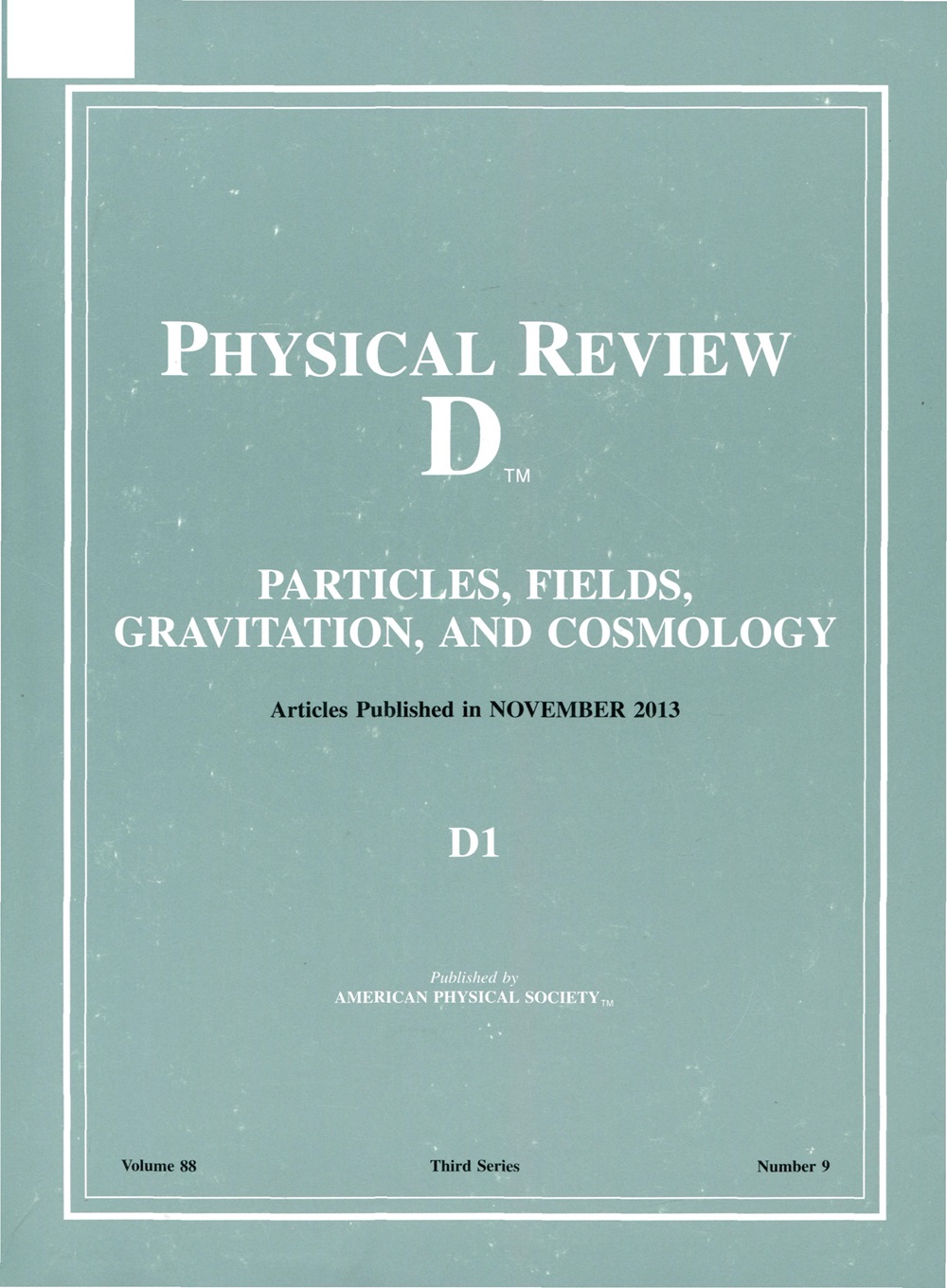
Physical Review D (PRD) is a leading journal in elementary particle physics, field theory, gravitation, and cosmology and is one of the top-cited journals in high-energy physics.
PRD covers experimental and theoretical results in all aspects of particle physics, field theory, gravitation and cosmology, including:
Particle physics experiments,
Electroweak interactions,
Strong interactions,
Lattice field theories, lattice QCD,
Beyond the standard model physics,
Phenomenological aspects of field theory, general methods,
Gravity, cosmology, cosmic rays,
Astrophysics and astroparticle physics,
General relativity,
Formal aspects of field theory, field theory in curved space,
String theory, quantum gravity, gauge/gravity duality.



 京公网安备 11010802042870号
京ICP备2023020795号-1
京公网安备 11010802042870号
京ICP备2023020795号-1

 分享
分享
 求助内容:
求助内容: 应助结果提醒方式:
 扫码关注我们
