Loubna Baroudi, Ronald Fredrick Zernicke, Muneesh Tewari, Noelle E Carlozzi, Sung Won Choi, Stephen M Cain
{"title":"Using Wear Time for the Analysis of Consumer-Grade Wearables' Data: Case Study Using Fitbit Data.","authors":"Loubna Baroudi, Ronald Fredrick Zernicke, Muneesh Tewari, Noelle E Carlozzi, Sung Won Choi, Stephen M Cain","doi":"10.2196/46149","DOIUrl":null,"url":null,"abstract":"<p><strong>Background: </strong>Consumer-grade wearables allow researchers to capture a representative picture of human behavior in the real world over extended periods. However, maintaining users' engagement remains a challenge and can lead to a decrease in compliance (eg, wear time in the context of wearable sensors) over time (eg, \"wearables' abandonment\").</p><p><strong>Objective: </strong>In this work, we analyzed datasets from diverse populations (eg, caregivers for various health issues, college students, and pediatric oncology patients) to quantify the impact that wear time requirements can have on study results. We found evidence that emphasizes the need to account for participants' wear time in the analysis of consumer-grade wearables data. In Aim 1, we demonstrate the sensitivity of parameter estimates to different data processing methods with respect to wear time. In Aim 2, we demonstrate that not all research questions necessitate the same wear time requirements; some parameter estimates are not sensitive to wear time.</p><p><strong>Methods: </strong>We analyzed 3 Fitbit datasets comprising 6 different clinical and healthy population samples. For Aim 1, we analyzed the sensitivity of average daily step count and average daily heart rate at the population sample and individual levels to different methods of defining \"valid\" days using wear time. For Aim 2, we evaluated whether some research questions can be answered with data from lower compliance population samples. We explored (1) the estimation of the average daily step count and (2) the estimation of the average heart rate while walking.</p><p><strong>Results: </strong>For Aim 1, we found that the changes in the population sample average daily step count could reach 2000 steps for different methods of analysis and were dependent on the wear time compliance of the sample. As expected, population samples with a low daily wear time (less than 15 hours of wear time per day) showed the most sensitivity to changes in methods of analysis. On the individual level, we observed that around 15% of individuals had a difference in step count higher than 1000 steps for 4 of the 6 population samples analyzed when using different data processing methods. Those individual differences were higher than 3000 steps for close to 5% of individuals across all population samples. Average daily heart rate appeared to be robust to changes in wear time. For Aim 2, we found that, for 5 population samples out of 6, around 11% of individuals had enough data for the estimation of average heart rate while walking but not for the estimation of their average daily step count.</p><p><strong>Conclusions: </strong>We leveraged datasets from diverse populations to demonstrate the direct relationship between parameter estimates from consumer-grade wearable devices and participants' wear time. Our findings highlighted the importance of a thorough analysis of wear time when processing data from consumer-grade wearables to ensure the relevance and reliability of the associated findings.</p>","PeriodicalId":14756,"journal":{"name":"JMIR mHealth and uHealth","volume":"13 ","pages":"e46149"},"PeriodicalIF":6.2000,"publicationDate":"2025-03-21","publicationTypes":"Journal Article","fieldsOfStudy":null,"isOpenAccess":false,"openAccessPdf":"https://www.ncbi.nlm.nih.gov/pmc/articles/PMC11951812/pdf/","citationCount":"0","resultStr":null,"platform":"Semanticscholar","paperid":null,"PeriodicalName":"JMIR mHealth and uHealth","FirstCategoryId":"3","ListUrlMain":"https://doi.org/10.2196/46149","RegionNum":2,"RegionCategory":"医学","ArticlePicture":[],"TitleCN":null,"AbstractTextCN":null,"PMCID":null,"EPubDate":"","PubModel":"","JCR":"Q1","JCRName":"HEALTH CARE SCIENCES & SERVICES","Score":null,"Total":0}
引用次数: 0
Abstract
Background: Consumer-grade wearables allow researchers to capture a representative picture of human behavior in the real world over extended periods. However, maintaining users' engagement remains a challenge and can lead to a decrease in compliance (eg, wear time in the context of wearable sensors) over time (eg, "wearables' abandonment").
Objective: In this work, we analyzed datasets from diverse populations (eg, caregivers for various health issues, college students, and pediatric oncology patients) to quantify the impact that wear time requirements can have on study results. We found evidence that emphasizes the need to account for participants' wear time in the analysis of consumer-grade wearables data. In Aim 1, we demonstrate the sensitivity of parameter estimates to different data processing methods with respect to wear time. In Aim 2, we demonstrate that not all research questions necessitate the same wear time requirements; some parameter estimates are not sensitive to wear time.
Methods: We analyzed 3 Fitbit datasets comprising 6 different clinical and healthy population samples. For Aim 1, we analyzed the sensitivity of average daily step count and average daily heart rate at the population sample and individual levels to different methods of defining "valid" days using wear time. For Aim 2, we evaluated whether some research questions can be answered with data from lower compliance population samples. We explored (1) the estimation of the average daily step count and (2) the estimation of the average heart rate while walking.
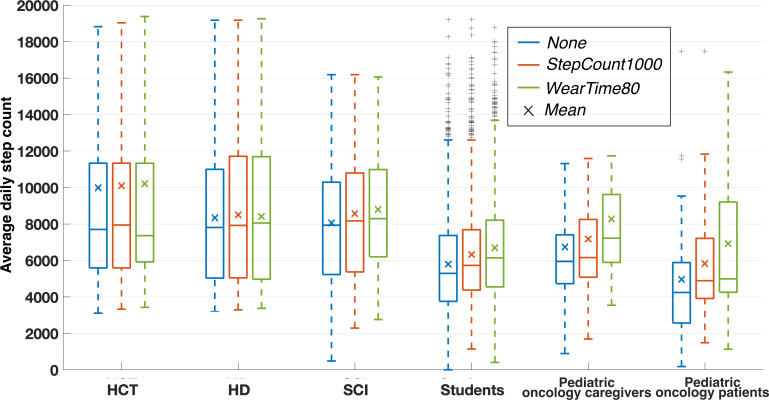
Results: For Aim 1, we found that the changes in the population sample average daily step count could reach 2000 steps for different methods of analysis and were dependent on the wear time compliance of the sample. As expected, population samples with a low daily wear time (less than 15 hours of wear time per day) showed the most sensitivity to changes in methods of analysis. On the individual level, we observed that around 15% of individuals had a difference in step count higher than 1000 steps for 4 of the 6 population samples analyzed when using different data processing methods. Those individual differences were higher than 3000 steps for close to 5% of individuals across all population samples. Average daily heart rate appeared to be robust to changes in wear time. For Aim 2, we found that, for 5 population samples out of 6, around 11% of individuals had enough data for the estimation of average heart rate while walking but not for the estimation of their average daily step count.
Conclusions: We leveraged datasets from diverse populations to demonstrate the direct relationship between parameter estimates from consumer-grade wearable devices and participants' wear time. Our findings highlighted the importance of a thorough analysis of wear time when processing data from consumer-grade wearables to ensure the relevance and reliability of the associated findings.
期刊介绍:
JMIR mHealth and uHealth (JMU, ISSN 2291-5222) is a spin-off journal of JMIR, the leading eHealth journal (Impact Factor 2016: 5.175). JMIR mHealth and uHealth is indexed in PubMed, PubMed Central, and Science Citation Index Expanded (SCIE), and in June 2017 received a stunning inaugural Impact Factor of 4.636.
The journal focusses on health and biomedical applications in mobile and tablet computing, pervasive and ubiquitous computing, wearable computing and domotics.
JMIR mHealth and uHealth publishes since 2013 and was the first mhealth journal in Pubmed. It publishes even faster and has a broader scope with including papers which are more technical or more formative/developmental than what would be published in the Journal of Medical Internet Research.





 京公网安备 11010802042870号
京ICP备2023020795号-1
京公网安备 11010802042870号
京ICP备2023020795号-1

 分享
分享
 求助内容:
求助内容: 应助结果提醒方式:
 扫码关注我们
