Mohamad Shahrimi Hashim , Salma Mohamad Yusop , Irman Abdul Rahman , Ahsanulkhaliqin Abdul Wahab , Athirah Hizwani Rosdey
{"title":"Impact of gamma irradiation on the quality parameters and composition of smoked duck breast","authors":"Mohamad Shahrimi Hashim , Salma Mohamad Yusop , Irman Abdul Rahman , Ahsanulkhaliqin Abdul Wahab , Athirah Hizwani Rosdey","doi":"10.1016/j.foodcont.2025.111308","DOIUrl":null,"url":null,"abstract":"<div><div>This study aimed to evaluate the effects of gamma irradiation at doses of 0, 5, 10, 15, and 20 kGy on smoked duck breast, focusing on various aspects of quality, including microbiological, physicochemical, and proximate composition as well as fatty acid profiling. Gamma irradiation was selected for its efficacy in prolonging shelf life while preserving product quality at a reasonable cost. Duck breasts were subjected to warm smoking, cut into 20 g cubes, and vacuum packed. The samples were divided into five treatment groups: a non-irradiated control group stored at −18 °C and four irradiated groups exposed to 5, 10, 15, and 20 kGy, which were stored at room temperature. The result showed that gamma irradiation at 5–20 kGy significantly reduced microbes, ash, moisture, protein, SFA, and PUFA in smoked duck breast while increasing MUFA, fat content, and a∗ value. While this approach alters carbohydrate content, it has minimal impact on pH, acidity, water activity, water-holding capacity, colour (L∗, b∗), or texture. This study indicates that lower gamma irradiation doses (5–10 kGy) effectively control microbes and lipid oxidation, preserving smoked duck breast quality, while higher doses (15–20 kGy) may impair flavour quality due to increased oxidation. This study distinctively examines gamma-irradiated warm-smoked duck breast at room temperature, highlighting its shelf stability potential beyond refrigerated or frozen storage. The discovery can be utilised for industrial applications to predict the optimum gamma dose for poultry products.</div></div>","PeriodicalId":319,"journal":{"name":"Food Control","volume":"175 ","pages":"Article 111308"},"PeriodicalIF":6.3000,"publicationDate":"2025-09-01","publicationTypes":"Journal Article","fieldsOfStudy":null,"isOpenAccess":false,"openAccessPdf":"","citationCount":"0","resultStr":null,"platform":"Semanticscholar","paperid":null,"PeriodicalName":"Food Control","FirstCategoryId":"97","ListUrlMain":"https://www.sciencedirect.com/science/article/pii/S095671352500177X","RegionNum":1,"RegionCategory":"农林科学","ArticlePicture":[],"TitleCN":null,"AbstractTextCN":null,"PMCID":null,"EPubDate":"2025/3/19 0:00:00","PubModel":"Epub","JCR":"Q1","JCRName":"FOOD SCIENCE & TECHNOLOGY","Score":null,"Total":0}
引用次数: 0
Abstract
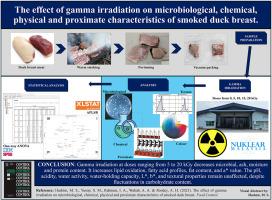
This study aimed to evaluate the effects of gamma irradiation at doses of 0, 5, 10, 15, and 20 kGy on smoked duck breast, focusing on various aspects of quality, including microbiological, physicochemical, and proximate composition as well as fatty acid profiling. Gamma irradiation was selected for its efficacy in prolonging shelf life while preserving product quality at a reasonable cost. Duck breasts were subjected to warm smoking, cut into 20 g cubes, and vacuum packed. The samples were divided into five treatment groups: a non-irradiated control group stored at −18 °C and four irradiated groups exposed to 5, 10, 15, and 20 kGy, which were stored at room temperature. The result showed that gamma irradiation at 5–20 kGy significantly reduced microbes, ash, moisture, protein, SFA, and PUFA in smoked duck breast while increasing MUFA, fat content, and a∗ value. While this approach alters carbohydrate content, it has minimal impact on pH, acidity, water activity, water-holding capacity, colour (L∗, b∗), or texture. This study indicates that lower gamma irradiation doses (5–10 kGy) effectively control microbes and lipid oxidation, preserving smoked duck breast quality, while higher doses (15–20 kGy) may impair flavour quality due to increased oxidation. This study distinctively examines gamma-irradiated warm-smoked duck breast at room temperature, highlighting its shelf stability potential beyond refrigerated or frozen storage. The discovery can be utilised for industrial applications to predict the optimum gamma dose for poultry products.
期刊介绍:
Food Control is an international journal that provides essential information for those involved in food safety and process control.
Food Control covers the below areas that relate to food process control or to food safety of human foods:
• Microbial food safety and antimicrobial systems
• Mycotoxins
• Hazard analysis, HACCP and food safety objectives
• Risk assessment, including microbial and chemical hazards
• Quality assurance
• Good manufacturing practices
• Food process systems design and control
• Food Packaging technology and materials in contact with foods
• Rapid methods of analysis and detection, including sensor technology
• Codes of practice, legislation and international harmonization
• Consumer issues
• Education, training and research needs.
The scope of Food Control is comprehensive and includes original research papers, authoritative reviews, short communications, comment articles that report on new developments in food control, and position papers.



 京公网安备 11010802042870号
京ICP备2023020795号-1
京公网安备 11010802042870号
京ICP备2023020795号-1

 分享
分享
 求助内容:
求助内容: 应助结果提醒方式:
 扫码关注我们
