A novel volatile organic compound composite from Wickerhamomyces anomalus controls blue and gray mold of kiwifruit through direct inhibition and host resistance activation
Qianhua Zhao , Yu Zhang , Dhanasekaran Solairaj , Xi Zhang , Yuchun Lu , Xiaoyun Zhang , Qiya Yang , Yuan Sui , Hongyin Zhang
{"title":"A novel volatile organic compound composite from Wickerhamomyces anomalus controls blue and gray mold of kiwifruit through direct inhibition and host resistance activation","authors":"Qianhua Zhao , Yu Zhang , Dhanasekaran Solairaj , Xi Zhang , Yuchun Lu , Xiaoyun Zhang , Qiya Yang , Yuan Sui , Hongyin Zhang","doi":"10.1016/j.foodcont.2025.111309","DOIUrl":null,"url":null,"abstract":"<div><div>Postharvest blue and gray mold diseases are major threats to kiwifruit storage, causing significant economic losses worldwide. This study developed a potent biocontrol agent by formulating a composite of eight volatile organic compounds (VOCs) produced by <em>Wickerhamomyces anomalus</em>. These VOCs mainly consist of esters and alcohols, with 2-Phenethyl acetate and 3-Methyl-1-butanol being the most abundant components. The VOC composite exhibited complete fungal inhibition (100 %), significantly outperforming individual VOCs, which achieved inhibition rates below 40 %. Fumigation with the VOC composite effectively controlled blue and gray mold diseases, preventing lesions at a dose of 50 units, and reducing the decay rate to 26.67 % by day 21, compared to 86.67 % in the control group. The antifungal activity was associated with inhibiting spore germination and mycelial growth, structural deformation and collapse of fungal cells, and disruption of cell membrane integrity. Furthermore, the VOC composite enhanced antioxidant enzyme activities and promoted the accumulation of disease-resistant metabolites, such as total phenols and flavonoids, boosting systemic resistance in kiwifruit. These findings highlight the potential of microbial VOCs as sustainable and eco-friendly biocontrol agents for managing postharvest diseases in kiwifruit.</div></div>","PeriodicalId":319,"journal":{"name":"Food Control","volume":"175 ","pages":"Article 111309"},"PeriodicalIF":6.3000,"publicationDate":"2025-09-01","publicationTypes":"Journal Article","fieldsOfStudy":null,"isOpenAccess":false,"openAccessPdf":"","citationCount":"0","resultStr":null,"platform":"Semanticscholar","paperid":null,"PeriodicalName":"Food Control","FirstCategoryId":"97","ListUrlMain":"https://www.sciencedirect.com/science/article/pii/S0956713525001781","RegionNum":1,"RegionCategory":"农林科学","ArticlePicture":[],"TitleCN":null,"AbstractTextCN":null,"PMCID":null,"EPubDate":"2025/3/20 0:00:00","PubModel":"Epub","JCR":"Q1","JCRName":"FOOD SCIENCE & TECHNOLOGY","Score":null,"Total":0}
引用次数: 0
Abstract
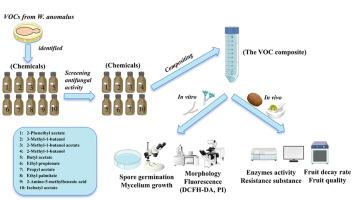
Postharvest blue and gray mold diseases are major threats to kiwifruit storage, causing significant economic losses worldwide. This study developed a potent biocontrol agent by formulating a composite of eight volatile organic compounds (VOCs) produced by Wickerhamomyces anomalus. These VOCs mainly consist of esters and alcohols, with 2-Phenethyl acetate and 3-Methyl-1-butanol being the most abundant components. The VOC composite exhibited complete fungal inhibition (100 %), significantly outperforming individual VOCs, which achieved inhibition rates below 40 %. Fumigation with the VOC composite effectively controlled blue and gray mold diseases, preventing lesions at a dose of 50 units, and reducing the decay rate to 26.67 % by day 21, compared to 86.67 % in the control group. The antifungal activity was associated with inhibiting spore germination and mycelial growth, structural deformation and collapse of fungal cells, and disruption of cell membrane integrity. Furthermore, the VOC composite enhanced antioxidant enzyme activities and promoted the accumulation of disease-resistant metabolites, such as total phenols and flavonoids, boosting systemic resistance in kiwifruit. These findings highlight the potential of microbial VOCs as sustainable and eco-friendly biocontrol agents for managing postharvest diseases in kiwifruit.
期刊介绍:
Food Control is an international journal that provides essential information for those involved in food safety and process control.
Food Control covers the below areas that relate to food process control or to food safety of human foods:
• Microbial food safety and antimicrobial systems
• Mycotoxins
• Hazard analysis, HACCP and food safety objectives
• Risk assessment, including microbial and chemical hazards
• Quality assurance
• Good manufacturing practices
• Food process systems design and control
• Food Packaging technology and materials in contact with foods
• Rapid methods of analysis and detection, including sensor technology
• Codes of practice, legislation and international harmonization
• Consumer issues
• Education, training and research needs.
The scope of Food Control is comprehensive and includes original research papers, authoritative reviews, short communications, comment articles that report on new developments in food control, and position papers.



 京公网安备 11010802042870号
京ICP备2023020795号-1
京公网安备 11010802042870号
京ICP备2023020795号-1

 分享
分享
 求助内容:
求助内容: 应助结果提醒方式:
 扫码关注我们
