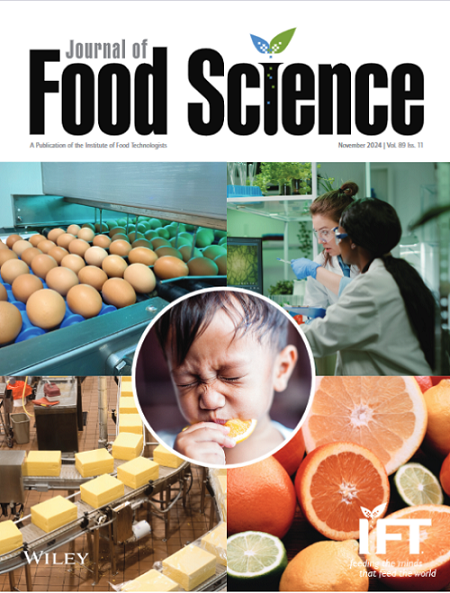
Utilizing onion peel extract as photosensitizer combined with 405 nm blue light to control Salmonella Typhimurium on eggshells

IF 3.4 2区 农林科学 Q2 FOOD SCIENCE & TECHNOLOGY Journal of Food Science Pub Date : 2025-03-27 DOI:10.1111/1750-3841.70167
Chae-Yeon Woo, Gi-Hyeok Lee, Kyung-Jik Lim, Jun-Won Kang
{"title":"Utilizing onion peel extract as photosensitizer combined with 405 nm blue light to control Salmonella Typhimurium on eggshells","authors":"Chae-Yeon Woo,&nbsp;Gi-Hyeok Lee,&nbsp;Kyung-Jik Lim,&nbsp;Jun-Won Kang","doi":"10.1111/1750-3841.70167","DOIUrl":null,"url":null,"abstract":"<div>\n \n <section>\n \n \n <p>The use of blue light within a range of 400–470 nm holds significant potential for sanitization purposes. However, due to an extended exposure duration needed for an antibacterial effect, the utilization of a photosensitizer (PS) to increase the efficacy of the treatment becomes essential. This study investigated prospective use of onion peel extract as a PS in combination with 405 nm blue light for the inactivation of <i>Salmonella</i> Typhimurium, a common foodborne pathogen on eggs. Extracts were obtained using 99% ethanol, 50% ethanol, and distilled water (DW). Their photosensitizing activities were then compared. The combination of 405 nm blue light and onion peel extract using 99% ethanol reduced bacterial populations more effectively than blue light treatment alone, while also increasing reactive oxygen species generation, cell membrane permeability, lipid peroxidation, and DNA damage levels. However, the antimicrobial effect of the 99% ethanol extract did not show a concentration dependence. Spraying DW extract on eggshell treated with 99% ethanol onion peel extract at 1 mg/mL and blue light further enhanced <i>Salmonella</i> reduction. Liquid chromatography was conducted for component separation. However, none of the separated fractions exhibited a significant antibacterial effect, suggesting that the active compounds responsible for antibacterial activity might work synergistically in the crude extract rather than individually. In contrast, the crude extract exhibited a significant antibacterial effect, suggesting that 99% ethanol-extracted onion peel can serve as a PS, particularly in its crude state without purification, and effectively inactivate <i>Salmonella</i> on eggshells.</p>\n </section>\n \n <section>\n \n <h3> Practical Application</h3>\n \n <p>Antimicrobial blue light (aBL) in the range of 400–470 nm is a promising nonthermal technology with several advantages, including minimal impact on food quality and safety. This study optimized the concentration of onion peel extract to improve its effectiveness as a photosensitizer in aBL treatment against <i>Salmonella</i> Typhimurium on eggshells. These results may serve as a reference for further optimizing aBL treatments, offering a potentially sustainable and cost-effective photosensitizer for pathogen control.</p>\n </section>\n </div>","PeriodicalId":193,"journal":{"name":"Journal of Food Science","volume":"90 3","pages":""},"PeriodicalIF":3.4000,"publicationDate":"2025-03-27","publicationTypes":"Journal Article","fieldsOfStudy":null,"isOpenAccess":false,"openAccessPdf":"https://onlinelibrary.wiley.com/doi/epdf/10.1111/1750-3841.70167","citationCount":"0","resultStr":null,"platform":"Semanticscholar","paperid":null,"PeriodicalName":"Journal of Food Science","FirstCategoryId":"97","ListUrlMain":"https://ift.onlinelibrary.wiley.com/doi/10.1111/1750-3841.70167","RegionNum":2,"RegionCategory":"农林科学","ArticlePicture":[],"TitleCN":null,"AbstractTextCN":null,"PMCID":null,"EPubDate":"","PubModel":"","JCR":"Q2","JCRName":"FOOD SCIENCE & TECHNOLOGY","Score":null,"Total":0}
引用次数: 0

Abstract

The use of blue light within a range of 400–470 nm holds significant potential for sanitization purposes. However, due to an extended exposure duration needed for an antibacterial effect, the utilization of a photosensitizer (PS) to increase the efficacy of the treatment becomes essential. This study investigated prospective use of onion peel extract as a PS in combination with 405 nm blue light for the inactivation of Salmonella Typhimurium, a common foodborne pathogen on eggs. Extracts were obtained using 99% ethanol, 50% ethanol, and distilled water (DW). Their photosensitizing activities were then compared. The combination of 405 nm blue light and onion peel extract using 99% ethanol reduced bacterial populations more effectively than blue light treatment alone, while also increasing reactive oxygen species generation, cell membrane permeability, lipid peroxidation, and DNA damage levels. However, the antimicrobial effect of the 99% ethanol extract did not show a concentration dependence. Spraying DW extract on eggshell treated with 99% ethanol onion peel extract at 1 mg/mL and blue light further enhanced Salmonella reduction. Liquid chromatography was conducted for component separation. However, none of the separated fractions exhibited a significant antibacterial effect, suggesting that the active compounds responsible for antibacterial activity might work synergistically in the crude extract rather than individually. In contrast, the crude extract exhibited a significant antibacterial effect, suggesting that 99% ethanol-extracted onion peel can serve as a PS, particularly in its crude state without purification, and effectively inactivate Salmonella on eggshells.

Practical Application

Antimicrobial blue light (aBL) in the range of 400–470 nm is a promising nonthermal technology with several advantages, including minimal impact on food quality and safety. This study optimized the concentration of onion peel extract to improve its effectiveness as a photosensitizer in aBL treatment against Salmonella Typhimurium on eggshells. These results may serve as a reference for further optimizing aBL treatments, offering a potentially sustainable and cost-effective photosensitizer for pathogen control.

Abstract Image

Abstract Image

Abstract Image

Abstract Image

查看原文
分享 分享
微信好友 朋友圈 QQ好友 复制链接
本刊更多论文
利用洋葱皮提取物作为光敏剂,结合405 nm蓝光防治蛋壳上的鼠伤寒沙门菌
在400-470纳米范围内使用蓝光在消毒方面具有巨大的潜力。然而,由于抗菌效果需要较长的暴露时间,使用光敏剂(PS)来提高治疗效果变得至关重要。本研究探讨了洋葱皮提取物作为PS联合405 nm蓝光灭活鸡蛋上常见食源性致病菌鼠伤寒沙门菌的前景。分别用99%乙醇、50%乙醇和蒸馏水(DW)提取提取物。然后比较它们的光敏活性。405 nm蓝光和99%乙醇洋葱皮提取物的组合比单独蓝光处理更有效地减少了细菌数量,同时也增加了活性氧的产生、细胞膜通透性、脂质过氧化和DNA损伤水平。然而,99%乙醇提取物的抑菌效果不表现出浓度依赖性。在99%乙醇洋葱皮提取物(浓度为1 mg/mL)处理过的蛋壳上喷洒DW提取物,在蓝光照射下进一步增强了沙门氏菌的还原效果。采用液相色谱法进行组分分离。然而,没有一个分离的组分显示出显著的抗菌作用,这表明负责抗菌活性的活性化合物可能在粗提取物中协同作用,而不是单独作用。相比之下,粗提物的抑菌效果显著,说明99%乙醇提取的洋葱皮可以作为PS,特别是未经纯化的粗提物,有效灭活蛋壳上的沙门氏菌。400-470 nm范围内的抗菌蓝光(aBL)是一种很有前途的非热技术,具有对食品质量和安全影响最小等优点。本研究优化了洋葱皮提取物的浓度,以提高其作为aBL处理蛋壳上鼠伤寒沙门菌光敏剂的效果。这些结果可为进一步优化aBL处理提供参考,为病原菌控制提供具有潜在可持续性和成本效益的光敏剂。
本文章由计算机程序翻译,如有差异,请以英文原文为准。
求助全文
约1分钟内获得全文 去求助
来源期刊
Journal of Food Science
Journal of Food Science 工程技术-食品科技
CiteScore
7.10
自引率
2.60%
发文量
412
审稿时长
3.1 months
期刊介绍: The goal of the Journal of Food Science is to offer scientists, researchers, and other food professionals the opportunity to share knowledge of scientific advancements in the myriad disciplines affecting their work, through a respected peer-reviewed publication. The Journal of Food Science serves as an international forum for vital research and developments in food science. The range of topics covered in the journal include: -Concise Reviews and Hypotheses in Food Science -New Horizons in Food Research -Integrated Food Science -Food Chemistry -Food Engineering, Materials Science, and Nanotechnology -Food Microbiology and Safety -Sensory and Consumer Sciences -Health, Nutrition, and Food -Toxicology and Chemical Food Safety The Journal of Food Science publishes peer-reviewed articles that cover all aspects of food science, including safety and nutrition. Reviews should be 15 to 50 typewritten pages (including tables, figures, and references), should provide in-depth coverage of a narrowly defined topic, and should embody careful evaluation (weaknesses, strengths, explanation of discrepancies in results among similar studies) of all pertinent studies, so that insightful interpretations and conclusions can be presented. Hypothesis papers are especially appropriate in pioneering areas of research or important areas that are afflicted by scientific controversy.
期刊最新文献
Quality Differentiation and Mechanistic Insights Into Green Tea Processed by Different Fixation Methods. Effect of Different Pre-Treatments on Shell Peeling of Litopenaeus vannamei and Changes of Muscle Quality Under Refrigeration. Influence of Cashew Agro-Industrial By-Product (Anacardium occidentale) and Cashew Tree Gum on the Properties of Sponge Cakes: A Fat Replacement Approach. Functional Evaluation of Fermented Pomegranate Juice in Vitro and in Vivo and Its Impact on the Gut Microbiota. High-Resolution Neuraminidase Inhibition Profiling of Synsepalum Dulcificum Based on UPLC-MS/MS: A Study of Anti-Influenza Constituents in a Potential Edible Resource.
×
引用
GB/T 7714-2015
复制
MLA
复制
APA
复制
导出至
BibTeX EndNote RefMan NoteFirst NoteExpress
×
×
提示
您的信息不完整,为了账户安全,请先补充。
现在去补充
×
提示
您因"违规操作"
具体请查看互助需知
我知道了
×
提示
现在去查看 取消
×
提示
确定
0
微信
客服QQ
Book学术公众号 扫码关注我们
反馈
×
意见反馈
请填写您的意见或建议
请填写您的手机或邮箱
已复制链接
已复制链接
快去分享给好友吧!
我知道了
×
扫码分享
扫码分享
Book学术官方微信
Book学术文献互助
Book学术文献互助群
群 号:604180095
Book学术
文献互助 智能选刊 最新文献 互助须知 联系我们:info@booksci.cn
Book学术提供免费学术资源搜索服务,方便国内外学者检索中英文文献。致力于提供最便捷和优质的服务体验。
Copyright © 2023 Book学术 All rights reserved.
ghs 京公网安备 11010802042870号 京ICP备2023020795号-1