{"title":"Internal structure, density, and mechanical properties of cranberry fruits","authors":"Chang Liu, Tomomi Komatsu, Hector Lopez-Moreno, Jyostna Mura, Juan Zalapa, Shinya Ikeda","doi":"10.1111/1750-3841.70153","DOIUrl":null,"url":null,"abstract":"<p>Firmness is a critical quality attribute influencing the yield and overall quality of sweetened dried cranberries. This study aimed to seek correlations among the physicochemical characteristics of cranberry fruits, with a focus on internal structure, density, and mechanical properties. Micro-computed tomography imaging, the gravimetric buoyancy test, and the uniaxial compression test of six cranberry groups, which included cultivars with varying firmness levels and different postharvest storage conditions, were performed to investigate the internal structure, density, and mechanical properties of cranberry fruits, respectively. Postharvest freezing significantly affected the volume of interest, porosity, and density. A lower storage temperature resulted in a reduced volume of interest and porosity and an increased density of the Stevens cultivar. The compression force, often used as a measure of the firmness of cranberry fruits, decreased with prolonged storage at a lower temperature within the same cultivar. Additionally, both soft and firmer cultivars showed similar compression forces after freezing, suggesting stronger negative impacts of postharvest freezing on the firmness of the firmer cultivars. The stress and the apparent modulus of elasticity calculated using a conventional method appeared to be overestimated particularly at relatively small strains less than 0.05. Correlation analysis revealed that most examined properties, except density and the apparent modulus of elasticity, showed positive correlations with fruit firmness, expressed as the force at 10% strain. However, these correlations were relatively weak (i.e., correlation coefficients <0.41), suggesting the importance of incorporating the evaluation of various physicochemical properties to provide a basis for understanding the mechanisms that determine cranberry firmness.</p>","PeriodicalId":193,"journal":{"name":"Journal of Food Science","volume":"90 3","pages":""},"PeriodicalIF":3.4000,"publicationDate":"2025-03-27","publicationTypes":"Journal Article","fieldsOfStudy":null,"isOpenAccess":false,"openAccessPdf":"","citationCount":"0","resultStr":null,"platform":"Semanticscholar","paperid":null,"PeriodicalName":"Journal of Food Science","FirstCategoryId":"97","ListUrlMain":"https://ift.onlinelibrary.wiley.com/doi/10.1111/1750-3841.70153","RegionNum":2,"RegionCategory":"农林科学","ArticlePicture":[],"TitleCN":null,"AbstractTextCN":null,"PMCID":null,"EPubDate":"","PubModel":"","JCR":"Q2","JCRName":"FOOD SCIENCE & TECHNOLOGY","Score":null,"Total":0}
引用次数: 0
Abstract
Firmness is a critical quality attribute influencing the yield and overall quality of sweetened dried cranberries. This study aimed to seek correlations among the physicochemical characteristics of cranberry fruits, with a focus on internal structure, density, and mechanical properties. Micro-computed tomography imaging, the gravimetric buoyancy test, and the uniaxial compression test of six cranberry groups, which included cultivars with varying firmness levels and different postharvest storage conditions, were performed to investigate the internal structure, density, and mechanical properties of cranberry fruits, respectively. Postharvest freezing significantly affected the volume of interest, porosity, and density. A lower storage temperature resulted in a reduced volume of interest and porosity and an increased density of the Stevens cultivar. The compression force, often used as a measure of the firmness of cranberry fruits, decreased with prolonged storage at a lower temperature within the same cultivar. Additionally, both soft and firmer cultivars showed similar compression forces after freezing, suggesting stronger negative impacts of postharvest freezing on the firmness of the firmer cultivars. The stress and the apparent modulus of elasticity calculated using a conventional method appeared to be overestimated particularly at relatively small strains less than 0.05. Correlation analysis revealed that most examined properties, except density and the apparent modulus of elasticity, showed positive correlations with fruit firmness, expressed as the force at 10% strain. However, these correlations were relatively weak (i.e., correlation coefficients <0.41), suggesting the importance of incorporating the evaluation of various physicochemical properties to provide a basis for understanding the mechanisms that determine cranberry firmness.
期刊介绍:
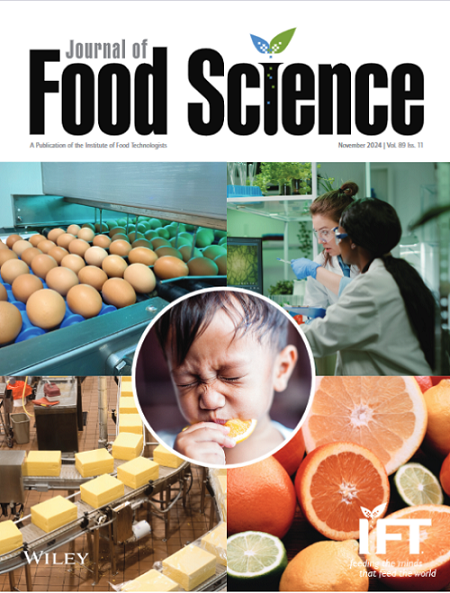
The goal of the Journal of Food Science is to offer scientists, researchers, and other food professionals the opportunity to share knowledge of scientific advancements in the myriad disciplines affecting their work, through a respected peer-reviewed publication. The Journal of Food Science serves as an international forum for vital research and developments in food science.
The range of topics covered in the journal include:
-Concise Reviews and Hypotheses in Food Science
-New Horizons in Food Research
-Integrated Food Science
-Food Chemistry
-Food Engineering, Materials Science, and Nanotechnology
-Food Microbiology and Safety
-Sensory and Consumer Sciences
-Health, Nutrition, and Food
-Toxicology and Chemical Food Safety
The Journal of Food Science publishes peer-reviewed articles that cover all aspects of food science, including safety and nutrition. Reviews should be 15 to 50 typewritten pages (including tables, figures, and references), should provide in-depth coverage of a narrowly defined topic, and should embody careful evaluation (weaknesses, strengths, explanation of discrepancies in results among similar studies) of all pertinent studies, so that insightful interpretations and conclusions can be presented. Hypothesis papers are especially appropriate in pioneering areas of research or important areas that are afflicted by scientific controversy.




 京公网安备 11010802042870号
京ICP备2023020795号-1
京公网安备 11010802042870号
京ICP备2023020795号-1

 分享
分享
 求助内容:
求助内容: 应助结果提醒方式:
 扫码关注我们
