Guofeng Liu , Runxia Li , Biao Wang , Zhenmin Wang , Hongfei Zhang
{"title":"Synergistic deformation of bimodal-structured AZ80 Mg alloy for excellent strength-ductility synergy via regulating the heterogeneity level","authors":"Guofeng Liu , Runxia Li , Biao Wang , Zhenmin Wang , Hongfei Zhang","doi":"10.1016/j.jma.2025.03.006","DOIUrl":null,"url":null,"abstract":"<div><div>The trade-off between strength and ductility has long been a challenge for Mg alloy. To address this issue, bimodal-structured AZ80 Mg alloys with varying heterogeneity levels were fabricated via low-temperature extrusion in this work. The results reveal the microstructure comprising second-phase particle (SP<sub>p</sub>, <em>β-</em>Mg<sub>17</sub>Al<sub>12</sub> and Mg<sub>3</sub>Mn<sub>2</sub>Al<sub>18</sub>)-reinforced fine grains (FGs) FGs and SP<sub>p</sub>-free coarse grains (CGs), with the heterogeneity level decreasing as extrusion temperature increases. As the heterogeneity level decreases, the synergistic deformation capacity initially improves, reaching a maximum at the moderate heterogeneity level of 0.31 GPa and 0.238, and then declines. This exceptional capacity is attributed to the hetero-deformation induced (HDI) stress, which effectively alleviates the strain gradients by activating 〈<em>c</em> + <em>a</em>〉 dislocations and non-basal 〈<em>a</em>〉 dislocations during deformation. An optimal combination of 287 MPa in yield strength, 393 MPa in ultimate tensile strength, and 14.96% in elongation is achieved in the alloy with a moderate heterogeneity level. The excellent strength-ductility synergy originates from the enhanced capacity of dislocations accumulation driven by remarkable capacity of synergistic deformation and the synergistic strengthening mechanisms. This work provides a new insight into the design of bimodal structure to produce high-performance Mg alloys.</div></div>","PeriodicalId":16214,"journal":{"name":"Journal of Magnesium and Alloys","volume":"13 8","pages":"Pages 3964-3985"},"PeriodicalIF":13.8000,"publicationDate":"2025-08-01","publicationTypes":"Journal Article","fieldsOfStudy":null,"isOpenAccess":false,"openAccessPdf":"","citationCount":"0","resultStr":null,"platform":"Semanticscholar","paperid":null,"PeriodicalName":"Journal of Magnesium and Alloys","FirstCategoryId":"88","ListUrlMain":"https://www.sciencedirect.com/science/article/pii/S2213956725000878","RegionNum":1,"RegionCategory":"材料科学","ArticlePicture":[],"TitleCN":null,"AbstractTextCN":null,"PMCID":null,"EPubDate":"2025/4/1 0:00:00","PubModel":"Epub","JCR":"Q1","JCRName":"METALLURGY & METALLURGICAL ENGINEERING","Score":null,"Total":0}
引用次数: 0
Abstract
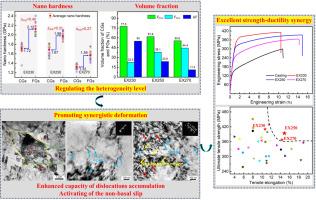
The trade-off between strength and ductility has long been a challenge for Mg alloy. To address this issue, bimodal-structured AZ80 Mg alloys with varying heterogeneity levels were fabricated via low-temperature extrusion in this work. The results reveal the microstructure comprising second-phase particle (SPp, β-Mg17Al12 and Mg3Mn2Al18)-reinforced fine grains (FGs) FGs and SPp-free coarse grains (CGs), with the heterogeneity level decreasing as extrusion temperature increases. As the heterogeneity level decreases, the synergistic deformation capacity initially improves, reaching a maximum at the moderate heterogeneity level of 0.31 GPa and 0.238, and then declines. This exceptional capacity is attributed to the hetero-deformation induced (HDI) stress, which effectively alleviates the strain gradients by activating 〈c + a〉 dislocations and non-basal 〈a〉 dislocations during deformation. An optimal combination of 287 MPa in yield strength, 393 MPa in ultimate tensile strength, and 14.96% in elongation is achieved in the alloy with a moderate heterogeneity level. The excellent strength-ductility synergy originates from the enhanced capacity of dislocations accumulation driven by remarkable capacity of synergistic deformation and the synergistic strengthening mechanisms. This work provides a new insight into the design of bimodal structure to produce high-performance Mg alloys.
长期以来,强度和延展性之间的平衡一直是镁合金面临的挑战。为了解决这一问题,本文采用低温挤压法制备了具有不同非均质性的AZ80镁合金。结果表明:随着挤压温度的升高,非均质性逐渐降低,显微组织由第二相颗粒(SPp、β-Mg17Al12和Mg3Mn2Al18)增强的细晶(FGs)和不含SPp的粗晶(CGs)组成。随着非均质水平的降低,协同变形能力先提高,在中等非均质水平0.31 GPa和0.238时达到最大值,然后下降。这种特殊的能力归因于异质变形诱导(HDI)应力,通过在变形过程中激活< c + a >位错和非基底< a >位错,有效地缓解了应变梯度。合金的屈服强度为287 MPa,极限抗拉强度为393 MPa,伸长率为14.96%。优异的强度-延性协同源于显著的协同变形能力和协同强化机制驱动的位错积累能力增强。本研究为高性能镁合金的双峰结构设计提供了新的思路。
期刊介绍:
The Journal of Magnesium and Alloys serves as a global platform for both theoretical and experimental studies in magnesium science and engineering. It welcomes submissions investigating various scientific and engineering factors impacting the metallurgy, processing, microstructure, properties, and applications of magnesium and alloys. The journal covers all aspects of magnesium and alloy research, including raw materials, alloy casting, extrusion and deformation, corrosion and surface treatment, joining and machining, simulation and modeling, microstructure evolution and mechanical properties, new alloy development, magnesium-based composites, bio-materials and energy materials, applications, and recycling.




 京公网安备 11010802042870号
京ICP备2023020795号-1
京公网安备 11010802042870号
京ICP备2023020795号-1

 分享
分享
 求助内容:
求助内容: 应助结果提醒方式:
 扫码关注我们
